
网络维权

Search documents
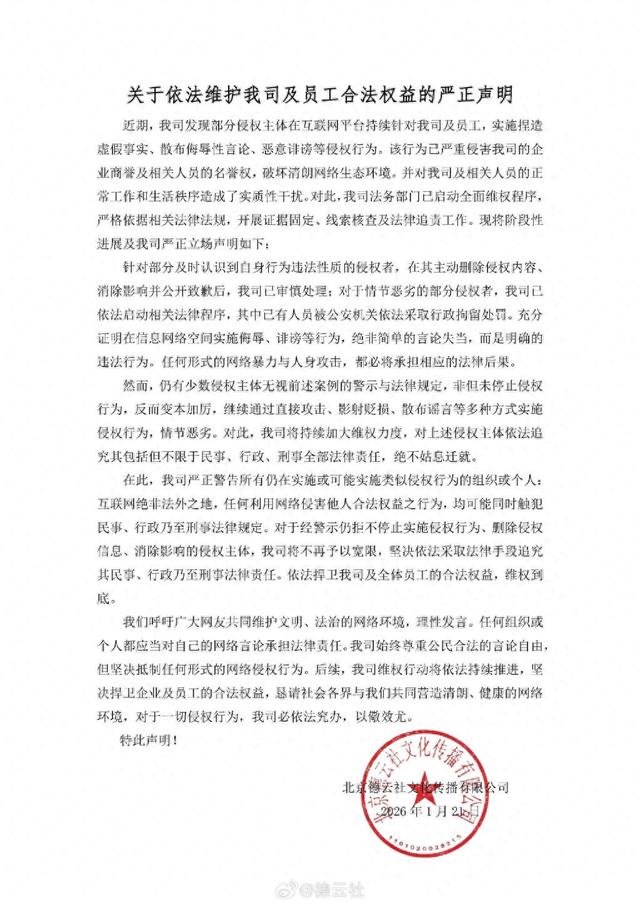
德云社发布声明:已启动全面维权程序,依法维护员工合法权益
Xin Lang Cai Jing· 2026-01-21 13:23
Core Viewpoint - The company has issued a stern statement regarding the protection of its and its employees' legal rights against ongoing defamation and malicious attacks on the internet [1][2]. Group 1: Legal Actions and Responses - The company has initiated comprehensive legal actions to safeguard its reputation and the rights of its employees, including evidence collection and legal accountability measures [1]. - For those infringing parties who have acknowledged their illegal actions and have taken steps to delete harmful content and apologize, the company has handled these cases cautiously [1]. - Legal proceedings have been initiated against particularly egregious infringers, with some individuals already facing administrative detention by law enforcement [1]. Group 2: Ongoing Violations and Warnings - Despite previous warnings, some infringing parties continue their malicious activities, prompting the company to intensify its legal efforts against them [2]. - The company warns all organizations and individuals engaging in similar infringing behaviors that the internet is not a lawless space, and such actions may violate civil, administrative, and criminal laws [2]. - The company emphasizes that it will not provide further grace periods for those who refuse to cease their infringing actions and will pursue all legal avenues to hold them accountable [2]. Group 3: Call for a Civilized Online Environment - The company calls on the public to help maintain a civilized and lawful online environment, urging individuals to take responsibility for their online statements [2]. - While the company respects citizens' rights to free speech, it firmly opposes any form of online infringement and will continue its legal actions to protect its and its employees' rights [2].

互联网“升堂”、小作文“断案”,“网闹”你咋看?
Xin Lang Cai Jing· 2026-01-04 04:33
Core Viewpoint - The rise of online rights protection has provided a platform for marginalized voices, but it has also led to the phenomenon of "online chaos," where emotional manipulation and public pressure can distort the original intent of advocacy [1][4]. Group 1: Online Rights Protection and Its Challenges - Online rights protection has the potential to promote social justice, but it is often undermined by "online chaos," where louder voices are perceived as more legitimate [1][4]. - The manipulation of emotions and sensationalism in online discourse can lead to a distortion of facts, making it difficult for rational discussions to take place [2][4]. - The phenomenon of "anger baiting" has emerged, where extreme expressions and misleading narratives attract more attention than rational arguments [1][2]. Group 2: Governance and Response to Online Chaos - The root of online chaos lies in unresolved issues offline, leading individuals to seek resolution through online platforms [3]. - Some local governance bodies may choose to avoid confrontation with public opinion, opting for temporary solutions that can undermine long-term trust in legal processes [3][5]. - The approach of resolving issues based on the level of public outcry can erode the credibility of rules and procedures, ultimately harming the rights of law-abiding citizens [4][5]. Group 3: Recommendations for Improvement - To address online chaos, it is essential to establish formal channels for legal rights protection and effective mechanisms for dispute resolution, which can simplify processes and enhance response efficiency [5]. - Online platforms should take responsibility for monitoring and intervening against false information and malicious incitement, fostering a more responsible online environment [6]. - Encouraging rational participation and critical judgment among internet users can help mitigate the spread of unverified and emotionally charged information [6][7].
抖音升级批量侵权举报工具,单次最多可提交两千条内容
Huan Qiu Wang· 2025-12-18 07:20
Core Insights - Douyin has upgraded its batch infringement reporting tool, allowing users to report up to 2,000 instances of infringement at once via a PC website, addressing user pain points in reporting difficulties and inefficiencies [1][2][5] - The tool supports various infringement scenarios, including portrait rights, privacy rights, personal reputation rights, corporate reputation, and copyright, enhancing user efficiency in protecting their rights [1][7] - This upgrade follows a previous feature launched in May that prevents the spread of similar infringing content, further reducing the cost of repeated reporting for users [1][7] User Experience Improvements - The new batch reporting tool simplifies the reporting process, allowing users to copy and paste links in one go, significantly reducing the complexity compared to the previous method of reporting multiple items individually [2][5] - Users can track the progress of their reports in real-time, with a detailed history of submissions, including types of infringement, descriptions, submission times, and current statuses, which helps avoid duplicate reports [3][4] Legal and Operational Efficiency - Legal professionals have noted that the upgraded tool saves significant time by providing clear visibility into submission times and processing statuses, transforming the reporting process from "blind waiting" to "precise control" [5] - The platform aims to enhance its rights protection system in response to the evolving landscape of online infringement, addressing issues like trademark counterfeiting and damage to corporate reputation more effectively [7] Future Developments - Douyin plans to continue iterating on the batch reporting tool based on user feedback, aiming to further simplify the reporting process and reduce the costs associated with online rights protection [7]

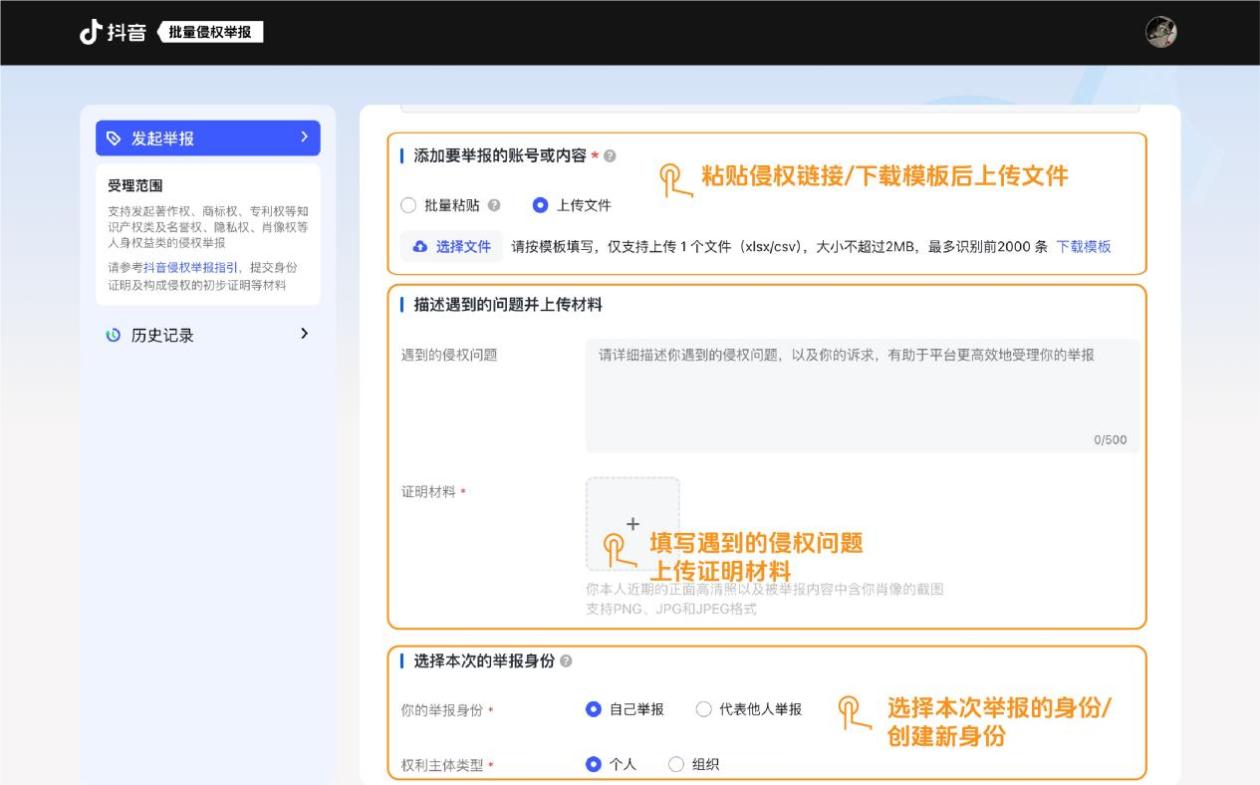
抖音升级批量侵权举报工具,推动解决“举报难、删不完”难题
Xin Lang Cai Jing· 2025-12-18 02:04
Core Viewpoint - Douyin has upgraded its batch infringement reporting tool, allowing users to submit up to 2,000 reports at once via a PC website, addressing user pain points related to reporting difficulties and inefficiencies in handling mass infringement cases [1][8]. Group 1: Tool Features - The new tool supports reporting various infringement scenarios, including portrait rights, privacy rights, personal reputation rights, corporate reputation, and copyright [1][7]. - Users can track the progress of their batch complaints in real-time, which resolves previous issues of manually checking the status of multiple reports [12][4]. - The tool allows users to upload identification and authorization materials once, streamlining the process for future reports [5][12]. Group 2: User Experience Improvement - The upgrade simplifies the reporting process, moving from a cumbersome method of reporting multiple items individually to a more efficient one-click submission [2][10]. - Users can view detailed reporting history, including the type of infringement, description, submission time, and current status, which helps avoid duplicate reports [12][4]. - The system categorizes reports based on their status, such as "successful," "failed," or "pending additional materials," enhancing user understanding of their submissions [4][12]. Group 3: Strategic Importance - This upgrade is part of Douyin's broader initiative to enhance the protection of personal and corporate rights in response to the increasing prevalence of online infringement [13][14]. - The platform aims to improve the efficiency of handling corporate infringement cases, which have become more complex due to the rise of counterfeit trademarks and damage to corporate reputation [13][14]. - Future iterations of the tool will continue to simplify the reporting process and reduce the costs associated with online rights protection [14].
网络“维权”变“侵权”?互联网法庭判了!
Yang Zi Wan Bao Wang· 2025-09-18 06:47
Core Viewpoint - The rise of short video platforms has led to an increase in individuals using these platforms for rights protection, but there is a fine line between legitimate claims and defamation, as illustrated by a recent court case involving a defamation dispute stemming from a short video posted on Douyin [1][2]. Case Summary - In May 2024, an individual named Zhang was entrusted by Li to handle certain matters for a fee of 30,000 yuan, but after Li terminated the contract, Zhang only refunded 20,000 yuan. Li then posted a video on Douyin accusing Zhang of being a fraud, which garnered significant attention with nearly 400 shares, over 700 comments, and more than 2,000 likes [2]. - Zhang claimed that Li's video severely damaged his reputation and filed a lawsuit for defamation, seeking compensation for the harm caused [2]. Court Ruling - The court determined that Li's video constituted a negative evaluation of Zhang, and Li failed to provide evidence to support the truthfulness of his claims. The court found that Li's actions resulted in a significant reduction in Zhang's social standing, establishing a clear causal link between Li's defamatory statements and the damage to Zhang's reputation [3]. - Although Li deleted the video before the court hearing, the court ruled that he must publicly apologize to Zhang on Douyin, aligning the scope of the apology with the extent of the infringement [3]. Legal Implications - The case highlights the legal boundaries of free speech in the context of online platforms, emphasizing that while individuals have the right to express their opinions, they must not infringe upon the legitimate rights of others, particularly regarding defamation [4]. - The court's decision reinforces the notion that online statements must be truthful and lawful, as failure to adhere to these standards can lead to legal repercussions, including the obligation to cease infringement and restore the injured party's reputation [4][5]. Recommendations for Individuals - Individuals facing online defamation should preserve evidence such as screenshots, links, and comments to support their claims [7]. - They should utilize reporting mechanisms on social media platforms to request the removal of infringing content and seek assistance in identifying the infringer [7]. - In cases of serious defamation, individuals are advised to report to law enforcement and consider filing civil lawsuits to seek damages and public apologies [8][9].
网络维权不能越过法律底线
Xin Jing Bao· 2025-05-20 03:55
Core Points - The "Private Economy Promotion Law" officially implemented on May 20 aims to create a comprehensive support network for the private economy, covering fair competition, investment promotion, technological innovation, service assurance, and rights protection [1] - The law emphasizes the protection of the personal rights and reputation of private economic organizations and their operators, addressing long-standing concerns about the public opinion environment for private enterprises [1] - The private economy significantly contributes to the economy, accounting for over 50% of tax revenue, 60% of GDP, 70% of technological innovations, 80% of urban employment, and 90% of market entities [1] Group 1 - The law provides a strong response to the negative public perception of private enterprises, aiming to stabilize confidence and stimulate vitality within the sector [1] - There has been a long-standing unfair treatment of private enterprises in public discourse, leading to reputational damage and interference with normal business operations [2] - Recent government actions have targeted online harassment and misinformation against private enterprises, aiming to create a better environment for their development [2] Group 2 - The case of internet influencer Ai Fen and Aier Eye Hospital highlights the complexities of online reputation management and the consequences of spreading misinformation [3] - The recent banning of Ai Fen and her associated accounts underscores that the internet is not a lawless space, and online advocacy must adhere to legal standards [3] - There is a need for society to foster a positive public opinion environment for private enterprises and to strictly combat illegal online defamation [4] Group 3 - While the "Private Economy Promotion Law" does not grant private enterprises immunity from scrutiny, all oversight must occur within legal frameworks to ensure fairness and justice [5]