职业教育数智化转型

Search documents
AI正重塑职业教育:近五成高职院校开设人工智能通识课
Zhong Guo Qing Nian Bao· 2026-02-06 01:35
Core Insights - The report highlights that 71.5% of vocational college students are using generative artificial intelligence (AI) for knowledge expansion, with over 70% expressing a positive attitude towards this usage [1] - Nearly 50% of higher vocational colleges have introduced general AI courses, indicating a significant shift in educational practices [1] - The report, compiled by Tsinghua University, presents data from 1.4 million responses across 32 provinces, illustrating the current state of "AI + vocational education" in China [1] Group 1: AI Integration in Vocational Education - 67.33% of vocational colleges have applied AI to enhance teaching efficiency, while 45.79% have developed digital resources [1] - The report identifies 14 challenges in integrating AI into vocational education, including uneven development of AI literacy among teachers and students, and low overall AI penetration in schools [2] - Teachers recognize AI's potential to enhance student learning and teaching efficiency but express concerns about its impact on emotional engagement and critical thinking skills [2] Group 2: Student Engagement and Learning - Students show a high interest in learning about generative AI, with over 50% focusing on tool usage, professional applications, and industry trends [3] - Approximately 50% of higher vocational colleges have fully or partially implemented AI general courses, indicating a shift in teaching scenarios [3] - AI is primarily applied in resource creation and course design, with over two-thirds of applications focused on resource production [3] Group 3: Teaching Methodologies and Student Roles - The role of teachers is evolving from knowledge transmitters to facilitators of learning environments and scenarios [4] - Students are transitioning from passive recipients of knowledge to active participants in their learning, driven by AI and teacher guidance [5] - The emphasis is on fostering students' subjective initiative in learning, supported by quality resources and technological platforms [6] Group 4: Innovative Talent Development - Customized teaching modules like "AI + X" are being developed to cater to diverse student backgrounds and interests [7] - New teaching models allow students with limited programming skills to engage in higher-level learning tasks using AI tools [7] - The focus of AI general courses is on enhancing students' employability and practical skills [7] Group 5: Policy and Institutional Support - National policies are driving the digital transformation of vocational education, with new teaching standards emphasizing practical training [8] - Over 60% of vocational colleges are using AI for collaborative course resource development, enhancing efficiency and quality [9] - More than half of vocational colleges are responding to regional AI policies, with many developing clear AI application plans and budget allocations [9]
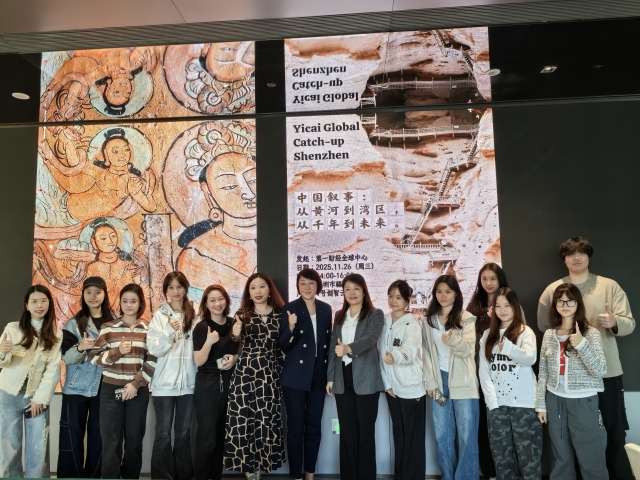
中国叙事:从黄河到湾区,从千年到未来|一财全球读者沙龙深圳站
Di Yi Cai Jing· 2025-12-05 03:14
Core Insights - The event focused on discussing how media can effectively convey "China's narrative" and "cultural narrative" in a globalized context [1][3] - The Guangdong-Hong Kong-Macao Greater Bay Area, which occupies only 0.6% of China's land but contributes 10% of its economic output, is emphasized for its role in enhancing innovation and cultural strategy [1] - The integration of culture, sports, and technology in the Greater Bay Area showcases its unique appeal and potential for deeper collaboration [1][3] Group 1 - The closed-door meeting was held at the Chuangzhi Cloud Center, a new industrial hub in Shenzhen, which fosters cross-cultural exchanges among various enterprises [3] - The event utilized the digitalization of the Bingling Temple Caves as a starting point to discuss media's role in global narratives [3][4] - The discussion included insights from Yicai Global's ten years of experience in international communication, highlighting the importance of adapting to global market dynamics [3][4] Group 2 - Shenzhen Vocational and Technical University shared its innovative approaches in talent cultivation, aligning with the region's industrial development [6] - The university aims to produce graduates who understand both industry and media, emphasizing the impact of AI and big data on media communication [6] - The collaboration between Yicai Global and Shenzhen Vocational and Technical University reflects a shared vision of preparing global communication talents for the Greater Bay Area [6]