肉鸡育种

Search documents
“广明2号”打破白羽肉鸡种源垄断,助力实现吃鸡自由
2 1 Shi Ji Jing Ji Bao Dao· 2026-02-05 12:45
Core Viewpoint - The domestic white feather broiler industry is facing supply disruptions due to an outbreak of highly pathogenic avian influenza in France, leading to a halt in the introduction of grandparent breeding chickens. The domestic self-breeding system has become a crucial buffer against external shocks, with significant growth in self-breeding capacity projected for 2025 [1][2]. Group 1: Industry Developments - The domestic self-breeding capacity for grandparent breeding chickens is expected to reach 907,200 sets by 2025, accounting for 59.07% of the total renewal volume, marking a 10.36% increase from 2024 [1]. - The introduction of domestic breeds like "Guangming No. 2" has broken the long-standing foreign monopoly in the market, showcasing advantages in disease resistance and adaptability [1][2]. - The "Guangming No. 2" breed has achieved a weight of 2.8 kg at 42 days and a feed conversion ratio of 1.45 to 1.5, making it a high-protein, low-fat meat source suitable for various food service sectors [2]. Group 2: Technological Advancements - The Guangdong Academy of Agricultural Sciences has collaborated with multiple institutions to address key challenges in broiler breeding, successfully developing the "Lingnan Yellow Chicken No. 5" and "Guangming No. 2" breeds, marking a significant advancement in the field [1][3]. - The "Lingnan Yellow Chicken No. 5" exhibits superior growth rates, with market weights 8% to 10% higher than similar breeds, and is well-suited for both standardized processing and live chicken markets [3]. Group 3: Strategic Initiatives - The "Yueqiang Breeding Core" initiative aims to establish a self-sufficient breeding system, with a complete new generation of broiler breeding technology developed over more than a decade [6][7]. - Guangdong has produced 41 new livestock and poultry breeds, with 31 being broiler breeds, accounting for over 40% of the national total, and is the leading supplier of yellow feather broiler breeding chickens in China [7]. - The provincial government aims to stabilize poultry output at over 1.35 billion birds in 2026, emphasizing the importance of optimizing breeding technologies and expanding the application of new breeds [7].
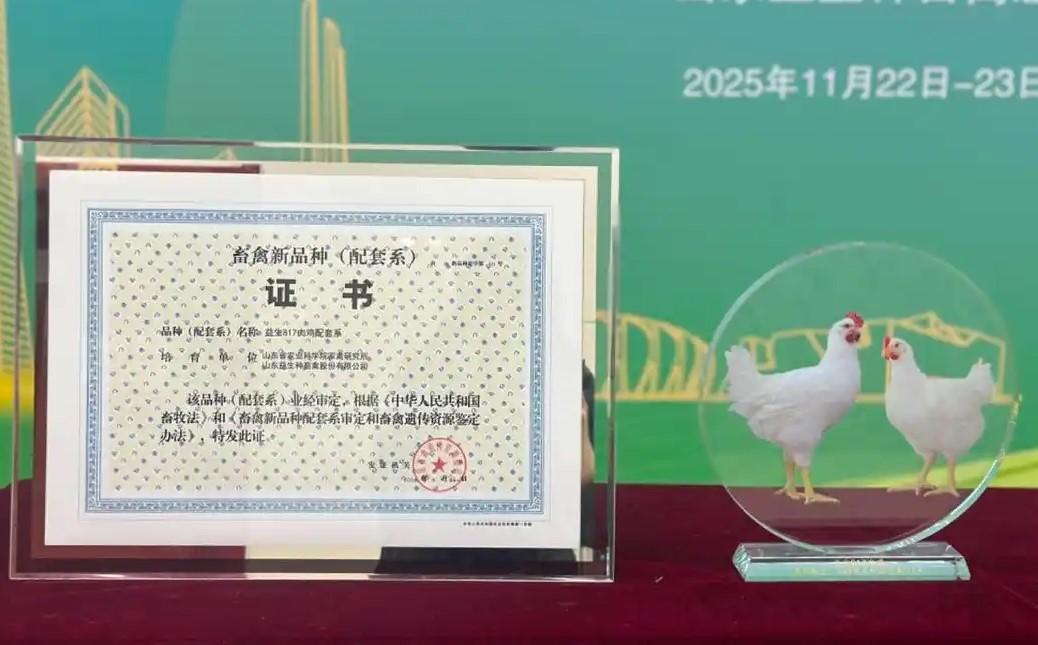
“益生817肉鸡”拿到国家新品种证书
Ke Ji Ri Bao· 2025-11-24 07:19
Core Viewpoint - The successful approval of the "Yisheng 817 broiler chicken" as a national poultry variety marks a significant milestone in China's poultry breeding history, indicating a transition from breeding technology to a nationally recognized variety [1][3]. Group 1: Industry Development - The "Yisheng 817 broiler chicken" was developed to address the shortage of specialized breeds for traditional chicken dishes like "pa chicken" and "roast chicken" [3]. - The breeding model of the 817 chicken integrates existing commercial breed resources, resulting in a breed that is efficient in growth, adaptable, and cost-effective, thus paving a unique development path for China's poultry industry [3][4]. - The 817 chicken has become one of the three main types in China's poultry industry, with an expected output of 2.47 billion birds in 2024, accounting for 17.2% of the national broiler output, and approximately 40% of this production will come from Shandong Province [4]. Group 2: Breeding and Market Impact - The breeding model of the 817 chicken involves a hybridization of fast-growing white feather broiler roosters and high-yield brown-shelled egg layers, which allows for the integration of advanced global breeding results [4]. - The "Yisheng 817 small white feather broiler chicken" has been well-received in the market, with 400,000 sets promoted within a few months [4]. - The breed is characterized by low cost, fast growth, and high-quality meat, making it suitable for both traditional Chinese and Western-style chicken products [5].