
广明2号

Search documents
强化基础研究战略性、前瞻性、体系化布局 不断夯实高水平科技自立自强根基
Ren Min Ri Bao· 2026-02-20 01:24
Group 1 - Strengthening basic research is an urgent requirement for achieving high-level technological self-reliance and building a world-class scientific power [1] - The emphasis on basic research has led to significant achievements, with over half of the top ten scientific advancements in China for 2025 stemming from basic research [1] - The development of quantum computing in China illustrates the importance of foundational issues in advancing technology [2][3] Group 2 - Basic research serves as the theoretical foundation for technological breakthroughs and is a driving force for industrial transformation [4] - The establishment of collaborative frameworks between enterprises and research institutions is crucial for advancing basic research [5][9] - The integration of enterprises into the national basic research system allows for a collaborative innovation mechanism where companies can propose scientific challenges [6][7] Group 3 - The cultivation of young scientific talent is essential for the future of basic research, with significant support being provided to young researchers [10][11] - A high percentage of funded projects are led by researchers aged 45 and below, indicating a focus on nurturing young talent in the scientific community [12] - The National Natural Science Foundation has funded a substantial number of projects, contributing significantly to foundational scientific advancements [12]
强化基础研究战略性、前瞻性、体系化布局——不断夯实高水平科技自立自强根基
Ren Min Ri Bao· 2026-02-19 22:17
Group 1 - Strengthening basic research is an urgent requirement for achieving high-level technological self-reliance and building a world-class scientific power [1] - The emphasis on basic research has led to significant achievements, with over half of the top ten scientific advancements in China for 2025 stemming from basic research [1] - The development of quantum computing in China demonstrates the importance of addressing foundational scientific issues to meet national strategic needs [2][3] Group 2 - Basic research serves as the theoretical foundation for technological breakthroughs and is a driving force for industrial transformation [4] - The establishment of collaborative frameworks between enterprises and research institutions is crucial for advancing basic research [5][9] - The integration of enterprises into the national basic research system allows for a collaborative innovation mechanism where companies can propose scientific challenges to be addressed by research teams [6][7] Group 3 - The cultivation of young scientific talent is essential for the future of basic research, with significant support being provided to young researchers [10][12] - The National Natural Science Foundation has funded numerous projects led by researchers aged 45 and below, indicating a strong focus on nurturing young talent [12] - The foundation has supported a total of 880,000 research projects over 40 years, with funding amounting to 460.8 billion yuan, contributing to a wealth of foundational and original scientific achievements [12]
“广明2号”打破白羽肉鸡种源垄断,助力实现吃鸡自由
2 1 Shi Ji Jing Ji Bao Dao· 2026-02-05 12:45
Core Viewpoint - The domestic white feather broiler industry is facing supply disruptions due to an outbreak of highly pathogenic avian influenza in France, leading to a halt in the introduction of grandparent breeding chickens. The domestic self-breeding system has become a crucial buffer against external shocks, with significant growth in self-breeding capacity projected for 2025 [1][2]. Group 1: Industry Developments - The domestic self-breeding capacity for grandparent breeding chickens is expected to reach 907,200 sets by 2025, accounting for 59.07% of the total renewal volume, marking a 10.36% increase from 2024 [1]. - The introduction of domestic breeds like "Guangming No. 2" has broken the long-standing foreign monopoly in the market, showcasing advantages in disease resistance and adaptability [1][2]. - The "Guangming No. 2" breed has achieved a weight of 2.8 kg at 42 days and a feed conversion ratio of 1.45 to 1.5, making it a high-protein, low-fat meat source suitable for various food service sectors [2]. Group 2: Technological Advancements - The Guangdong Academy of Agricultural Sciences has collaborated with multiple institutions to address key challenges in broiler breeding, successfully developing the "Lingnan Yellow Chicken No. 5" and "Guangming No. 2" breeds, marking a significant advancement in the field [1][3]. - The "Lingnan Yellow Chicken No. 5" exhibits superior growth rates, with market weights 8% to 10% higher than similar breeds, and is well-suited for both standardized processing and live chicken markets [3]. Group 3: Strategic Initiatives - The "Yueqiang Breeding Core" initiative aims to establish a self-sufficient breeding system, with a complete new generation of broiler breeding technology developed over more than a decade [6][7]. - Guangdong has produced 41 new livestock and poultry breeds, with 31 being broiler breeds, accounting for over 40% of the national total, and is the leading supplier of yellow feather broiler breeding chickens in China [7]. - The provincial government aims to stabilize poultry output at over 1.35 billion birds in 2026, emphasizing the importance of optimizing breeding technologies and expanding the application of new breeds [7].
揭秘“吃鸡自由”背后的科技力量
Zhong Guo Jing Ji Wang· 2026-02-05 08:01
Group 1 - Chicken is the second largest meat consumption product in China, with broiler chickens accounting for over 70% of chicken production [1] - By 2025, China is expected to consume over 9 billion broiler chickens, with domestic varieties holding over 30% market share and exports to countries like Tajikistan, Pakistan, and Tanzania [1] - The average weight of broiler chickens at market age exceeds 3 kg, requiring only 1.5 to 1.6 kg of feed for each additional kg of meat [1] Group 2 - Fujian Shengze Biotechnology Development Co., Ltd. is the birthplace of the "Shengze 901" breed, which has expanded its market share by promoting 47 million parent stock sets across 15 provinces [2] - "Shengze 901" has also begun exporting to Belt and Road countries, with nearly 10,000 parent stock sets and over 270,000 eggs exported, marking a significant entry into African and Central Asian markets [2] - The national breeding joint task force has accelerated research and development in molecular breeding and disease prevention technologies during the 14th Five-Year Plan period [2] Group 3 - The "Guangming 2" breed, supported by the Chinese Academy of Agricultural Sciences, has made progress in genomic breeding technology, reducing breeding cycles by 2 to 3 generations [3] - The "Wode 188" breed has also emerged in the market, with over 633,000 parent stock sets promoted and a complete disease purification barrier established [3] Group 4 - The broiler chicken industry has entered an intelligent farming phase, utilizing IoT, cloud computing, big data, and blockchain for management [4] - The "Shengze 901" breed employs advanced computational capabilities for genomic selection analysis and bioinformatics, maximizing social, economic, and ecological benefits [4]
【BOYAR观察】预计2025年白羽肉鸡祖代更新量接近150万套
Xin Lang Cai Jing· 2025-12-02 10:09
Core Insights - The total number of grandparent stock updates in November 2025 was 197,000 sets, a month-on-month decrease of 3.9% but a year-on-year increase of 18.67% [3] - From January to November 2025, the total updates amounted to 1.3312 million sets, reflecting a year-on-year decline of 9.61% [5] Group 1: Update Trends - The grandparent stock updates showed a continuous increase in the second half of 2025, with a total of 501,100 sets in the first half, down 37.01% year-on-year [3] - The updates from July to September totaled 418,100 sets, with October at 205,000 sets and November at 197,000 sets [3] Group 2: Update Sources - The updates in 2025 were primarily from domestic breeding and imports, with the first eleven months seeing 60% from domestic sources and 40% from imports [10] - The imported varieties included AA+, Ross, and Lifen, while domestic breeds included Cobb, SZ901, and Guangming No. 2 [10] Group 3: Update Distribution by Variety - The total updates from January to November included Cobb at 361,500 sets, AA+ at 205,200 sets, and Lifen at 256,000 sets [6] - The market share for the varieties was Cobb at 27.2%, AA+ at 15.4%, and Lifen at 19.2% [6] Group 4: Company Market Share - A total of 18 companies were involved in grandparent stock updates, with Yisheng occupying the largest share at 236,000 sets, representing 17.7% [11] - Other notable companies included Fujian Shengze at 227,000 sets (17.1%) and Beijing Poultry Breeding at 10.5% [11] Group 5: Future Projections - The grandparent stock updates for 2025 are expected to exceed 1.45 million sets [13]



“十四五”,我们见证这些硬核突破|从粒粒良种,到仓廪充盈
Ren Min Ri Bao Hai Wai Ban· 2025-11-04 07:41
Core Insights - China is implementing a seed industry revitalization action plan during the 14th Five-Year Plan period, achieving over 95% of crop breeding area with domestically bred varieties, including high-yield rice and disease-resistant wheat [1][3][4] Group 1: Crop Breeding Achievements - Breakthrough varieties of staple crops such as rice and wheat have been developed, with significant increases in yield; for instance, the combined yield of regenerated rice and mid-season rice in Sichuan reached over 1300 kg per mu [3][4] - The average yield of early rice is projected to exceed 400 kg per mu by 2025, marking a historical high [4] - New wheat varieties, such as "Yangmai 53," have been developed to combat diseases like Fusarium head blight, achieving a yield increase of 10.13% compared to control varieties [4][5] Group 2: Livestock and Aquaculture Innovations - The domestic breeding of white feather broilers has transitioned from 100% reliance on imports to the introduction of varieties like "Shenze 901," which has begun to penetrate international markets [6][7] - The market share of domestically bred white feather broilers has surpassed 25%, while the Huaxi cattle breed has achieved over 20% market share, reducing dependency on imported livestock [7] - The self-bred South American white shrimp varieties now hold over 30% of the market, previously costing millions in imports [7] Group 3: Genetic Resource Survey and Utilization - A comprehensive national agricultural germplasm resource survey has been conducted, collecting 139,000 new germplasm resources, which are crucial for breeding superior varieties [9][10] - The survey has identified and protected traditional local varieties and wild relatives, enhancing the foundation for breeding high-yield and resilient crops [10]
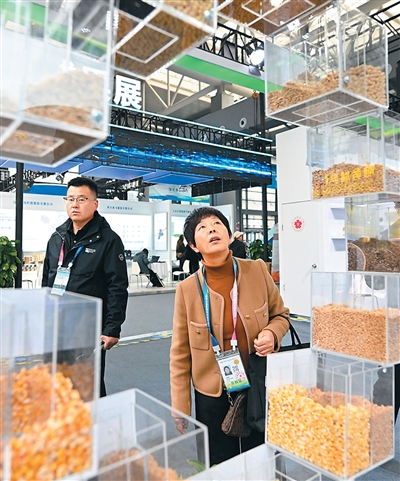
农作物自主选育品种占比超95%,多个品种打破国外种源依赖——从粒粒良种,到仓廪充盈
Ren Min Ri Bao Hai Wai Ban· 2025-11-04 07:40
Core Insights - The article emphasizes the significant advancements in China's agricultural seed industry during the "14th Five-Year Plan" period, highlighting the development of high-quality and high-yield crop varieties, which have led to increased self-sufficiency in food production [1][2][3][4][5][6][7][8] Group 1: Crop Innovations - China has successfully bred a variety of high-yield rice, wheat, and other crops, with over 95% of the cultivated area consisting of self-bred varieties [1] - In Sichuan Province, the introduction of breakthrough rice varieties has led to an average yield of over 1300 kg per mu (approximately 2170 kg per hectare) [2] - The development of disease-resistant wheat varieties, such as "Yangmai 53," has resulted in a yield increase of 10.13% compared to traditional varieties [3] Group 2: Livestock and Aquaculture - The domestic breeding of white feather broilers has transitioned from complete reliance on imports to achieving over 25% market share, with significant exports to international markets [4][5][6] - The introduction of the Huaxi cattle breed has improved domestic beef production, achieving a market share exceeding 20% [6] - The self-bred varieties of South American white shrimp have also gained a market share of over 30%, reducing previous import costs significantly [6] Group 3: Genetic Resource Management - A comprehensive national agricultural germplasm resource survey has been conducted, collecting 139,000 new germplasm resources, which is crucial for breeding superior varieties [7][8] - The survey has identified and protected traditional local varieties and wild relatives, enhancing the genetic diversity available for breeding programs [8] - Over 6000 germplasm resources have already been applied in breeding innovation and industrial development, supporting the goal of enhancing self-innovation capabilities in the seed industry [8]