脑机接口产业

Search documents
金鹰基金欧阳娟:创新药迎来业绩窗口期 脑机和AI医疗焕发产业新生
Xin Lang Cai Jing· 2026-01-22 07:09
Core Insights - The innovative drug sector is entering a critical performance realization phase in 2026, driven by multiple catalysts and advancements in brain-computer interfaces and AI medical technologies [1][6][7] - Fund managers, including Ouyang Juan from Jinying Fund, express optimism about the innovative drug sector's upward trend, supported by domestic healthcare policies and China's competitive edge in global markets [1][6][7] - The potential of AI in healthcare is significantly underestimated, with expectations for new business models to emerge as AI applications in drug development, cancer screening, and personalized treatment evolve [2][7] Group 1: Industry Outlook - The innovative drug sector is expected to maintain a positive outlook, benefiting from ongoing support from domestic healthcare policies and the global competitiveness of Chinese innovative drugs [1][6] - The year 2026 is anticipated to be pivotal for the brain-computer interface industry, with significant changes expected in both domestic and international markets [3][8] - The AI healthcare sector is entering a phase of commercial exploration, with vast amounts of medical data and a growing demand for AI applications [2][8] Group 2: Investment Strategies - Focus areas for investment include innovative drugs with strong global competitiveness, which can benefit from both domestic and Western markets [3][8] - The innovative drug supply chain, including CXO and life sciences services, is projected to see a recovery in order growth as global financing accelerates [3][8] - The brain-computer interface and AI medical sectors are highlighted as emerging areas of interest, with potential for substantial growth and innovation [2][3][8]
A股指数集体低开:沪指跌0.19%,铁矿石、证券IT等板块跌幅居前
Feng Huang Wang Cai Jing· 2025-12-09 01:28
Market Overview - Major indices in China opened lower, with the Shanghai Composite Index down 0.19%, the Shenzhen Component down 0.26%, and the ChiNext Index down 0.21% [1] - The Shanghai Composite Index closed at 3916.51, with a decrease of 0.19% [2] - The Shenzhen Component closed at 13295.62, down 0.26% [2] - The NASDAQ and S&P 500 indices in the US also closed lower, with the Dow Jones down 0.45% [3] Institutional Insights - Galaxy Securities highlighted that the upcoming Central Economic Work Conference is expected to provide clearer policy guidance, which could enhance market confidence and stability [4] - CICC noted that the underlying logic for A-share market valuation remains intact, despite recent fluctuations, indicating a healthy market environment [5] - CITIC Securities reported that the domestic brain-computer interface industry is expected to see accelerated clinical and commercial progress, driven by supportive government policies [6] - Guotai Junan emphasized the positive outlook for the military industry and commercial aerospace, citing recent successful launches and collaborations [7] - Guojin Securities suggested that improved external conditions may lead to an increase in leverage limits for quality brokerage firms, which could enhance their valuation recovery [8][9]


医药生物周报(25年第31周):机接口政策频出,关注国内脑机接口产业链-20250816
Guoxin Securities· 2025-08-16 13:50
Investment Rating - The report maintains an "Outperform" rating for the pharmaceutical and biotechnology sector [5][39]. Core Insights - The pharmaceutical sector has shown stronger performance compared to the overall market, with a total A-share increase of 2.04% and a decline of 0.84% in the biotechnology sector [1][30]. - The brain-computer interface (BCI) industry is rapidly developing, supported by recent government policies and successful clinical trials, indicating significant growth potential [2][11]. - The report emphasizes the importance of innovative drugs and their supporting infrastructure, highlighting the positive impact of adjustments in medical insurance and commercial health insurance on domestic innovative drug sales [3][39]. Summary by Sections Market Performance - The overall A-share market increased by 2.04%, while the biotechnology sector decreased by 0.84%, indicating a weaker performance relative to the market [1][30]. - The current price-to-earnings (P/E) ratio for the pharmaceutical sector is 38.77x, which is at the 80.28th percentile of its historical valuation over the past five years [1][35]. Brain-Computer Interface Industry - The BCI industry is characterized by a growing number of supportive policies and technological advancements, with a focus on both invasive and non-invasive methods [2][11]. - The market for non-invasive BCIs is the primary research direction, accounting for 86% of the market share [11][16]. - The potential market size for serious medical applications of BCIs is estimated between $15 billion and $85 billion, while consumer medical applications could reach $25 billion to $60 billion [16]. Key Companies and Investment Recommendations - **Mindray Medical (300760.SZ)**: Rated "Outperform" with projected net profits increasing from 116.7 billion in 2024 to 161.9 billion in 2027 [4]. - **WuXi AppTec (603259.SH)**: Rated "Outperform" with expected net profits rising from 93.5 billion in 2024 to 145.1 billion in 2027 [4]. - **Aier Eye Hospital (300633.SZ)**: Rated "Outperform" with a focus on expanding its service network and enhancing service prices [39]. - **Huitai Medical (688617.SH)**: Rated "Outperform" with a strong focus on electrophysiology and interventional medical devices [40]. - **Innovative Medical (002173.SZ)**: Rated "Outperform" with ongoing clinical trials and expected registration of medical devices [39].




城市24小时 | 汽车产量强省格局生变,谁在进位?
Mei Ri Jing Ji Xin Wen· 2025-07-24 16:31
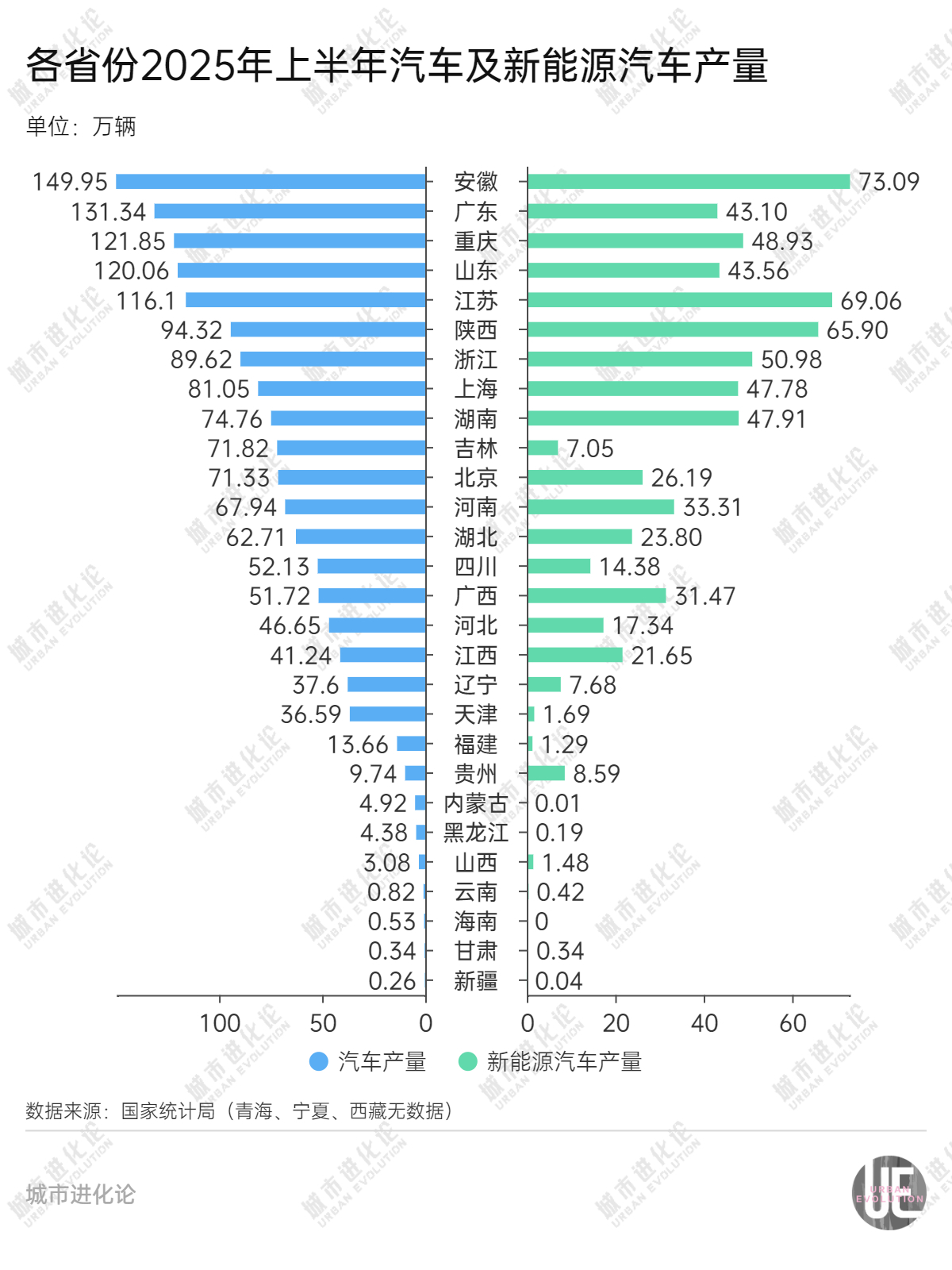
Automotive Industry - In the first half of 2025, China's automotive production and sales reached 15.62 million and 15.65 million units respectively, marking a year-on-year increase of 12.5% and 11.4%, achieving a historic milestone of both production and sales exceeding 15 million units for the first time in the same period [1][3] - Anhui province led the nation in both total automotive production at 1.4995 million units and new energy vehicle (NEV) production at 730,900 units, marking a significant shift in the automotive industry landscape [1][4] - Guangdong, which had held the top position for nearly a decade, fell to second place with a production of 1.3134 million units, 186,100 units less than Anhui, and its NEV production dropped to 431,000 units, falling from first to ninth place [3][4] Regional Developments - Hunan province made notable advancements, ranking ninth in total automotive production with 747,600 units and sixth in NEV production with 479,100 units, reflecting a growth of 25.1% in automotive manufacturing and 167.7% in NEV manufacturing [5] - Henan province also showed significant growth, with total automotive production reaching 679,400 units, moving up from 17th to 12th place, and NEV production at 333,100 units, advancing from 18th to the top ten [5] Industry Trends - The automotive industry in China is undergoing a major reshuffle, with Anhui's rise attributed to its comprehensive industrial layout and the presence of major automotive manufacturers, including Chery, NIO, and BYD [4] - The shift in production rankings indicates a potential long-term change in the competitive landscape of the automotive sector in China, with implications for investment and market strategies [1][4]