自动化与智能化

Search documents
研判2026!中国汽车焊装设备行业焊接方法、产业链、市场规模、重点企业及未来前景:汽车产业快速发展,带动焊装设备规模增至360.48亿元[图]
Chan Ye Xin Xi Wang· 2026-02-27 01:20
Industry Overview - The automotive welding equipment industry is crucial for the manufacturing process, which includes stamping, welding, painting, and assembly, with welding being the most complex and quality-determining phase [1][8] - Recent advancements in automation and intelligence in the automotive industry have led to the upgrade of welding equipment technology, transitioning from traditional welding robots to advanced techniques such as laser welding and friction stir welding, enhancing quality and efficiency while reducing labor dependency [1][8] Market Dynamics - The Chinese automotive welding equipment market is projected to reach 36.048 billion yuan by 2025, with a year-on-year growth of 3.96%. The automotive modification sector is expected to grow to 16.391 billion yuan (4.69% growth), while the new capacity sector is anticipated to reach 19.657 billion yuan (3.35% growth) [1][8] - The automotive industry is a pillar of the national economy, with a long industrial chain and strong correlation, playing a significant role in stabilizing industrial economic growth [8] Industry Development Trends - The industry is expected to accelerate towards high automation and intelligent systems, integrating robotic welding, visual guidance, online detection, and autonomous path planning for a fully automated welding process [13] - There will be continuous breakthroughs in high precision and high performance to meet the stringent quality requirements of new energy vehicles and lightweight bodies, with advanced technologies like high-dynamic welding robots and laser welding becoming more prevalent [14] - Flexibility and modular design will become core focuses, allowing for quick switching and expansion of production lines to accommodate various models and materials, thus supporting agile and sustainable development in the welding system [15] Key Companies - Tianyong Intelligent Equipment Co., Ltd. focuses on intelligent automation equipment and has seen a decline in specialized equipment manufacturing revenue, reporting 269 million yuan in the first half of 2025, down 15.94% year-on-year [10][11] - Sanfeng Intelligent Equipment Group Co., Ltd. provides comprehensive solutions for intelligent welding production lines, reporting 573 million yuan in revenue for its intelligent welding production line in the first half of 2025, a year-on-year increase of 1.96% [11][12]


大家提前做好准备!如果不出意外,2026年1月以后,国内将迎来3个变化
Sou Hu Cai Jing· 2026-01-25 18:24
Group 1: Changes in Employment and Work - The trend of automation in factories reflects a broader societal change, with many industries moving towards automation and smart technologies, particularly in repetitive and low-skill jobs [1][2] - From 2026 onwards, the pace of job displacement due to automation is expected to accelerate, creating pressure on workers in these roles but also new opportunities for those who adapt [2][5] - Workers are encouraged to learn new skills, such as data analysis or programming, to remain competitive in the evolving job market, as traditional skills may become obsolete [5][10] Group 2: Changes in Consumer Behavior - Overall consumer spending is declining, but the approach to consumption is shifting towards more rational and cost-effective choices, with a rise in demand for affordable products [6][7] - Consumers are becoming more discerning, often opting for lower-priced items while still maintaining quality through smart purchasing strategies, leading to the phrase "spending less to look good" [6][7] - Retailers that can adapt to these changes and offer high-value products will find growth opportunities, while those relying on high-end sales may face challenges [7][10] Group 3: Policy and Social Management Adjustments - There is a shift in policy focus from stimulating short-term economic growth to long-term structural adjustments, impacting industries reliant on government support [9][10] - Policies are evolving to provide an environment conducive to innovation and competition rather than direct financial support, favoring industries that can self-sustain and innovate [9][10] - Sectors related to technology innovation, industrial upgrades, and social services are expected to receive more policy attention and support [9][10] Group 4: Interconnected Changes - The changes in employment, consumer behavior, and policy are interconnected, requiring individuals and businesses to adapt to a new era where traditional methods may no longer suffice [10][11] - Companies need to rethink their strategies to improve product quality and service, as well as innovate their business models to remain competitive in the upcoming market reshuffle expected by 2026 [10][11] - Individuals are advised to proactively consider their career paths and skill development to enhance their competitiveness in the changing landscape [11][13]

永利股份:昆山智能传动系统产业化基地正按规划稳步推进中
Zheng Quan Ri Bao Wang· 2026-01-16 15:10
Group 1 - The core viewpoint of the article is that Yongli Co., Ltd. is progressing with the construction of its intelligent transmission system industrialization base in Kunshan, having secured the land use rights for the relevant plots [1] - The project is expected to have a construction period of two years, with the specific production timeline influenced by industrial policies and the completion of necessary procedures, indicating some uncertainty in the implementation schedule [1] - The project aims to enhance automation and intelligence in production processes, operational management, and supply chain collaboration, thereby establishing a more efficient and agile operational system to strengthen the company's long-term competitiveness and profitability [1]

全球与中国非球面精密模压机市场现状及未来发展趋势
QYResearch· 2025-10-30 02:40
Core Viewpoint - The article discusses the advancements and market potential of aspherical precision molding machines, highlighting their high precision, low manufacturing costs, and suitability for mass production in various high-end optical applications [4][6][14]. Group 1: Advantages of Aspherical Precision Molding Machines - High forming precision is achieved through strict control of temperature and pressure, resulting in high dimensional accuracy and excellent surface quality [4][6]. - The molding process significantly reduces reliance on expensive equipment and skilled labor, allowing for efficient production in smaller workshops, thus lowering manufacturing costs [4][6]. - The machines are highly automated and capable of consistent mass production, making them ideal for producing precision aspherical optical components [4][6]. Group 2: Industry Development Status - Continuous technological advancements have improved processing precision, temperature control uniformity, and pressure stability, enabling sub-micron level optical component processing [6][8]. - Rapid demand growth is driven by applications in security, automotive lenses, smartphones, drones, AR/VR, and lidar, leading to an expanding market for aspherical molding machines [6][8]. - The industry is witnessing an increase in domestic manufacturers enhancing R&D capabilities, with local equipment gradually approaching the precision and reliability of imported models [6][8][15]. Group 3: Market Trends - The trend towards higher precision and ultra-precision processing is evident, with increasing demands for sub-micron and even nano-level optical components in various applications [8]. - There is a shift towards large-scale and automated production, integrating smart technologies to enhance efficiency and reduce labor dependency [8]. - The adaptability to new optical materials and composites is becoming crucial, with ongoing optimizations needed for temperature control and molding processes to accommodate diverse material types [8]. Group 4: Market Size and Growth - The global market for aspherical precision molding machines is projected to grow from $70.97 million in 2024 to $308.21 million by 2031, with a CAGR of 23.56% [14]. - The Chinese market is expected to account for 53.88% of the global market by 2024, growing to 59.79% by 2031, indicating rapid regional growth [14]. - The automotive lens sector holds a significant market share, with a projected CAGR of 16.63% in the coming years [14]. Group 5: Competitive Landscape - The industry is highly concentrated, with key players including Guangdong Jinding Optical Technology Co., Shibaura Machine, and others, with the leading firms holding a significant market share [15]. - The competitive landscape is expected to intensify as new entrants emerge, driven by technological innovation and market positioning strategies [15].

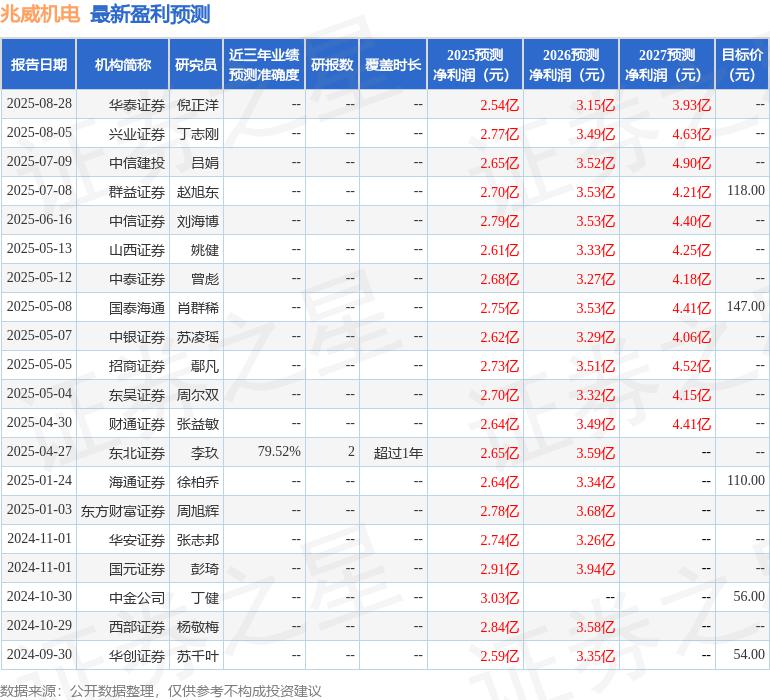
山西证券:给予兆威机电增持评级
Zheng Quan Zhi Xing· 2025-08-29 13:10
Core Viewpoint - The report highlights the strong financial performance of Zhao Wei Electromechanical (003021) in Q2 2025, with significant revenue and profit growth, and emphasizes the ongoing development of its robotic dexterous hand products and global expansion efforts [1][2][3]. Financial Performance - In the first half of 2025, the company achieved operating revenue of 790 million yuan, a year-on-year increase of 21.9%, and a net profit attributable to shareholders of 110 million yuan, up 20.7% year-on-year [1]. - For Q2 2025, the company reported operating revenue of 420 million yuan, reflecting a year-on-year growth of 25.9% and a quarter-on-quarter increase of 14.0%. The net profit for the same period was 60 million yuan, representing a year-on-year increase of 52.3% and a quarter-on-quarter rise of 7.0% [1][2]. Product Performance - Revenue from the micro drive system reached 500 million yuan, contributing 63.3% to total revenue, with a gross margin of 27.6%, down 2.1 percentage points year-on-year. Precision parts generated 240 million yuan, accounting for 30.4% of revenue, with a gross margin of 43.8%, up 5.8 percentage points year-on-year. Revenue from precision molds and others surged to 50 million yuan, a year-on-year increase of 88.5%, contributing 6.3% to total revenue, with a gross margin of 18.6%, up 15.7 percentage points year-on-year [1][2]. Cost and Efficiency - In Q2 2025, the company's gross margin and net margin were 32.2% and 14%, respectively, reflecting increases of 2.5 percentage points and 2.4 percentage points year-on-year. The total expense ratio decreased by 4.0 percentage points year-on-year to 18.0% [2]. R&D and Product Development - The company is actively advancing the research and development of its robotic dexterous hand and core components. In July, it launched new dexterous hand products, DM17 and LM06, utilizing differentiated technology routes for various operational scenarios [2]. - The company has completed technical breakthroughs for a 4mm brushless hollow cup motor and is progressing with small-batch production of small-diameter products [2]. Global Expansion - The company is successfully advancing its globalization strategy, having initiated capacity construction in Thailand and filed for an H-share listing on the Hong Kong Stock Exchange [2]. It plans to invest up to 100 million USD in the new factory [2]. Investment Outlook - The company is positioned as a global leader in micro drive and drive system solutions, benefiting from trends in miniaturization, automation, and intelligence across various sectors including smart vehicles, consumer and medical technology, and advanced manufacturing [3]. - EPS forecasts for 2025, 2026, and 2027 are projected at 1.12, 1.43, and 1.81 yuan, respectively, with corresponding PE ratios of 108.8, 85.4, and 67.3 [3].