芯片测试与可测性/可靠性设计

Search documents
原英特尔芯片架构师苏菲回国,加盟清华大学
Feng Huang Wang· 2025-09-23 07:17
Core Viewpoint - Tsinghua University has appointed former Intel chip architect Sophie as a tenured professor and doctoral advisor at its Integrated Circuit Institute, highlighting the institution's commitment to advancing semiconductor research and innovation [1] Group 1: Appointment Details - Sophie holds a Bachelor's and Master's degree in Automation from Tsinghua University, obtained in 1999 and 2001 respectively, and earned her Ph.D. from Duke University in 2006 [1] - She worked at Intel from 2006 to 2025, serving as a chip architect [1] Group 2: Research Focus - Sophie's primary research areas include chip testing, reliability design, and lifecycle management, aiming to address critical challenges in chip testability, reliability, security, and computational resilience [1] - Her research has led to innovations that have been applied in several influential chip products, contributing to the advancement of the semiconductor industry [1] Group 3: Achievements and Contributions - Sophie holds multiple international patents related to 3D chip testing, functional safety of analog chips, and smart sensors [1] - She has participated in the development of several IEEE international technical standards and is a senior member of the IEEE, also serving as the associate editor for IEEE's "Design and Test" [1]

原英特尔芯片架构师苏菲加盟清华大学任长聘教授
Xin Lang Ke Ji· 2025-09-23 07:02
Core Viewpoint - The appointment of former Intel chip architect Sophie as a tenured professor at Tsinghua University's School of Integrated Circuits signifies a strategic move to enhance research capabilities in chip design and reliability [1] Group 1: Appointment Details - Sophie has been appointed as a tenured professor and Xinhua Chair Professor at Tsinghua University, as well as a doctoral advisor [1] - She holds a Bachelor's and Master's degree in Automation from Tsinghua University and a Ph.D. from Duke University in Electrical and Computer Engineering [1] Group 2: Research Focus - Sophie's research areas include chip testing, reliability design, and lifecycle management, aiming to address critical issues in chip testability, reliability, security, and computational resilience [1] - Her research contributions have been applied to several influential chip products, showcasing her impact on the industry [1] Group 3: Achievements and Contributions - Sophie has been awarded multiple international patents related to 3D chip testing, chiplet technology, functional safety of analog chips, and smart sensors [1] - She has played a role in the standardization of advanced research outcomes and has participated in the formulation of several IEEE international technical standards [1] Group 4: Professional Affiliations - In addition to her tenure at Intel, Sophie is a senior member of the IEEE and serves as the associate editor for IEEE's "Design and Test" [1] - She has held positions on the technical program committees of various conferences, further establishing her influence in the field [1]

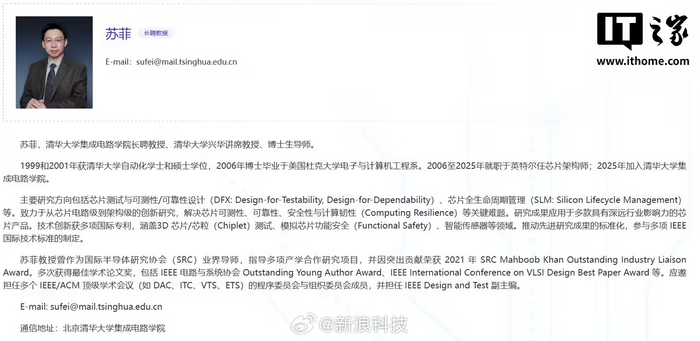
美国工作20年!英特尔资深专家加入清华大学
是说芯语· 2025-09-15 04:09
Core Insights - A leading semiconductor architect from Intel, Su Fei, has left the company after nearly two decades to join Tsinghua University as a full-time professor [1][3] - Su Fei has extensive experience in chip testing and semiconductor reliability, focusing on enhancing the reliability, safety, and long-term performance of advanced microprocessors used in various products [1][4] Group 1: Professional Background - Su Fei is a senior engineer and has held the position of Chief Chip Architect at Intel from 2006 to 2025, after which he joined Tsinghua University [3][4] - He has contributed to the development of global chip design standards and has received multiple industry honors for his work [3] Group 2: Research Focus - His research interests include design-for-testability, design-for-dependability, and silicon lifecycle management, addressing critical challenges in chip testability, reliability, safety, and computing resilience [4] - Su Fei's innovations have led to multiple international patents in areas such as 3D chip testing and functional safety of analog chips [4]