芯片设计与制造

Search documents
印度本土实现2nm芯片流片 真相令人相当无语
Xin Lang Cai Jing· 2026-02-11 10:32
据网传消息显示,印度方面宣布成功进行2nm流片,该消息给人的感觉就是假新闻,毕竟现在能实现 2nm工艺的只有三星和台积电,印度不可能凭空出现2nm工艺的制造能力。 在2月7日,高通方面宣布成功流片2nm芯片,高通印度 方面确认,印度班加罗尔、金奈、海德拉巴三大研发中 心参与了该芯片的设计。也就是说,印度方面只参与到 了设计,真正的制造还是在台积电完成的,与印度的制 造能力毫无关联。 印度方面对此则表示,此举标志着印度芯片设计能力正 式升级为核心研发枢纽,下一步还将推动制程节点向 7nm及以下先进制程节点过渡。这也再次验证了,印度 现在根本不具备2nm工艺的制造能力,甚至连7nm工艺 都无法完成。 因此,印度方面具备了出色的芯片设计能力,这在业界 中并不罕见,华为、小米在这方面都是世界顶级水平。但在先进工艺制造能力上,依然与领先者存在巨 大差距。 在我们深入了解后发现,这显然是一场以讹传讹的谣言闹剧。 据网传消息显示,印度方面宣布成功进行2nm流片,该消息给人的感觉就是假新闻,毕竟现在能实现 2nm工艺的只有三星和台积电,印度不可能凭空出现2nm工艺的制造能力。 在我们深入了解后发现,这显然是一场以讹传讹的谣言 ...

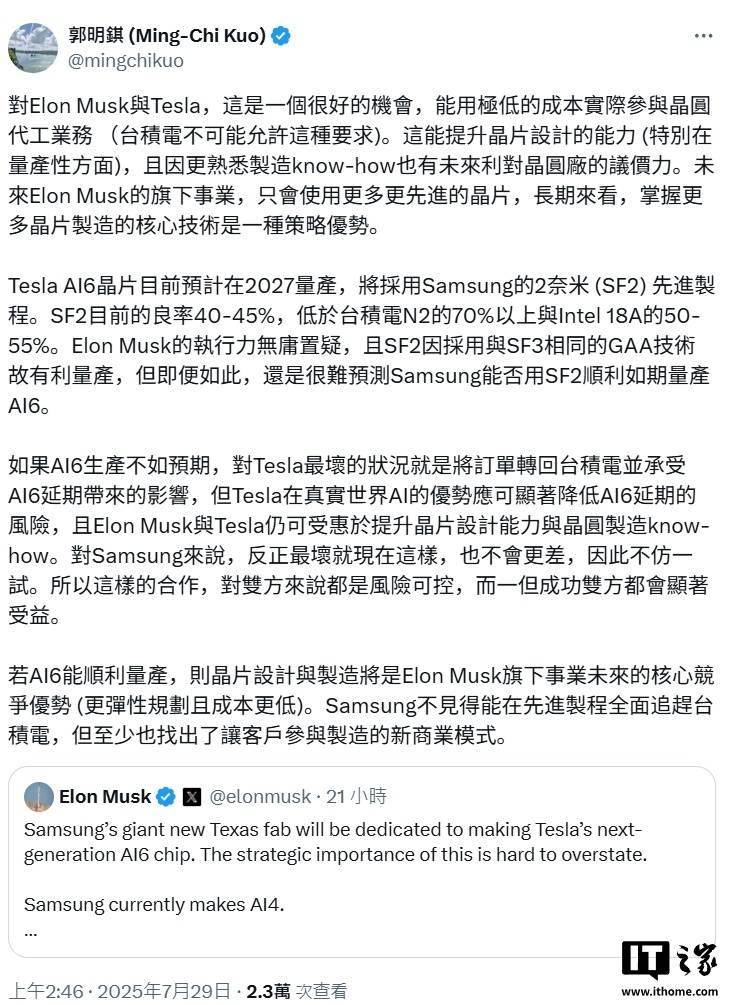
郭明錤:特斯拉AI6芯片预计用三星2纳米工艺,量产时间难测
Sou Hu Cai Jing· 2025-07-29 02:41
Core Viewpoint - The AI6 chip presents a significant opportunity for both Elon Musk and Tesla, allowing them to engage in wafer foundry operations at a low cost and enhance their chip design capabilities [2] Group 1: Tesla's AI6 Chip Production - Tesla plans to mass-produce the AI6 chip by 2027 using Samsung's 2nm (SF2) advanced process, which currently has a yield rate of 40-50%, lower than TSMC's N2 process (over 70%) and Intel's 18A (50-55%) [4] - The execution capability of Musk is deemed "undeniable," and the GAA (Gate-All-Around) technology used in SF2 is beneficial for mass production, although predicting the timely production of the AI6 chip remains challenging [4] Group 2: Risks and Contingencies - If AI6 production falls short of expectations, Tesla may revert orders to TSMC and face the consequences of a potential delay, but its real-world AI advantages could significantly mitigate the risk of postponement [4] - The collaboration with Samsung is viewed as a controlled risk for both parties, with significant benefits if the AI6 chip is successfully produced [6] Group 3: Strategic Advantages - Successful mass production of the AI6 chip would provide Musk with core competitive advantages in chip design and manufacturing, allowing for more flexible planning and lower costs [6] - While Samsung may not fully catch up to TSMC in advanced processes, it can explore a business model that involves customer participation in manufacturing [6]

中国芯片,迎来“关键一天”
Xin Lang Cai Jing· 2025-05-20 01:27
Group 1 - The core message highlights significant breakthroughs in China's semiconductor industry, particularly with Huawei's launch of the self-developed "Harmony Computer" and Xiaomi's announcement of a 3nm chip design, marking a critical step towards achieving advanced chip design capabilities [3][4] - The industry consensus emphasizes the importance of self-research and independence in the semiconductor sector, with companies focusing on strengthening domestic supply chains and localizing production to mitigate the impact of external restrictions [3][4][7] - The article underscores the dual importance of chip design and manufacturing, noting that leading companies like Apple and Qualcomm focus solely on design, which allows them to maintain significant influence in the industry [3][4] Group 2 - The challenges faced by Chinese companies in semiconductor manufacturing are acknowledged, with a comparison illustrating the difficulty of advancing from a score of 80 to 100 in terms of technology [7][10] - Positive developments are noted, including Huawei's continuous progress and the anticipated mass production of the N+2 process by SMIC, alongside breakthroughs in 5nm and 3nm chip designs [7][10][13] - The article emphasizes the need for different strategies in chip manufacturing and design due to their unique characteristics, with a clear development blueprint emerging for the industry [10][13] Group 3 - The urgency of advancing in the semiconductor field is highlighted, with the article suggesting that time is limited for China's semiconductor industry to catch up [14][16] - The narrative discusses the historical context of U.S.-China competition, indicating that future focus will be on critical sectors like semiconductors, with both sides striving for breakthroughs [16][18] - The article reflects on Xiaomi's long-term commitment to chip development, detailing its investment strategy and the establishment of a dedicated team to achieve high-end SoC capabilities [21][22] Group 4 - The resilience of the Chinese semiconductor industry is emphasized, with the notion that pressure from external restrictions can lead to innovative solutions and breakthroughs [22] - The article acknowledges the complexity of chip manufacturing, requiring extensive expertise across various fields, and highlights the efforts of companies like Huawei and Xiaomi in navigating these challenges [22]