菲尔兹奖

Search documents
丘成桐:未来5到10年中国将成为数学强国
第一财经· 2026-01-05 11:27
Core Viewpoint - The article discusses the optimistic outlook for China's future in mathematics, predicting that it will become a mathematical powerhouse within the next 5 to 10 years, as stated by the first Chinese Fields Medalist, Shing-Tung Yau, during the 10th International Conference of Chinese Mathematicians (ICCM) held in Shanghai [3][4]. Group 1: Talent Development - Yau emphasizes the importance of nurturing mathematical talent, noting that Chinese students around the age of 12 exhibit exceptional creativity and intuition comparable to their peers globally [7]. - He expresses concern that the current educational focus on standardized testing and rote learning ("刷题") stifles innovation and critical thinking among students as they progress into high school [6][8]. - The goal of specialized programs is not only to produce mathematicians but to provide a solid mathematical foundation for various scientific disciplines, allowing students to pursue their interests later on [7]. Group 2: AI and Mathematics - Yau argues that while AI enhances research efficiency, it does not revolutionize scientific paradigms, and breakthroughs in AI will ultimately require a return to mathematical fundamentals [6][10]. - He refutes the notion that AI will replace mathematicians, asserting that significant mathematical problems require years of deep contemplation and cannot be solved merely by searching existing knowledge [10]. - Yau highlights that the current reliance of AI on vast computational power reflects a lag in foundational mathematical theories, suggesting that advancements in AI will necessitate a deeper mathematical understanding [10].


“我国数学在部分领域已经世界领先”
Ke Ji Ri Bao· 2025-11-27 01:25
Core Insights - The lecture by Professor Efim G. Gemanov at Beijing Jiaotong University emphasized the beauty and intelligence of mathematics, expressing strong confidence in China's potential to produce a Fields Medal winner [1] - The Fields Medal is regarded as the "Nobel Prize of Mathematics," recognizing young scholars under 40 for groundbreaking contributions, which often shape the future of global mathematics [1] Group 1: China's Mathematical Landscape - Gemanov highlighted the importance of overall improvement in a country's mathematical capabilities over individual awards, stressing the need for top universities, high schools, and IT companies [2] - He noted that China's foundational sciences have reached a world-class level, with an increasing number of international scholars choosing to conduct research in China [2] - The Shenzhen International Mathematics Center, where Gemanov works, aims to gain a more significant position in the global mathematics landscape, hosting large international conferences to attract scholars [2] Group 2: Talent Development in Mathematics - Zhang Jiping, a prominent mathematician, acknowledged that while China leads in certain mathematical fields, there is still a need for overall improvement in talent cultivation [2] - Both Gemanov and Zhang emphasized the importance of perseverance and deep thinking in becoming a great mathematician, with Gemanov stating that significant results often take years of contemplation [3] - Zhang pointed out the necessity of fostering independent thinking and problem-solving skills in students, advocating for a balance between academic rigor and life skills [3][4] Group 3: Attitudes Towards Failure - Zhang Jiping remarked on the inevitability of failure in research, suggesting that successful outcomes are often a small fraction of total attempts, and that embracing failure is crucial for growth [4]
在“现代世界中的数学”专题讲座上 院士专家共话: “我国数学在部分领域已经世界领先”
Ke Ji Ri Bao· 2025-11-26 23:58
Core Viewpoint - The lecture by Professor Efim G. Zhemanov emphasizes the importance of mathematics in modern society and expresses strong confidence in the potential for China to produce a Fields Medal winner in the future [1][2]. Group 1: Mathematics in China - Zhemanov believes that the overall improvement of a country's mathematics level is more important than individual awards, highlighting the need for top universities, high schools, and IT companies in China [2]. - He notes that China's foundational science has reached a world-class level, with an increasing number of international scholars choosing to conduct research in China [2]. - The Shenzhen International Mathematics Center, where Zhemanov works, aims to become a more significant player on the global mathematics stage, hosting large international conferences to attract scholars [2]. Group 2: Talent Development - Zhang Jiping, a prominent mathematician, acknowledges that while China leads in certain mathematical fields, there is still a need for overall improvement in talent cultivation [2][3]. - Both Zhemanov and Zhang emphasize the importance of perseverance and deep thinking in developing great mathematicians, suggesting that true understanding comes from exploring the origins and derivations of mathematical concepts [3]. - Zhang stresses the necessity for students to learn independent thinking and problem-solving skills, advocating for a balance between academic rigor and life skills [3][4]. Group 3: Research and Failure - The process of research is inherently fraught with challenges, and both Zhemanov and Zhang highlight the importance of resilience in the face of failure, with Zhang noting that successful researchers may only achieve a small fraction of their attempts [4].
90后王虹连夺两大「菲尔兹奖」风向标,韦神都来听她讲课,陶哲轩盛赞
3 6 Ke· 2025-10-28 08:05
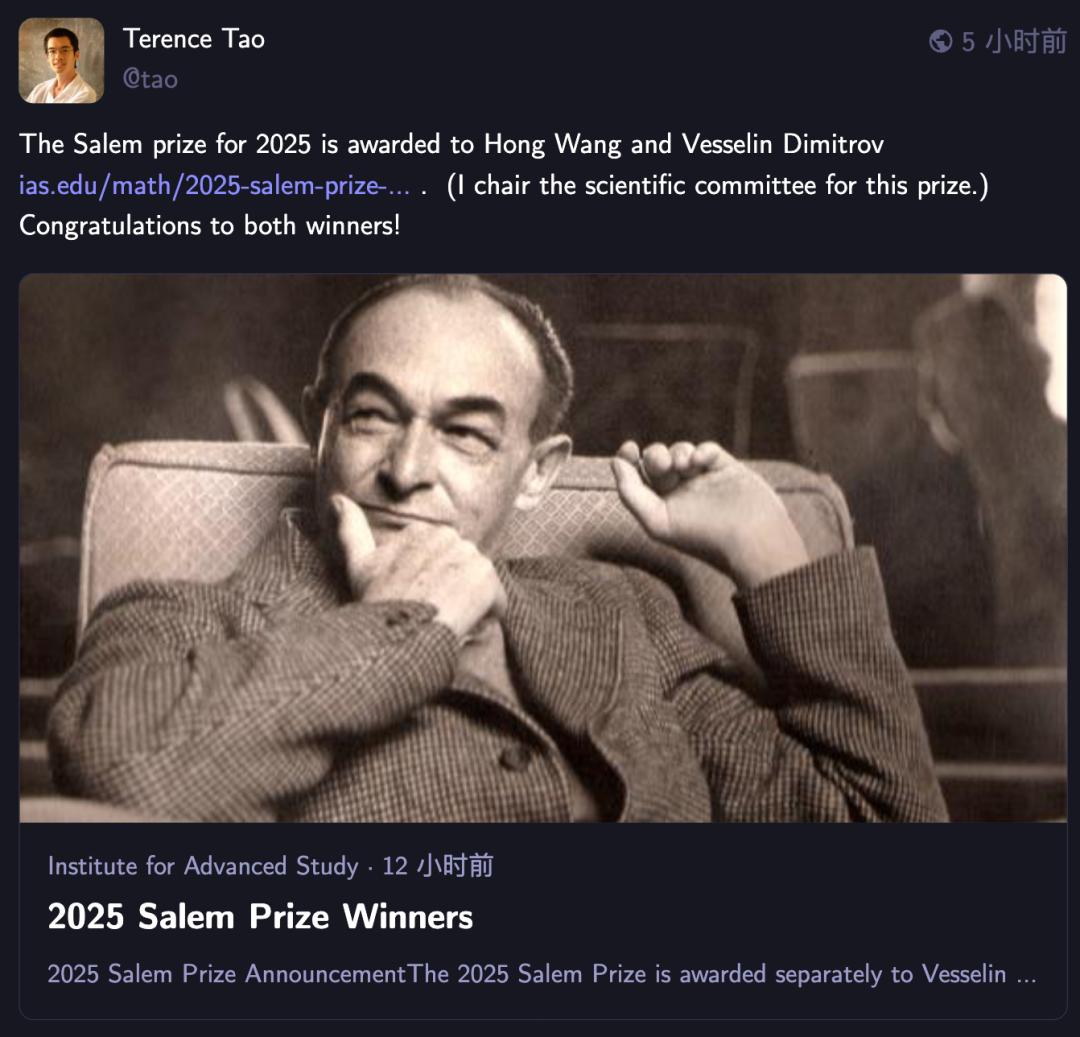
Core Points - Chinese mathematician Wang Hong has recently won two prestigious mathematics awards: the 2025 Salem Prize and the ICCM Mathematics Prize [1][3] - The Salem Prize is awarded for significant contributions in Fourier analysis and related fields, typically to mathematicians under 40 years old [9][12] - Wang Hong's achievements in harmonic analysis and geometric measure theory have positioned her as a leading candidate for the Fields Medal, often regarded as the "Nobel Prize of Mathematics" [7][14] Group 1 - Wang Hong received the 2025 Salem Prize for her outstanding contributions to unresolved problems in harmonic analysis and geometric measure theory [1] - The ICCM Mathematics Prize, which Wang also won, is considered the "Fields Medal" of the Chinese mathematics community [3] - The likelihood of winning the Fields Medal is notably high for those who have previously won the Salem Prize, with ten past recipients achieving this honor [12] Group 2 - Wang Hong's recent research breakthroughs include solving the three-dimensional Kakeya conjecture, a significant problem in the field [31][34] - Her academic journey includes degrees from prestigious institutions such as École Polytechnique and MIT, culminating in a postdoctoral position at the Institute for Advanced Study [22][24] - Wang's work has been published in top mathematics journals, further solidifying her reputation in the mathematical community [31]
两大数学奖项同时颁给王虹!北大三校友包揽“华人菲尔兹”
量子位· 2025-10-28 05:12
Core Viewpoint - The article highlights the significant achievements of mathematician Wang Hong, who received two prestigious awards: the 2025 Salem Prize and the ICCM Mathematics Award, marking a remarkable year for Chinese mathematicians [2][5][56]. Group 1: Awards and Recognition - Wang Hong was awarded the 2025 Salem Prize for her contributions to solving major open problems in harmonic analysis and geometric measure theory [17][29]. - The ICCM Mathematics Award was also given to Wang Hong, along with fellow Peking University alumni Deng Yu and Yuan Xinyi, recognizing their exceptional work in mathematics [5][30]. - The Salem Prize is considered a precursor to the Fields Medal, with a notable history of past winners going on to receive the Fields Medal [2]. Group 2: Wang Hong's Academic Journey - Wang Hong transitioned from studying Earth and Space Sciences at Peking University to pursuing mathematics, showcasing her passion for the field [10]. - She graduated from Peking University in 2011, furthered her studies at École Polytechnique and Paris 11 University, and completed her PhD at MIT in 2019 under renowned mathematician Larry Guth [11][13]. - Wang is currently an assistant professor at UCLA and a tenured professor at the Institut des Hautes Études Scientifiques (IHES), where she is the first female tenured professor in its history [15]. Group 3: Contributions to Mathematics - Wang Hong made significant advancements in several century-old mathematical problems, including the Kakeya set conjecture, which she proved in collaboration with Professor Joshua Zahl [20][28]. - She has also contributed to the Fourier restriction conjecture and the Falconer distance set conjecture, publishing two papers in top mathematical journals this year alone [23]. - Her groundbreaking work has positioned her as a leading candidate for the Fields Medal, especially following her recent accolades [29]. Group 4: Fellow Awardees - Deng Yu, another ICCM awardee, is a professor at the University of Chicago and has received numerous accolades, including the Putnam Fellow award and the IMO gold medal [32]. - Yuan Xinyi, also an ICCM awardee, is known for his work in Arakelov geometry and algebraic dynamics, having made significant contributions to various mathematical fields [45]. - All three awardees share a common background as alumni of Peking University's mathematics department, highlighting the institution's role in nurturing top mathematical talent [55].

北大校友王虹,将任法国高等研究所常任教授!2/3前辈为菲尔兹奖得主
量子位· 2025-05-28 05:59
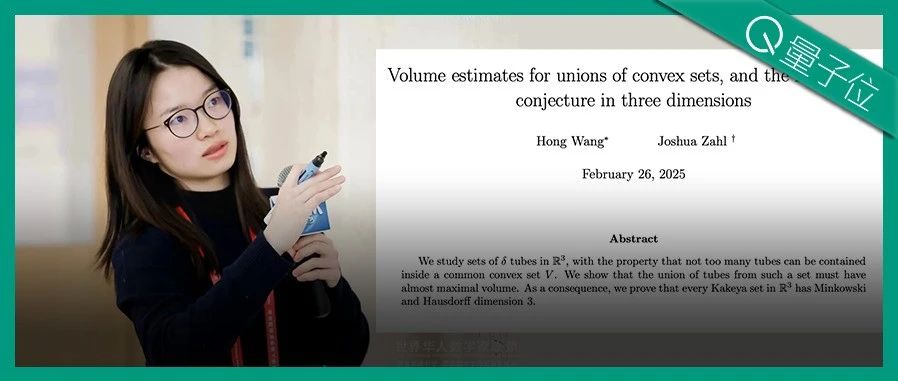
Core Viewpoint - The article highlights the recent appointment of Chinese mathematician Wang Hong, known for solving the Kakeya conjecture, as a permanent professor at the Institut des Hautes Études Scientifiques (IHES) in France, marking a significant achievement in her career and the mathematics community [1][2][10]. Group 1: Appointment Details - Wang Hong will officially join IHES on September 1, 2025, and will also hold a position as a mathematics professor at New York University's Courant Institute of Mathematical Sciences [6]. - IHES currently has only seven permanent professors, with five being prominent mathematicians, including two Fields Medal winners [3][4]. Group 2: Academic Background - Wang Hong was born in 1991 in Guilin, Guangxi, and demonstrated exceptional academic ability from a young age, entering Peking University at 16 [15]. - She obtained her bachelor's degree in mathematics in 2011, followed by an engineering degree from École Polytechnique and a master's degree from Paris XI University in 2014, and completed her PhD at MIT in 2019 [16]. Group 3: Research Contributions - Wang Hong, along with UBC mathematics associate professor Joshua Zahl, solved the Kakeya conjecture, a long-standing problem in mathematics that has implications across various fields such as harmonic analysis and number theory [10][12]. - The Kakeya conjecture in three dimensions asserts that a set containing unit-length line segments in every direction must have Minkowski and Hausdorff dimensions equal to three [11]. Group 4: Community Reception - The announcement of Wang Hong's appointment was met with enthusiasm in the mathematics community, with notable figures expressing their support and anticipation for her contributions [7][9]. - Many believe her recent achievement could position her as a strong candidate for the Fields Medal [14].

90后北大校友破解挂谷猜想,陶哲轩激动转发!网友:预定菲尔兹奖
量子位· 2025-02-28 05:19
Core Viewpoint - The article discusses the recent proof of the Kakeya conjecture in three-dimensional space by Chinese mathematician Wang Hong and Columbia University professor Joshua Zahl, which has generated significant interest and could position Wang as a strong candidate for the Fields Medal in 2026 [1][5][6]. Group 1: Kakeya Conjecture Overview - The Kakeya conjecture, proposed by Japanese mathematician Sōichi Kakeya in 1917, involves determining the minimum area that a needle can sweep when rotated in a confined space [8][9]. - The conjecture states that a Kakeya set in three-dimensional space must have both Minkowski and Hausdorff dimensions equal to three, indicating that these sets geometrically fill the space despite appearing sparse [10][11][12]. Group 2: Proof Details - Wang Hong and Joshua Zahl published a 127-page paper proving the three-dimensional Kakeya conjecture, employing complex strategies including non-concentration conditions and multi-scale analysis [3][20]. - Their proof involves defining a situation K(d) and demonstrating a relationship that allows for the induction of dimension parameters towards three [21][23]. - The authors utilized multi-scale analysis to study the organization of pipe-like structures, leading to insights about the density and overlap of these structures [24][25][28]. Group 3: Background on Wang Hong - Wang Hong, born in 1991, is a notable mathematician who could become the first Chinese woman to win the Fields Medal if awarded [7][34]. - She has an impressive academic background, having studied at prestigious institutions and focusing on Fourier transform-related problems [36][38].