虚拟制造

Search documents
求是芯缘•十载同行:求是缘半导体联盟十周年峰会圆满落幕
半导体行业观察· 2025-11-20 10:07
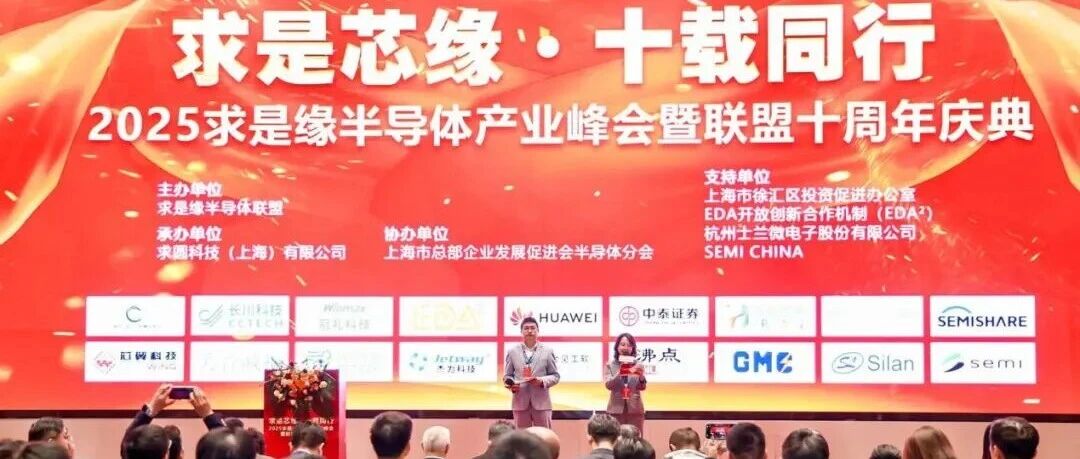
Core Insights - The summit "Qiusiyuan Semiconductor Alliance 2025 Industry Summit and 10th Anniversary Celebration" was held in Shanghai, gathering 562 attendees to discuss key topics in the semiconductor industry, including supply chain, AI-driven material innovation, and green manufacturing [1][3]. Group 1: Alliance Development and Achievements - The Qiusiyuan Semiconductor Alliance has grown from 175 individual members and 16 organizational members in 2015 to over 2,250 individual members and more than 420 organizational members by 2025, evolving into a comprehensive ecosystem platform for the semiconductor industry [3][9]. - The alliance has hosted over 50 high-quality events annually, with total participation exceeding 3,000 attendees, providing continuous technical exchanges and industry resource connections [9][10]. - The first phase of the alliance's fund invested in 9 projects, with one project achieving a 9-fold return, while the second phase is currently progressing steadily [9][10]. Group 2: Government and Industry Support - The Deputy District Mayor of Xuhui District highlighted the area's deep roots in integrated circuits, with over 1,500 AI companies and a total output scale reaching billions, aiming to accelerate the growth of the semiconductor and AI industries [5]. - The Shanghai Integrated Circuit Industry Association emphasized the alliance's role in breaking down industry and regional barriers, fostering collaboration across the entire semiconductor value chain [7]. Group 3: Future Directions and Strategic Focus - The alliance's six key development focuses for 2026 include enhancing team building, expanding membership, improving event quality, promoting the second phase of the fund, deepening external cooperation, and expanding regional liaison points [10]. - The alliance aims to adapt its governance structure to better respond to industry changes, enhancing its decision-making and management capabilities [12]. Group 4: Technological Innovations and Challenges - Wu Hanying, an academician, discussed the challenges in the integrated circuit industry, proposing a "cost reduction + virtualization" approach to address the disconnect between design and manufacturing [16][19]. - The need for innovation in materials and architectures was emphasized, particularly in the context of AI's explosive demand for computing power, which is expected to double every two months [21][22]. Group 5: Roundtable Discussions and Industry Insights - The roundtable forum highlighted the necessity for multi-dimensional collaboration in technology, materials, packaging, and algorithms to drive innovation in the semiconductor industry [37]. - Participants discussed the dual challenges in talent cultivation, emphasizing the need for interdisciplinary education that integrates semiconductor and AI knowledge [38]. Group 6: Sustainability and ESG Initiatives - The summit included discussions on ESG practices, with representatives sharing insights on sustainable water management and the latest trends in ESG disclosure standards in the semiconductor industry [49]. Conclusion - The summit showcased the Qiusiyuan Semiconductor Alliance's achievements over the past decade and emphasized the importance of innovation, collaboration, and sustainability in driving the future of the semiconductor industry [50].

芯片制造,将被改写
半导体行业观察· 2025-08-25 01:46
Core Viewpoint - The article emphasizes the critical role of hybrid bonding technology in advancing semiconductor manufacturing, particularly as it moves towards sub-micron dimensions, highlighting the challenges and necessary innovations in process control and design integration [2][3][26]. Group 1: Current State of Hybrid Bonding - Hybrid bonding has been in production for years, achieving stable yields with 10µm interconnects, but as the process scales down to 5µm, the tolerances become extremely tight, requiring precise control of surface morphology and alignment [2][3]. - Most manufacturers currently operate within the 8 to 6µm range, with new bonding and measurement equipment pushing defect rates closer to the sub-micron thresholds needed for next-generation applications [3][5]. Group 2: Challenges in Sub-Micron Bonding - As bonding distances shrink below 1µm, surface treatment and alignment become equally critical, with even minor defects potentially leading to significant yield loss [5][6]. - Defect control extends beyond microscopic features; macro defects like edge chipping and residue can critically impact yield, necessitating rigorous inspection of the entire wafer [6][7]. Group 3: Process Control and Measurement - The complexity of managing variables in sub-micron bonding requires a fundamental restructuring of design, measurement, and process control interactions [2][5]. - Real-time monitoring and feedback control systems are essential to maintain alignment and process parameters, as even slight deviations can lead to yield loss [15][16]. Group 4: Integration of Design and Manufacturing - The separation between design and manufacturing becomes a burden as hybrid bonding technology advances, necessitating early consideration of bonding process parameters in design [23][24]. - Assembly Design Kits (ADK) bridge the gap by translating manufacturing constraints into actionable design rules, ensuring that designs are manufacturable and yield-friendly [23][24]. Group 5: Future Directions and Economic Viability - The success of sub-micron hybrid bonding hinges on the integration of design, process, and supply chain ecosystems, with a focus on achieving predictable economic benefits [26][27]. - The industry must address interoperability issues among equipment from different suppliers and the challenges posed by heterogeneous stacking to realize the full potential of hybrid bonding technology [26][27].