
虚拟货币挖矿

Search documents
金融啄木鸟小讲堂|关于进一步防范和处置虚拟货币等相关风险的通知
Sou Hu Cai Jing· 2026-02-11 12:03
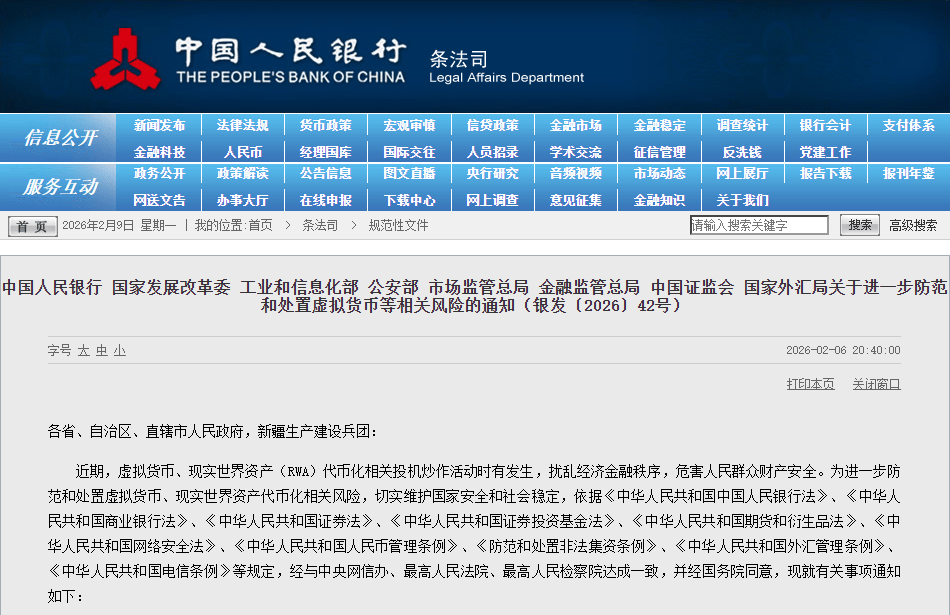
Core Viewpoint - The recent notice issued by the People's Bank of China and other regulatory bodies aims to prevent and address risks associated with virtual currencies and the tokenization of real-world assets, emphasizing that these activities disrupt economic order and threaten public financial security [3][4][5]. Group 1: Nature of Virtual Currencies and Tokenization - Virtual currencies do not have the same legal status as fiat currencies and should not be circulated as money in the market [3][4]. - Activities related to virtual currencies and the tokenization of real-world assets are classified as illegal financial activities, including exchanges between fiat and virtual currencies, and the issuance of tokens without approval [4][5]. Group 2: Regulatory Framework and Coordination - A collaborative mechanism among various government departments, including the People's Bank of China, is established to oversee and manage risks associated with virtual currencies and tokenization [6][13]. - Local governments are responsible for risk prevention and management within their jurisdictions, working in coordination with financial regulatory bodies and law enforcement [6][13]. Group 3: Risk Monitoring and Management - Financial institutions are prohibited from providing services related to virtual currencies, including account opening and transaction facilitation [7][8]. - Internet companies are not allowed to support virtual currency activities through marketing or operational services, and must report any illegal activities [8][9]. Group 4: Enforcement and Legal Responsibility - Strict penalties will be imposed on entities engaging in illegal financial activities related to virtual currencies and tokenization, with criminal charges applicable for severe violations [14]. - Individuals and organizations that assist foreign entities in providing virtual currency services within China will also face legal consequences [14].

虚拟货币相关业务,境内一律禁止!
Sou Hu Cai Jing· 2026-02-09 09:25
Core Viewpoint - The recent notice issued by eight Chinese regulatory bodies emphasizes that all virtual currency-related activities are illegal financial activities within China, reinforcing a strict prohibition on such operations [1][3]. Group 1: Virtual Currency Regulations - Virtual currencies do not have the same legal status as fiat currencies and cannot be used for market circulation [1]. - All activities related to virtual currencies, including exchanges between fiat and virtual currencies, trading services, and token issuance, are strictly prohibited [1][3]. - The notice specifies that any issuance of virtual currencies by domestic entities or their controlled foreign entities without approval is illegal [3]. Group 2: Real World Asset (RWA) Tokenization - The concept of RWA tokenization is defined as converting ownership and income rights of assets into tokens using encryption and distributed ledger technology [3][5]. - Activities related to RWA tokenization, including providing intermediary and technical services, are considered illegal financial activities unless approved by regulatory authorities [5]. - The notice warns against the speculative nature of RWA tokenization, highlighting risks associated with low-threshold investments [3]. Group 3: Mining Activities - The notice mandates strict control over virtual currency mining activities, including the closure of existing projects and prohibition of new ones [5]. - Companies involved in the production and sale of mining machines are also prohibited from providing services within China [5].

八部门重申虚拟货币非法
21世纪经济报道· 2026-02-07 02:43
Core Viewpoint - The recent notice issued by the People's Bank of China and eight other departments emphasizes that virtual currency and the tokenization of real-world assets (RWA) are illegal financial activities, aiming to prevent risks and maintain social stability [1][2][8]. Group 1: Virtual Currency Regulations - Virtual currencies do not have the same legal status as fiat currencies and should not be circulated as money in the market [1][2]. - The notice prohibits any domestic entity or individual from issuing stablecoins linked to the RMB without approval from relevant authorities [1][8]. - Financial institutions are barred from providing services related to virtual currencies, including account opening, fund transfers, and the issuance of related financial products [5][8]. Group 2: RWA Tokenization Regulations - The notice defines RWA tokenization as the conversion of ownership and income rights of assets into tokens using encryption and distributed ledger technology [4]. - Engaging in RWA tokenization activities within the country is considered illegal financial activity, including providing intermediary and technical services [4][5]. - Any foreign entity or individual is prohibited from providing RWA tokenization services to domestic subjects [4][5]. Group 3: Enforcement and Compliance - The notice emphasizes a high-pressure regulatory stance against illegal activities related to virtual currencies and RWA, with a focus on cross-departmental collaboration [5][9]. - Market supervision departments are tasked with managing the registration of business entities, ensuring that names and business scopes do not include terms related to virtual currencies or RWA [6]. - Violations of the notice will result in penalties, and criminal liability may be pursued for serious offenses [9].
央行等八部门发文:虚拟货币属非法,从严监管,整治“挖矿”
Sou Hu Cai Jing· 2026-02-06 23:56
Core Viewpoint - The recent notification from multiple Chinese regulatory bodies reiterates the illegality of virtual currency activities, emphasizing the need for strict regulation and enforcement against virtual currencies and related activities [2][3][4] Group 1: Regulatory Actions - The notification reaffirms that virtual currencies do not have legal tender status and their related activities are considered illegal financial activities [2] - It establishes a regulatory framework for the tokenization of real-world assets, stating that such activities are prohibited domestically and strictly regulated abroad [3] - The notification emphasizes the prohibition of virtual currency mining activities, with strict controls mandated by the National Development and Reform Commission [3] Group 2: Enforcement and Monitoring - There is a call for enhanced inter-departmental collaboration and coordination to improve risk monitoring and prevention measures against illegal activities related to virtual currencies [4] - The notification highlights the rise of illegal fundraising and fraud activities associated with virtual currencies, stressing the need for ongoing enforcement against such crimes [3][4]

八部门发文 进一步防范处置虚拟货币等相关风险
Zhong Guo Zheng Quan Bao· 2026-02-06 23:21
Core Viewpoint - The People's Bank of China and other regulatory bodies have issued a notification aimed at further preventing and addressing risks associated with virtual currencies and Real World Assets (RWA) tokenization, highlighting the rise of illegal activities in these markets since last year [1][2]. Regulatory Stance - The central bank and the China Securities Regulatory Commission (CSRC) maintain a prohibitive policy stance on virtual currency-related activities, reiterating that virtual currencies do not hold the same legal status as fiat currencies and that any related business activities within the country are illegal [2][4]. - The notification emphasizes that stablecoins pegged to fiat currencies are also subject to regulation, and any issuance of stablecoins linked to the Renminbi (RMB) without approval is prohibited [2][3]. RWA Tokenization - The notification defines RWA tokenization as the process of converting ownership and income rights of assets into tokens using cryptographic and distributed ledger technologies [3]. - Activities related to RWA tokenization within the country are deemed illegal unless approved by relevant authorities, and foreign entities are prohibited from providing related services to domestic subjects [3][4]. Cross-Border Regulations - Strict regulations are imposed on domestic entities engaging in RWA tokenization activities abroad, with oversight from various regulatory bodies to ensure compliance with domestic laws [4][5]. - Financial institutions' overseas subsidiaries must adhere to compliance and risk management frameworks established by their domestic counterparts when providing RWA tokenization services [5][6]. Risk Monitoring and Management - Financial institutions are prohibited from facilitating virtual currency-related activities, including account opening and fund transfers, and must report any illegal activities [6][7]. - Continuous efforts are being made to regulate and eliminate virtual currency mining activities, with local governments responsible for identifying and shutting down existing operations [6][7].
关于进一步防范和处置虚拟货币等相关风险的通知
Sou Hu Cai Jing· 2026-02-06 14:34
Core Viewpoint - The People's Bank of China and other regulatory bodies have issued a notification to further prevent and address risks associated with virtual currencies and the tokenization of real-world assets, emphasizing the need to maintain economic and financial order and protect public property safety [1][2]. Group 1: Nature of Virtual Currencies and Tokenization - Virtual currencies do not have the same legal status as fiat currencies and should not be circulated as money in the market [1]. - Activities related to virtual currencies, such as exchanges and token issuance, are classified as illegal financial activities and are strictly prohibited [2][3]. Group 2: Regulatory Mechanisms - A collaborative mechanism among various departments, including the People's Bank of China and the China Securities Regulatory Commission, will be established to coordinate efforts in preventing and addressing risks related to virtual currencies and tokenization [4]. - Local governments are responsible for managing risks associated with virtual currencies and tokenization within their jurisdictions, with financial management departments leading the efforts [4]. Group 3: Risk Monitoring and Management - Financial institutions are prohibited from providing services related to virtual currencies, including account opening and transaction facilitation [5]. - Internet companies are not allowed to provide platforms for virtual currency activities and must report any illegal activities to relevant authorities [5]. Group 4: Enforcement and Legal Responsibility - Strict penalties will be imposed on entities engaging in illegal financial activities related to virtual currencies and tokenization, with criminal charges applicable for serious violations [11]. - Any investment in virtual currencies or related financial products that contravenes public order will be deemed invalid, and losses incurred will be the responsibility of the investor [11].
人民银行等八部门:全面梳理排查并关停存量虚拟货币“挖矿”项目
Bei Jing Shang Bao· 2026-02-06 13:35
Group 1 - The People's Bank of China and seven other departments issued a notice to further prevent and address risks related to virtual currencies and tokenization of real-world assets [1][2] - Financial institutions, including non-bank payment institutions, are prohibited from providing services related to virtual currency activities, including account opening, fund transfers, and settlement [1] - Internet companies are not allowed to provide online operating venues, marketing, or payment services for virtual currency and tokenization activities, and must report any illegal activities [2] Group 2 - The National Development and Reform Commission is strictly controlling virtual currency mining activities and is responsible for shutting down existing mining projects [3] - Provincial governments are tasked with overseeing the rectification of mining activities within their jurisdictions, following national guidelines [3] - New mining projects are banned, and companies producing mining machines are prohibited from offering sales or related services domestically [3]
七家协会联合警示涉虚拟货币等非法活动风险
Guo Ji Jin Rong Bao· 2025-12-05 16:05
Core Viewpoint - The rapid rise of virtual currency concepts has led to illegal activities such as fraud and illegal fundraising, prompting regulatory bodies in China to issue warnings and guidelines to prevent risks associated with virtual currencies and related activities [1][2][3][4] Group 1: Regulatory Actions - Chinese regulatory authorities, including the People's Bank of China and the China Securities Regulatory Commission, have issued announcements to prevent risks related to token issuance and virtual currency trading [1][2] - Seven financial associations in China have reiterated that their members must not participate in the issuance or trading of virtual currencies or reality world asset tokens within the country [3] Group 2: Risks Associated with Virtual Currencies - Virtual currencies are not issued by monetary authorities and do not have the same legal status as fiat currencies, making them unsuitable for circulation in China [1] - Stablecoins currently fail to meet customer identification and anti-money laundering requirements, posing risks of being used for illegal activities such as money laundering and fundraising fraud [2] - The tokenization of real-world assets carries multiple risks, including false asset risks and speculative trading risks, and no such activities have been approved by Chinese financial authorities [2] Group 3: Public Warnings - The public is urged to be vigilant against various forms of virtual currency and real-world asset token activities, which are often associated with speculation and fraud [4] - Individuals are advised to avoid participating in virtual currency and real-world asset token activities, as well as illegal fundraising and securities issuance disguised as "mining" [4] - The public should report any suspicious activities related to virtual currencies and real-world asset tokens to regulatory authorities and law enforcement [4]