蛋鸡养殖盈利

Search documents
2025年蛋鸡养殖行业利润跌至近五年最低水平,预计2026年或将有所回暖
Zhong Guo Jin Rong Xin Xi Wang· 2025-11-25 01:59
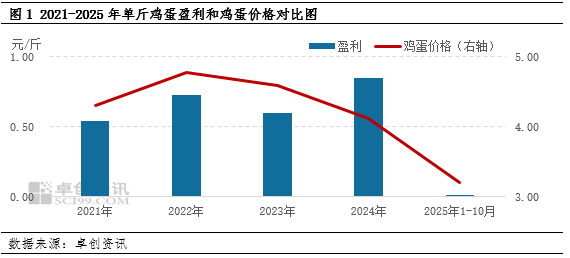
Core Viewpoint - The domestic egg-laying chicken farming industry faced unprecedented challenges in 2025, with a significant drop in profitability due to falling egg prices, despite a slight decrease in production costs. The outlook for 2026 suggests a potential recovery in profitability driven by a rise in egg prices and a decrease in supply [1][9]. Summary by Sections Profitability and Market Conditions - The egg-laying chicken farming industry was in a profitable cycle from 2021 to 2024, with average profits exceeding 0.50 yuan per pound. However, in 2025, profitability sharply declined, with average profits per pound dropping over 90% year-on-year from January to October, marking the lowest average profit level in five years [1][9]. - The decline in egg prices was the primary factor affecting profitability, despite production costs remaining low [1]. Demand and Supply Dynamics - Seasonal demand for eggs weakened, limiting the potential for demand growth. Direct consumption slightly increased, but overall demand was constrained by low prices of pork, broiler chickens, and vegetables, which reduced market acceptance of high-priced eggs. Additionally, food processing companies reduced order volumes, leading to a limited increase in egg demand [3]. - The average daily shipment of eggs from production areas increased slightly by 1.15% year-on-year from January to October 2025, but overall supply remained ample while demand support was weak, resulting in egg prices dropping over 20% year-on-year [3]. Production and Cost Factors - The high profitability in 2023-2024 led to increased enthusiasm for breeding, with total chick sales continuing to rise in 2024-2025. The average number of laying hens in production reached a five-year high, with a year-on-year increase of over 5% [4]. - Although feed costs slightly decreased due to lower prices for corn and soybean meal, this reduction was insufficient to offset the significant drop in income, leading to a continued decline in overall profitability [6]. Future Outlook for 2026 - The egg-laying chicken farming industry is expected to see a recovery in profitability in 2026, driven by a decrease in supply and a potential increase in egg prices due to traditional holiday demand and a recovery in restaurant consumption [8]. - The supply of laying hens is projected to decrease, which may alleviate some supply pressure. Egg prices are expected to rise by over 2% year-on-year, while feed costs may continue to decline by 1-2% [8][9]. - Overall, average profitability for egg-laying chicken farming is anticipated to improve by 0.10-0.20 yuan per pound in 2026, although the recovery process will still be influenced by factors such as culling rates and external market fluctuations [9].

“蛋”说无妨:需求旺季助推9月扭亏,10月后市承压
Xin Lang Cai Jing· 2025-09-29 02:20
Core Viewpoint - In September, the demand for eggs increased across the country, alleviating supply pressure and leading to a rise in egg prices, although still lower than the same period last year. Feed costs remained stable, allowing egg production to turn profitable. In October, egg prices are expected to stabilize initially before declining, with a potential reduction in profit margins for producers [1][8]. Group 1: Egg Market Dynamics - The national average price of eggs reached 3.49 yuan per jin by September 25, reflecting a month-on-month increase of 14.05% [1][3]. - The average cost of feed for eggs was 3.03 yuan per jin, showing a slight decrease of 0.33% month-on-month [1][3]. - The total number of laying hens increased to 1.365 billion by the end of August, marking a year-on-year growth of 6.06%, the highest level since 2021 [3]. Group 2: Supply and Demand Factors - The demand for eggs improved significantly due to seasonal factors, including increased purchases by schools and food companies ahead of the Mid-Autumn Festival [3][8]. - Despite the increase in demand, there remains some supply pressure, particularly from cold storage eggs entering the market [3][8]. - The egg production rate is expected to stabilize as temperatures drop, contributing to higher egg output [3]. Group 3: Feed Cost Trends - The price of soybean meal decreased by 3.92% compared to the beginning of the month, which slightly reduced feed costs [5][7]. - The average feed cost for eggs was reported at 3.01 yuan per jin, a minor decrease of 0.66% from the start of the month [5][7]. - Corn prices remained stable, with no significant changes observed in supply and demand dynamics [5]. Group 4: Future Outlook - In October, egg prices are anticipated to stabilize initially before experiencing a decline, with potential prices dropping to between 3.00 and 3.20 yuan per jin [8][9]. - The profit margin for egg producers is expected to shrink as feed costs may decrease at a slower rate than egg prices [9].

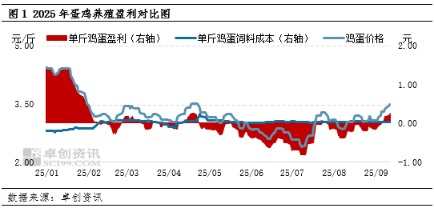
9月蛋鸡养殖扭亏为盈 养殖盈利局面是否昙花一现?
Xin Hua Cai Jing· 2025-09-17 07:01
Core Viewpoint - The domestic egg-laying chicken farming industry has transitioned from a loss to profitability in September due to rising egg prices and a slight decrease in costs, but the sustainability of this profitability is uncertain as seasonal demand may weaken towards the end of September and into October [1][3][9] Summary by Sections Profitability Trends - From May to August, the egg-laying chicken farming sector experienced losses, with only a brief period of profitability in late July 2025. However, by early September, profitability was achieved, with an average profit of 0.26 yuan per kilogram of eggs, reversing a loss of 0.13 yuan per kilogram [3][9] - The average profit in September has increased by 0.25 yuan compared to August, marking a significant turnaround from the previous four months of losses [3] Supply and Demand Dynamics - Demand for eggs has increased due to the start of the school year and the upcoming holidays, leading to a notable rise in egg prices, which increased by nearly 13% compared to the average in August [4][9] - Despite high egg supply levels, the demand boost has allowed for profitability in egg-laying operations [3][4] Cost Factors - The cost of feed, a major factor affecting profitability, has slightly decreased, with the average feed cost dropping by 0.01 yuan per kilogram compared to August [6][9] - While corn prices have seen a slight increase, soybean meal prices remain low, contributing to the overall reduction in feed costs [6] Future Outlook - The outlook for the egg-laying industry suggests that while demand may initially support prices, a decline in demand post-holidays could lead to price drops and potential profitability challenges [8][9] - It is anticipated that the average profit margin may compress to between 0.10 and 0.20 yuan per kilogram if demand weakens significantly, with the possibility of returning to losses if conditions do not improve [9]