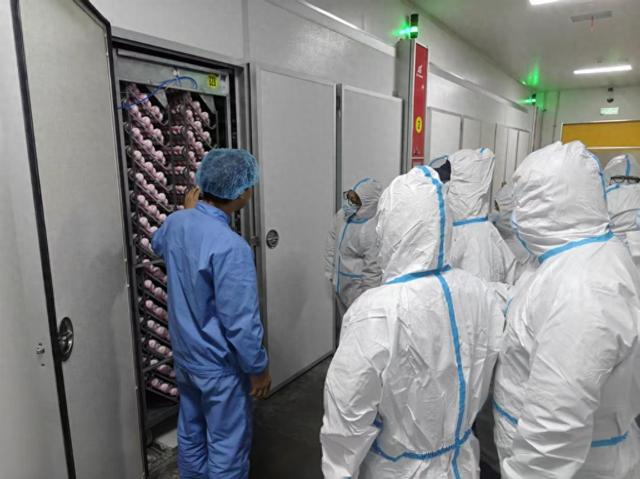
蛋鸡养殖

Search documents
晓鸣股份20260326
2026-03-26 13:20
Summary of the Conference Call for Xiaoming Co., Ltd. Industry Overview - The egg-laying chicken industry in 2025 is characterized by overproduction due to excessive replenishment in the first half of the year, with over 600 million chickens added, leading to a supply surplus that is expected to last until July-August 2026 [2][3][4]. - The second half of 2026 is anticipated to shift towards a tight balance in supply and demand, primarily due to insufficient replenishment in the latter half of 2025 and the first half of 2026, alongside expectations of a rebound in pork prices [2][5]. - The average laying hen stock in 2025 remained high, exceeding 1.3 billion, indicating a significant overcapacity [3][4]. Key Points on Xiaoming Co., Ltd. - Xiaoming Co., Ltd. aims for a chick sales target of 350 million in 2026, capturing a 30% market share, with orders extending to late May 2026 [2][9]. - The company’s core growth driver is the young chicken business, targeting sales of 10 million in 2026, doubling from the previous year, with plans to reach 50 million in 3-4 years [2][14]. - The company has implemented a strategy to convert low-cost chicks into branded eggs when chick prices fall below production costs, allowing for a price premium of 20%-30% [2][16]. - Digitalization and ESG initiatives are accelerating, with plans to establish a "Future Farm" by July 2026, incorporating AI and robotics for farm management [2][6]. Financial Performance and Market Dynamics - The average cost per chick is expected to stabilize around 3.2 yuan, with the company managing to keep costs in check despite rising feed prices [2][10][21]. - The company experienced a loss in January and February 2026 but anticipates profitability starting in March, with orders already booked through May [9][10]. - The young chicken business has shown resilience, with prices recovering in March 2026 after a slight loss in the previous months [13][14]. Market Trends and Consumer Behavior - The egg market is expected to see two small peaks in 2026, with prices fluctuating around the cost line in the first half and potentially rising in the second half due to reduced supply and increased demand for high-quality and branded eggs [5][8]. - There is a growing trend towards quality and brand differentiation in egg consumption, with a shift from traditional markets to supermarkets [5][18]. - The non-caged egg segment is anticipated to grow, although current supply is significantly below demand, indicating a potential market opportunity [18][19]. Strategic Initiatives and Future Outlook - The company plans to expand its "concentrated breeding, decentralized hatching" model, which has proven effective in ensuring biosecurity and operational efficiency [16][17]. - Future growth in the non-caged egg market will depend on legislative progress, increased food safety recognition, and transparency in procurement information [19]. - Xiaoming Co., Ltd. is exploring overseas investment opportunities, with potential developments expected in 2026 [20]. Conclusion - Xiaoming Co., Ltd. is positioned to navigate the challenges of the egg-laying chicken industry through strategic growth in young chicken sales, digital transformation, and a focus on high-quality products. The company is also preparing for potential international expansion while managing costs effectively amidst rising feed prices.
晓鸣股份20260204
2026-02-05 02:21
Summary of Xiaoming Co. Conference Call Company Overview - **Company**: Xiaoming Co. - **Industry**: Egg production and poultry farming Key Points and Arguments Financial Performance - In December 2023, Xiaoming Co. experienced a profit reduction of over 43 million yuan due to delayed expense reversals and year-end bonus provisions, leading to a monthly loss of approximately 20 million yuan in Q4 [2][3] - The net profit attributable to shareholders for 2025 is projected to be between 71 million and 92 million yuan, slightly below expectations due to inventory impairment provisions and bonus accruals [3] Industry Dynamics - The egg industry faced nearly nine months of losses in 2025, a historical first, with significant inventory pressure and no improvement even during peak seasons [2][4] - The egg price is expected to fluctuate around the cost line in the first half of 2026, with a potential peak price of 7.8 yuan/kg in Q3 2026 [2][10] Market Share and Sales - Xiaoming Co. achieved a market share of 26% in the egg market in 2025, with total sales of approximately 274 million eggs, an increase of 3 percentage points from the previous year [2][9] - Despite price declines due to competitors, the company maintains some pricing power due to its high market share [2][9] Production and Capacity - The company plans to introduce high-yield parent stock in Q2 2027, with current production capacity at approximately 27.5 million chicks per month, aiming for 280-300 million chicks by 2026 [18] - Orders for March and April 2026 are fully booked, with stable pricing above 3.4 yuan per chick [6][13] Future Strategies - Xiaoming Co. is focusing on optimizing production and sales strategies, including entering overseas markets with a focus on countries with populations over 100 million and lower egg consumption [20][21] - The company plans to invest approximately 150 million yuan domestically and is exploring opportunities in Africa and Southeast Asia [20][25] Risks and Challenges - The ongoing avian influenza pandemic poses significant risks to the industry, affecting the supply of quality breeding stock and leading to tighter supply conditions [15][16] - The company is cautious about the current market dynamics, emphasizing the need to monitor futures investment risks due to temporary supply-demand imbalances [5][10] Growth Opportunities - Future growth in the egg market is expected to come from increased household and outdoor consumption, particularly in pre-prepared meals and central kitchen sectors [14] - The anticipated rise in egg prices in 2026 is expected to positively impact upstream prices, leading to significant growth in Xiaoming Co.'s performance [28] Conclusion - Xiaoming Co. is navigating a challenging market environment with strategic plans for growth and adaptation, focusing on both domestic and international opportunities while managing risks associated with supply chain disruptions and market fluctuations.
中粮期货赣州市蛋鸡饲料价格险项目收官
Zheng Quan Ri Bao Wang· 2026-02-03 09:41
Core Insights - The project by COFCO Futures in Ganzhou, Jiangxi Province, marks a shift from the traditional "insurance + futures" model focused on agricultural product prices to risk management at the upstream raw material level for poultry feed [1][2] - The initiative aims to provide price protection for corn and soybean meal, which are critical raw materials in poultry farming, addressing the significant cost burden that constitutes 60%-70% of total feed costs [1] Summary by Sections Project Overview - COFCO Futures has implemented a risk management scheme tailored for a leading poultry farming enterprise in Ganzhou, focusing on corn and soybean meal price guarantees [1] - The project was initiated when egg prices were around 3100 yuan/ton, with the poultry industry facing losses and limited capacity reduction, while soybean meal and corn prices were at historical lows [1] Risk Management Mechanism - The project utilizes a "buying in-the-money enhanced Asian call options" strategy to hedge against raw material price increases, ensuring that the enterprise can receive compensation and lock in production costs during price hikes [2] - This innovative approach extends the "insurance + futures" model from the end product to the raw material side, enhancing the risk transfer capabilities of futures derivatives [2] Collaborative Framework - A closed-loop service system has been established, integrating government guidance, enterprise participation, and financial empowerment, benefiting all parties involved [2] - The initiative not only mitigates cost increase risks for poultry enterprises but also boosts the production enthusiasm of farmers, supporting the stable and scalable development of the poultry industry in the Ganzhou region [2] Future Outlook - COFCO Futures aims to deepen financial service innovations and expand the coverage and depth of the "insurance + futures" model, reinforcing the risk management framework for agricultural stakeholders [2]
贵州赫章每日100万枚鸡蛋畅销大湾区
Zhong Guo Xin Wen Wang· 2026-01-30 08:52
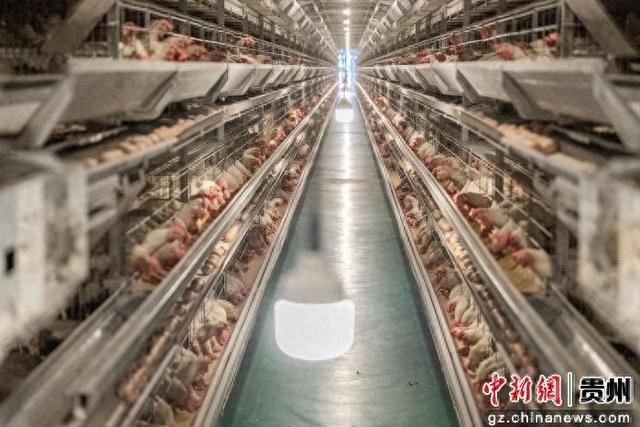
Core Insights - The egg-laying chicken farming industry in Hezhang County, Guizhou, has seen significant growth, with a stock of 4.0963 million chickens and an annual production of approximately 1.3 billion eggs, accounting for one-quarter of Guizhou's total output [1] - The collaboration between Panyu and Hezhang has enabled the local egg production to penetrate the Guangdong-Hong Kong-Macao Greater Bay Area market, with daily sales reaching 1 million eggs [1] Group 1: Industry Development - Hezhang County's ecological advantages, including clean air and water, support the development of ecological chicken farming [1] - The industry employs a full supply chain development approach, utilizing technology to enhance the efficiency of feed, breeding, and egg production processes [3] - The establishment of 14 large-scale farms, including three provincial and four municipal leading enterprises, positions Hezhang among the top producers in the province [5] Group 2: Quality Control and Branding - A comprehensive traceability system is implemented for Hezhang eggs, ensuring high standards and certifications for quality, including "supply to Hong Kong" and "Greater Bay Area vegetable basket project" certifications [3] - Panyu has invested 10.3 million yuan in cooperative funds to build facilities that enhance the scale of production, including a 5,016 square meter young chicken farm [5] - Branding efforts have led to the creation of well-known brands such as "China Sea Sparrow Egg" and "Axi Lisi Five Grain Egg," significantly increasing the added value of Hezhang eggs [5] Group 3: Logistics and Market Access - A new logistics network has been established to reduce transportation time from Hezhang to Guangzhou to within 72 hours, significantly lowering product loss rates [8] - Strategic partnerships with companies like Qian Dama Group have facilitated direct sourcing of Hezhang eggs, enhancing market presence and consumer trust [9] - The marketing initiatives, including promotional events and media collaborations, have successfully increased the visibility and sales of Hezhang eggs in urban markets [8]

晓鸣股份20260129
2026-01-30 03:11
Summary of Xiaoming Co. Conference Call Company Overview - **Company**: Xiaoming Co. (晓鸣股份) - **Industry**: Egg production and poultry farming Key Points Financial Performance and Projections - Xiaoming Co. expects a net profit of **71 million to 92 million** yuan for 2025, slightly below market expectations due to low chick sales prices in January and February, leading to a **14 million** yuan inventory impairment provision in Q4, which is expected to reverse after March, boosting profits [3][2] - The company sold **156 million** chicks in the first half of 2025, capturing approximately **27%** of the national market share, with a peak monthly sales of **29 million** chicks [3][2] - Total sales of chicken products for the year reached **278 million** chicks, accounting for over **25%** of the national commercial egg-laying hen population [3][2] Industry Insights - The egg industry is projected to face overall losses in 2025, with only minor profits in January, February, August, and September, while the rest of the year is expected to be unprofitable [5][2] - The egg price increase during the Spring Festival is deemed temporary, with a warning of potential price declines post-holiday due to sufficient inventory of laying hens, approximately **1.25 billion** [6][2] - The supply of egg-laying hens in 2026 will primarily depend on the 2024 batch, with a forecasted **4%** decrease in replenishment compared to the previous year [10][2] Strategic Goals and Expansion - Xiaoming Co. aims to achieve a **3.5 billion** yuan expenditure ratio and a **30%** production rate over the next five years, with plans for capacity expansion of **40 to 50 million** additional hens [7][2] - The company is actively developing non-caged brand eggs (welfare eggs) to mitigate overall loss risks and plans to expand its premix feed business to **5,000 to 6,000 tons** by 2026 [4][2][13][2] Digital Transformation and Management - The company is undergoing digital transformation by developing its own OA, HR, CRM, and farming management systems, aiming to enhance operational efficiency through AI and data analysis [4][22][23] - The implementation of a "Future Farm" concept is in progress, utilizing technology to improve management and efficiency [23][2] Market Dynamics and Future Outlook - The market is expected to experience a tight supply-demand balance starting in July 2026, potentially leading to a price recovery due to insufficient production from the previous year's replenishment [10][11][2] - The company has secured orders through April 2026, with March prices ranging from **3.4 to 3.8** yuan per egg, indicating a positive sales trend [9][2] - The outlook for 2026 suggests a cautious optimism for price recovery, supported by a potential increase in demand and a decrease in supply [24][2] Challenges and Risks - The ongoing threat of avian influenza poses significant risks to the industry, with potential impacts on future supply and pricing [16][17][2] - The reliance on older breeding stock may lead to supply shortages in 2026, as new breeding stock will not be available until 2027 [8][2] International Expansion - Xiaoming Co. is focusing on international markets with a young population and low protein intake, particularly in Southeast Asia and Africa, where there is significant growth potential [19][2][20][2] Youth Chicken Business - The youth chicken business has shown resilience, with sales exceeding expectations in 2025, and plans to increase sales to **8 million** in 2026 [21][2] This summary encapsulates the key insights and projections from Xiaoming Co.'s conference call, highlighting the company's strategic direction, market conditions, and future outlook in the egg production industry.
“蛋”说无妨:蛋价回暖扰动去产能节奏,蛋鸡行业格局再添变数
Xin Lang Cai Jing· 2026-01-29 02:45
Core Insights - The egg chicken industry faced significant losses in 2025, leading to accelerated capacity reduction driven by a "high elimination + low replenishment" pattern [2][12] - In January 2026, egg prices unexpectedly surged, disrupting the capacity reduction rhythm as the breeding sector turned profitable, leading to a delay in elimination and a warming of replenishment [2][5] - The industry is expected to transition towards a "tight balance" structure, but the speed of this transition remains uncertain and requires monitoring of key indicators [2][19] 2025 Industry Losses and Capacity Reduction - The egg chicken breeding sector entered a loss phase in 2025 due to an imbalance between supply and demand caused by prior capacity expansion [12][13] - By September 2025, the number of laying hens reached 1.368 billion, the highest in five years, while average egg prices fell to 3.17 yuan per jin, a decline of over 20% year-on-year [12][13] - The average loss per jin of eggs was 0.03 yuan, with the maximum loss reaching 0.72 yuan, resulting in two-thirds of the year being in a loss state [12][13] Capacity Reduction Initiatives - In response to losses, the industry began self-initiated capacity reduction, with the total number of old hens slaughtered increasing to 933 million, a year-on-year increase of 7.45% [13] - The age of slaughter for old hens decreased from approximately 550 days to around 480 days, while monthly replenishment dropped significantly from 94 million in April to 78 million in September, a cumulative decline of over 15% [13] January 2026 Price Surge - In January 2026, egg prices rebounded sharply, with prices in major production areas rising from 2.99 yuan per jin on January 1 to 3.92 yuan per jin by January 26, an increase of nearly 1 yuan per jin [5][15] - This price increase was driven by reduced supply and heightened demand due to the upcoming Spring Festival, with the number of laying hens decreasing to 1.344 billion by December 2025, a 1.75% decline from the peak [5][15] - The profitability of the breeding sector improved, with average daily profits per chicken reaching nearly 1 yuan, prompting changes in elimination and replenishment behaviors [5][15] Uncertainty in Capacity Reduction Speed - The theoretical number of laying hens is expected to decline to 1.301 billion by April 2026, indicating a steady capacity reduction trend [17] - However, the pace of this reduction may be affected by the reluctance to eliminate hens, as January's profitability has led to a decrease in slaughter rates [17] - The high replenishment levels from August 2024 to May 2025 will result in significant elimination pressure in 2026, but the strong price recovery in January introduces uncertainty regarding the speed of capacity reduction [17][19] Long-term Industry Outlook - A decline in the number of laying hens from January to April 2026 is highly probable, but the speed of this decline will closely relate to the progress of hen slaughtering [19] - Future changes in inventory will be influenced by post-holiday replenishment, hen elimination, and molting factors, with the industry expected to maintain a long-term trajectory towards a "tight balance" [19]

晓鸣股份(300967.SZ):预计2025年净利润同比增长58.43%~105.3%
Ge Long Hui A P P· 2026-01-26 08:12
Group 1 - The company expects a net profit attributable to shareholders of 71 million to 92 million yuan for 2025, representing a year-on-year growth of 58.43% to 105.30% [1] - The net profit after deducting non-recurring gains and losses is projected to be between 65.5 million and 85.05 million yuan, indicating a growth of 91.85% to 149.12% compared to the previous year [1] Group 2 - In the first half of 2025, the poultry farming industry has maintained profitability for four consecutive years, leading to substantial profits for farms and increased capital availability, which boosts the enthusiasm for restocking and expansion [2] - The company's core product, commodity broiler chicks, is experiencing strong demand, with both volume and price increasing [2] - The company has effectively released its production capacity to meet peak market demand, supporting sales growth, while also optimizing management to control costs and maintain profit margins [2] - Following the Spring Festival in 2025, egg prices are expected to enter a downward adjustment phase, leading to a shift from profit to loss in the poultry farming sector [2] - As the loss period for poultry farming extends, farmers' enthusiasm for restocking decreases, resulting in cautious market expectations and a reduction in chick orders and prices [2] - The company anticipates total sales of approximately 27.84 million chicks for the year 2025, with a net profit growth of over 50% year-on-year [2]
2月蛋鸡养殖利润或季节性回落
Xin Hua Cai Jing· 2026-01-26 06:38
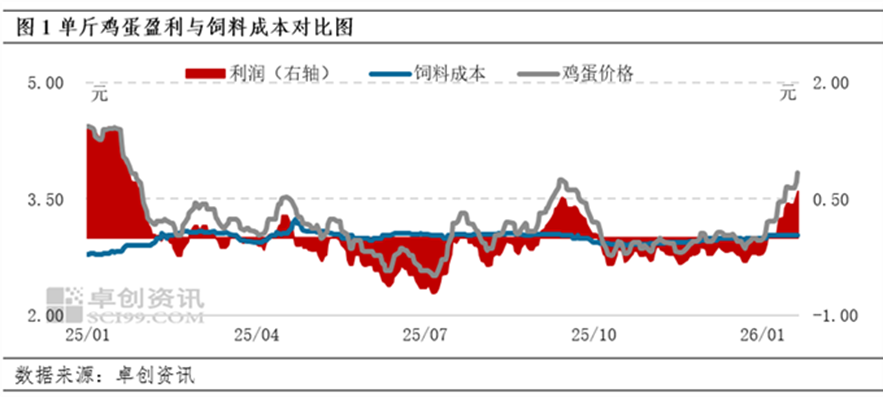
Core Viewpoint - In January 2026, the egg-laying chicken farming sector turned a profit after three months of losses, primarily due to a significant increase in revenue while costs remained relatively stable [1][2]. Group 1: January Performance - From January 1 to 23, egg-laying chicken farming shifted from a loss of 0.22 yuan to a profit of 0.61 yuan, marking an increase of 0.83 yuan [2]. - Both egg prices and feed prices rose in January, but the increase in egg prices was more substantial, supporting the profitability of egg-laying chicken farming [2][4]. - The decline in supply pressure and a notable seasonal demand increase contributed to the strong rise in egg prices, with a 2.54% increase in shipment volume by January 23 [4]. Group 2: February Outlook - In February, the egg market is expected to face a downturn as seasonal demand weakens while supply remains ample, leading to a potential decline in egg prices [6][9]. - The demand from food processing companies and schools is anticipated to decrease due to holidays, while the supply of eggs is expected to remain sufficient despite a slight reduction in the number of laying hens [7]. - The average egg price is projected to drop by 0.90 to 1.00 yuan per jin, with the farming sector potentially facing losses of 0.20 to 0.30 yuan per jin [9].
从“两头多”到“中间强”:结构优化如何影响鸡蛋价格?
Xin Lang Cai Jing· 2026-01-22 02:49
Core Viewpoint - The Chinese egg industry is entering a structural adjustment phase due to a shift from profit to loss in 2025, with an expected price pressure on egg prices in early 2026 due to an oversupply of medium and large eggs [2][10]. Group 1: Egg Size Distribution - The proportion of egg sizes is transitioning from a "two extremes" model to a "strong middle" model, with large eggs showing a "V" shaped fluctuation in their market share [2][10]. - The share of large eggs initially increased due to low temperatures and an abundance of older hens, but decreased later in the year due to poor profitability and accelerated culling [2][10]. - The share of small eggs increased in the first half of the year but decreased in the second half due to reduced stocking caused by industry losses, leading to a trend of supply contraction [2][10]. - The share of medium eggs is gradually increasing, becoming a stable source in the market as supply advantages become more pronounced [2][10]. Group 2: Age Structure of Laying Hens - The age structure of laying hens is optimizing, with a focus on reducing the extremes and stabilizing the middle, as the proportion of main egg-laying hens aged 120-450 days is expected to increase [4][12]. - The proportion of younger hens (under 120 days) is shrinking, reflecting a lack of confidence in restocking due to ongoing industry losses [4][12]. - The proportion of older hens (over 450 days) initially increased but is expected to decline as culling accelerates under financial pressure, reducing inefficient production capacity [4][12]. Group 3: Future Market Dynamics - The ongoing shortage of replacement hens will limit the number of new laying hens in the first half of 2026, tightening the supply of small eggs [6][14]. - The main flock will remain at a high level, ensuring a stable supply of medium eggs, while cost pressures will continue to drive the culling of older hens, limiting the market share of large eggs [6][14]. - The market is expected to see a pricing structure where large and medium eggs dominate, while small eggs will provide limited support due to tight supply [6][14]. - The average price of eggs in the first quarter of 2026 is projected to fluctuate between 2.80-3.30 yuan per jin, with the industry likely to remain in a state of micro-profit or break-even [6][14].
四川盐亭:川农大研究生团队开展县域农业高质量发展主题调研
Xin Lang Cai Jing· 2026-01-21 09:16
Core Insights - The research team from Sichuan Agricultural University conducted a field study in Yanting County to explore the internal logic and practical experiences of high-quality agricultural development [1][3] - The study aimed to clarify development fundamentals, explore innovative growth, and empower industrial upgrades through various methods such as site visits and discussions [1][3] Group 1: Agricultural Development Practices - Yanting County has developed a complete industrial chain for egg production, becoming the "number one county in the country for the egg chicken industry" by collaborating with Fengji Food Group [1][3] - The research team focused on issues such as standardized large-scale breeding, production operations, market expansion, deep processing technology of agricultural products, and models for extending the industrial chain [1][3] Group 2: Collaboration and Knowledge Sharing - The collaboration between Sichuan Agricultural University and Yanting County Agricultural and Rural Bureau aims to leverage academic expertise to systematically outline the development paths of order agriculture and the regional public brand "Lezhiwei" [3] - This partnership also serves to fulfill social responsibilities by providing a practical platform for talent cultivation and integrating theoretical research with local agricultural practices [3] Group 3: Modern Agricultural Goals - The "14th Five-Year Plan" emphasizes the modernization of agriculture and rural areas as crucial to China's overall modernization, advocating for the development of technological, green, quality, and brand agriculture [4] - The practices observed in Yanting County exemplify high-standard paradigms for modern agricultural development, enhancing the understanding of how theoretical knowledge can support local agricultural economic growth [4]