融资成本上升

Search documents
日本债市巨震冲击房地产,REITs再融资陷入“寒冬”
Zhi Tong Cai Jing· 2026-01-27 06:59
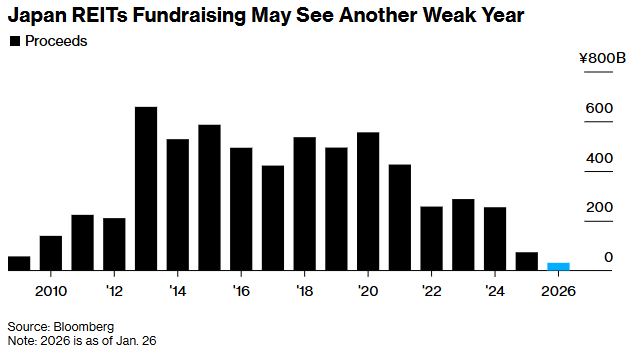
Group 1 - The Japanese REITs market is facing significant challenges due to rising financing costs, which have already led to a slowdown in fundraising activities [1][4] - In the previous year, listed REITs raised only 74 billion yen (approximately 480 million USD), marking the lowest level since 2009 [1] - Concerns over the Bank of Japan's continued interest rate hikes have resulted in a negative sentiment in the market, reflected in the underperformance of the REIT sector compared to the broader market [1][4] Group 2 - The rapid increase in bond yields has raised the potential for higher borrowing and refinancing costs across the REIT industry, despite not all REITs being directly affected [4] - The Tokyo Stock Exchange REIT index has seen a decline of 2.5% since January 20, while the TOPIX index has dropped by 2% following the bond market turmoil [4] - Inflation is increasing the costs for real estate managers, leading to potential asset sales by REITs to mitigate risks, which may further reduce their motivation to raise funds through the stock market [7]

俄罗斯市场深度解析:制裁下的重构机遇与风险应对指南
Sou Hu Cai Jing· 2025-09-29 08:33
Core Insights - The article highlights the structural changes in the Russian market post the Ukraine conflict, presenting new opportunities for Chinese enterprises to expand into Russia [1][12]. Economic Growth and Structural Changes - Russia's nominal GDP is projected to grow by 4.1% in 2024, marking one of the highest growth rates in the past five years, with an unemployment rate at a historical low of 2.3% [1]. - The growth is characterized by a significant shift towards defense-driven economic growth, with over 35% of industrial output growth in 2024 stemming from military and strategic security orders, while civilian manufacturing output has decreased by 1.2% [3]. - Defense and security spending in the federal budget is expected to rise to 36% in 2024, the highest since the dissolution of the Soviet Union [3]. - Russia's trade dynamics have shifted dramatically, with exports to the EU plummeting by 72%, while trade with China surged, increasing from 17% in 2021 to 35% in 2024 [3]. - Energy export revenues have risen from 39% of the federal budget in 2021 to 52% in 2024, indicating a growing dependency on energy [3]. Investment Opportunities by Sector - **Energy and Resources**: Russia, as a major oil and gas exporter, has seen a 46.6% increase in natural gas supplies to China in 2023, presenting collaboration opportunities for Chinese companies in energy extraction, transportation, and processing [4]. - **High-Tech and IT**: The local software industry is expected to grow at an annual rate of over 25% from 2023 to 2024, supported by tax incentives and the "Digital Sovereignty Law," particularly in areas like basic software and cybersecurity [4]. - **Agriculture and Food Processing**: Russia's wheat exports are projected to reach a record 55.3 million tons in the 2023-2024 agricultural season, accounting for 26% of global wheat exports, making agriculture a resilient sector amid sanctions [4]. - **Consumer and Retail**: The demand for home appliances, furniture, and daily consumer goods is increasing, with a notable rise in electronic products among younger consumers [4]. Government Support and Policy Initiatives - The Russian government is focusing on production-linked incentive programs to boost local industries, particularly in import substitution, with a 40% increase in domestic automotive and machinery manufacturing capacity from 2023 to 2024 [5]. - Infrastructure development remains a priority, with opportunities for Chinese companies to leverage their expertise in transportation, energy, and urban infrastructure [6]. Market Entry and Legal Structure - Foreign investors must navigate the Russian legal framework, which includes options like Limited Liability Companies (OOO) and Joint Stock Companies (AO), with a registration process typically taking 30-45 days [8]. - Companies are advised to establish a local presence through market research, pilot projects, and building local networks to facilitate entry into the Russian market [10][13].