行为偏差

Search documents
一份年末投资自省帖:承认吧,我们可能真的不适合自己炒股
Sou Hu Cai Jing· 2025-12-15 01:55
Group 1 - The A-share market has shown significant growth in 2023, with the Wind All A Index rising by 24.80%, and the ChiNext Index and Sci-Tech 100 both increasing by over 49% [1] - Many active investors struggle to outperform broad market indices, indicating a common issue in the A-share market where most active investors fail to beat the index [1] - The core reasons for this underperformance are cognitive biases, trading behaviors, and strategy construction, rather than a lack of information or effort [1] Group 2 - Individual stock investment requires a deep understanding of specific companies, including their business models, management teams, product competitiveness, financial conditions, and industry positions [3] - The dynamic nature of competition leads to unpredictable "flaws" in company operations, which can cause rapid and severe stock price reactions, often influenced by irrational investor emotions [3] - In contrast, index investment focuses on macro factors such as policy, liquidity, and economic cycles, allowing investors to concentrate on broader trends and reduce decision-making complexity [4] Group 3 - Behavioral biases significantly impact investment outcomes, with individual stock investors often caught in cycles of frequent trading due to short-term volatility, which can erode returns [5] - Index investors benefit from a "de-emotionalized" discipline system, relying on long-term holding strategies to share in macroeconomic growth, thus avoiding the risks associated with frequent market timing [5] - The emotional traps include overconfidence, loss aversion, and herd mentality, which can lead to poor decision-making in individual stock investments [7] Group 4 - The advantages of index investing include natural diversification, as broad indices encompass hundreds of stocks across various sectors, effectively mitigating concentration risks [13] - Mainstream broad indices regularly adjust their components based on transparent rules, ensuring they represent active and healthy companies in the market [13] - Index funds and ETFs typically have low management fees and clear investment directions, avoiding issues related to "style drift" [13]
研究 | 隋鹏飞:筹码效应与投资者行为:投资者行为偏差揭秘
Sou Hu Cai Jing· 2025-07-08 05:01
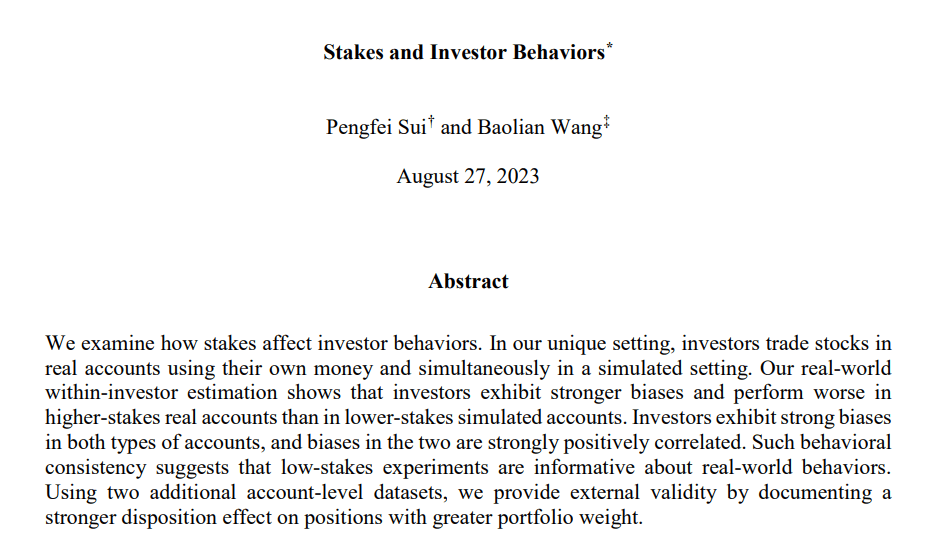
Core Insights - The research conducted by Professor Sui Pengfei from CUHK (Shenzhen) and Professor Wang Baolian from the University of Florida has been accepted by the Journal of Financial Economics, providing significant insights into the impact of stake effects on investor behavior [1][3] - The study challenges traditional views by demonstrating that investors exhibit more pronounced behavioral biases in high-stake real trading environments compared to low-stake simulated environments [1][11] Research Findings - The study utilized a unique natural experiment design, comparing the behaviors of investors managing both real and simulated accounts, revealing that higher stakes lead to increased behavioral biases such as disposition effect, lottery stock preference, and overconfidence [10][11] - Empirical results indicate that the performance of investors in real accounts is generally lower than in simulated accounts, contradicting the belief that higher stakes would enhance decision-making quality [1][11] Theoretical and Practical Implications - This research provides a new explanatory framework for the stake effect on investment behavior, raising important methodological questions about the applicability of laboratory findings to real-world high-stake financial scenarios [2][9] - The findings have significant implications for investor education, risk management in financial institutions, and regulatory policy formulation, emphasizing the need for a deeper understanding of investor psychology in high-stake environments [2][12] Behavioral Biases Identified - The study identifies four key behavioral biases that are exacerbated in high-stake environments: 1. Stronger disposition effect (selling winners too early and holding onto losers too long) [12] 2. More pronounced lottery stock preference [12] 3. Increased tendency for overconfidence [12] 4. More frequent overtrading behavior [12] Investor Characteristics - The research highlights that the impact of stake effects varies among different investor characteristics, with larger portfolio investors being less affected and those from economically developed regions showing stronger resilience to these biases [11][12]