指数投资

Search documents
ETF更名焕新背后:广发基金指数业务的“匠心”与“初心”
第一财经· 2026-03-26 07:13
Core Viewpoint - The domestic ETF market is experiencing rapid growth, with the number of products approaching 1,500, leading to both opportunities and challenges for investors in distinguishing between various offerings [1][3]. Group 1: ETF Naming and Structure - On March 26, 2026, GF Fund completed the renaming of all 75 ETFs to a standardized naming structure that includes "Investment Target Index Core Elements + ETF + GF" [1][4]. - The renaming initiative is a response to new regulatory requirements and reflects GF Fund's deep consideration of index investment, aiming to provide investors with clearer differentiation in a crowded market [3][5]. - The new naming strategy simplifies product identification by removing redundant terms and focusing on essential information, thereby enhancing decision-making efficiency for investors [5]. Group 2: Product Offerings and Strategy - GF Fund currently offers 151 index products and 75 ETFs, covering a diverse range of assets including stocks, bonds, and commodities across A-shares, Hong Kong stocks, and U.S. markets [8][12]. - The fund has developed a comprehensive toolbox of products, including 16 ETFs in the broad-based index category, designed to provide investors with a full-cycle asset allocation foundation [8][12]. - The thematic investment strategy focuses on sectors with high barriers to entry and low elimination rates, such as energy, infrastructure, and real estate, with 10 related thematic ETFs launched since 2015 [9][12]. Group 3: Cross-Border and Dividend Strategies - GF Fund has strategically launched several products in the cross-border space, including the Hong Kong Innovation Drug ETF, which has grown into a significant product in its category [12]. - The fund's dividend strategy includes a range of ETFs aimed at capturing high-dividend assets in both A and H-share markets, providing investors with defensive allocation options [11][12]. Group 4: Investor Education and Service - GF Fund emphasizes the importance of investor education, offering various resources to enhance understanding of index investments, including animated and interactive content [14]. - The company aims to create a collaborative ecosystem that integrates products, services, and investor engagement, enhancing the overall investment experience [13][14]. - The fund's index research team provides specialized services to professional investors, including market insights and trading strategies, to meet their sophisticated needs [13]. Group 5: Future Outlook - As the ETF market evolves, GF Fund is committed to high-quality development, focusing on enhancing investor experience through a comprehensive index service matrix [16][17]. - The company aims to build a transparent and efficient investment environment, leveraging its experienced team and advanced quantitative systems to improve product tracking accuracy and generate excess returns [16][17].


指数投资选“ETF嘉实”!从一站式配置到策略深度玩法
券商中国· 2026-03-26 03:10
Core Viewpoint - The article emphasizes the growing popularity and importance of ETF funds in wealth management for both institutional and retail investors, highlighting their advantages such as trading convenience, transparency, and a wide range of products [1]. Group 1: ETF Market Growth - The domestic ETF market has surpassed 5 trillion yuan in scale, with over 1,400 products available, indicating a robust development phase characterized by reallocation, strategy enhancement, and service improvement [2]. - Jiashi Fund has been a pioneer in index investment for over 21 years, focusing on fundamental research and innovative strategies to identify "super opportunities" in various industries [2]. Group 2: Product Diversity and Accessibility - Jiashi Fund's "Super ETF" offers a comprehensive range of products, allowing investors to achieve diversified allocations based on their risk preferences and investment goals, covering everything from broad-based indices to thematic ETFs [3]. - The naming convention for Jiashi Fund's 61 "Super ETF" products is standardized, making it easier for investors to understand and select appropriate investments [3]. Group 3: Core Opportunities and Research - Jiashi Fund's ability to identify and define core opportunities is rooted in its strong research capabilities and platform depth, with over 25 ETFs ranking first in scale among similar products [6]. - The fund has strategically invested in sectors like AI and rare metals, with products such as the Sci-Tech Chip ETF and Rare Earth ETF becoming market leaders in their categories [7][8]. Group 4: Enhanced Investment Experience - As the ETF market evolves, there is a shift from single product purchases to portfolio management, necessitating more active asset allocation and precise strategy services to enhance investment returns [9]. - Jiashi Fund has established a systematic service framework, including platforms for institutional empowerment and personal investment services, to meet diverse investor needs [9]. Group 5: Long-term Investment Philosophy - Jiashi Fund promotes a long-term investment philosophy, encouraging rational allocation and emphasizing the value of index investment over time [10]. - The annual "Super Index Festival" aims to engage various stakeholders in the investment ecosystem, fostering a deeper understanding of index investment as a wealth management solution [10].

好公司要是不上市,买指数不是一场空?
集思录· 2026-03-25 14:05
Core Viewpoint - The article discusses the implications of companies choosing not to go public, highlighting the potential risks and missed opportunities for investors who rely on index funds to capture the growth of successful companies that may never list on the stock market [1][4][10]. Group 1: Reasons for Companies Not Going Public - Some companies, like Huawei, have unique ownership structures that make going public unlikely, which could pose long-term risks for their governance and management [4]. - The article suggests that companies with strong market positions may not need to go public for financing, especially in low-interest-rate environments [10]. Group 2: Benefits of Going Public - Going public offers several advantages, including asset appreciation, easier liquidity for shareholders, generational wealth transfer, enforced corporate governance, and increased visibility due to mandatory disclosures [4][9]. - The average lifespan of publicly listed companies tends to be longer than that of smaller, non-listed firms, indicating a potential stability advantage [4]. Group 3: Market Dynamics and Index Funds - The article raises concerns about the effectiveness of index funds in capturing the growth of companies that remain private, suggesting that the performance of indices may be compromised if significant players do not enter the market [1][11]. - It is noted that the narrative around index funds can change dramatically based on market conditions, with the potential for significant reversals in sentiment [7][10]. Group 4: Investor Perspectives - Investors may perceive non-listed companies as more attractive due to their perceived mystery and potential, but this can lead to unrealistic expectations [5]. - The article emphasizes the importance of discerning investment opportunities and not solely relying on the assumption that buying index funds guarantees success [8][10].

大盘还会上4000点吗?|投资小知识
银行螺丝钉· 2026-03-23 14:06
Group 1 - The core viewpoint of the article emphasizes the long-term upward trend of stock indices, driven by corporate earnings growth, which ultimately supports index stability and growth [3][6]. - The Shanghai Composite Index has shown significant fluctuations over the years, with historical lows during bear markets, such as around 1,000 points in 2012-2014, 2,500 points in 2018, and around 3,000 points in recent years, indicating a gradual increase in the bear market bottom points [4][5]. - The article highlights that the CSI 300 and CSI 500 indices, which invest in both Shanghai and Shenzhen stocks, reflect a broader market trend, with the overall market index exceeding 4,000 points when including stocks from both exchanges [4][5]. Group 2 - The long-term growth of indices provides a solid foundation for investing in index funds, as it is primarily driven by corporate earnings growth, which is viewed as a "base salary" from the market [6]. - In the event of a bull market, there is potential for significant short-term valuation increases, allowing investors to benefit from both earnings growth and valuation expansion, described as "extra bonuses" from the market [6]. - The article notes that from 2004 to December 2025, the index has risen from 1,000 points to approximately 5,700 points, with dividends potentially pushing the total to 6,000-7,000 points, indicating a strong long-term performance of the market [5].

基金周报:证监会发布公募基金信息披露新规,南方基金推出首趋E指小程序-20260315
Guoxin Securities· 2026-03-15 14:27
- The report does not contain any specific quantitative models or factors related to quantitative investment strategies[5][39][41]
量化日报:量化日报超长单日输出概率有所下降
CAITONG SECURITIES· 2026-03-13 04:25
Investment Rating - The report maintains a bullish outlook on the 10-year treasury, 2-year treasury, CSI Dividend Total Return Index, Wind Micro Index, COMEX Gold, and IPE Brent Oil [1][5] - The report indicates an adjustment for the STAR 50 Index [2][5] - The report suggests a fluctuating outlook for the 30-year treasury, 3-year AAA medium-short bonds, Wind All A Index, Hang Seng Technology Index, and CSI 2000 Index [2][5] Core Insights - The original signal for the 30-year treasury is 51.36% with a 5-day moving average (MA5) of 57.04%, indicating a fluctuating outlook [2][5] - The original signal for the 3-year AAA medium-short bonds is 86.23% with an MA5 of 56.88%, also indicating a fluctuating outlook [2][5] - The original signal for the 10-year treasury is 43.90% with an MA5 of 32.36%, supporting a bullish outlook [2][5] - The original signal for the 2-year treasury is 10.55% with an MA5 of 13.88%, indicating a bullish outlook [2][5] - The original signal for the Wind All A Index is 70.48% with an MA5 of 57.59%, suggesting a fluctuating outlook [2][5] - The original signal for the CSI Dividend Total Return Index is 26.14% with an MA5 of 20.17%, supporting a bullish outlook [2][5] - The original signal for the Hang Seng Technology Index is 43.13% with an MA5 of 59.74%, indicating a shift from adjustment to a fluctuating outlook [2][5] - The original signal for the STAR 50 Index is 80.92% with an MA5 of 64.28%, indicating an adjustment [2][5] - The original signal for the Wind Micro Index is 16.56% with an MA5 of 30.15%, indicating a shift from fluctuating to a bullish outlook [2][5] - The original signal for the CSI 2000 Index is 86.75% with an MA5 of 53.01%, suggesting a fluctuating outlook [2][5] - The original signal for COMEX Gold is 13.41% with an MA5 of 10.19%, supporting a bullish outlook [2][5] - The original signal for IPE Brent Oil is 51.71% with an MA5 of 30.28%, indicating a bullish outlook [2][5]
指数投资时代,主动权益基金为何不可或缺?
YOUNG财经 漾财经· 2026-03-05 10:25
Core Viewpoint - The rise of index investing highlights the irreplaceable role of actively managed equity funds in investors' portfolios, especially for those seeking long-term stable growth and opportunities to exceed market average returns [3]. Group 1: Active Equity Funds' Core Value - Active equity funds provide the ability to uncover excess returns that are not captured by index funds, particularly in the A-share market, which is not fully efficient [5]. - The flexibility of active fund managers allows for adjustments in portfolio structure and position sizes based on market conditions, which can smooth out net value fluctuations and enhance the holding experience [6]. - Historical data shows that actively managed funds have significantly outperformed the CSI 300 index over various time frames, validating the long-term value of active management [6]. Group 2: Constructing a "Passive + Active" Portfolio - Investors should consider a "passive base, active enhancement" approach, using index funds as a foundational asset allocation to achieve low-cost market average returns, while actively managed funds serve as an enhancement to break through the average return ceiling [9]. - The success of active equity funds relies heavily on the research capabilities of the fund company and the expertise of fund managers, which are critical factors for investors when selecting active equity funds [7]. - 华夏基金 has demonstrated strong performance in active equity products, with multiple funds ranking in the top 5 of their categories, showcasing the company's deep expertise in global asset allocation and industry selection [8].

超4400万持有人,这家公司的ETF凭什么?
点拾投资· 2026-03-05 03:33
Core Viewpoint - The article discusses the launch of "Jimu Planet," a dedicated index investment education platform by Huazhang Fund, aimed at transforming the cold, tool-like nature of ETFs into a more engaging and supportive investment experience for users [4][6]. ETF Product Introduction - Investors often feel overwhelmed by the vast array of ETF options available, leading to a sense of isolation despite the wealth of information [3]. - The article highlights the need for a more personalized approach to ETF investment, where investors can feel understood and supported [4]. Jimu Planet Launch - Huazhang Fund launched "Jimu Planet" in early 2025, designed to provide comprehensive information and configuration services for investors [6][8]. - The platform aims to help investors build their own investment portfolios, likening the process to assembling building blocks [8]. Educational Initiatives - By the end of 2025, Jimu Planet had conducted nearly 300 online and offline educational activities across over 30 provinces, engaging with thousands of brokerage firms [8]. - The platform hosted over 200 live sessions, totaling more than 9,000 minutes, equivalent to reading 20 investment books [8]. - Huazhang Fund produced over 700 in-depth research reports, providing insights into the industries and companies behind ETFs [8]. Collaborative Efforts - The fund collaborated with exchanges to host events like "Exploring ETF Component Stocks" and "ETF Lectures," allowing investors to connect with real economic activities [9]. - This approach aims to build trust and a sense of community among investors, moving beyond mere transactions [9]. Growth Metrics - By the end of 2025, Huazhang Fund's index management scale exceeded 250 billion yuan, with ETF assets reaching 195.05 billion yuan, marking an annual growth of nearly 80 billion yuan [11]. - In the first three quarters of 2025, the fund generated over 50 billion yuan in profits for its investors [11]. - The fund has gained the trust of over 44 million investors, reflecting a strong preference for its products in a highly competitive market [11]. Product Offerings - Huazhang Fund offers a diverse range of ETFs, including the first domestic gold ETF, which saw a 58.54% increase in 2025, and the ChiNext 50 ETF, which rose over 57% [12]. - The fund emphasizes a diversified, specialized, and high-quality product strategy, covering various asset classes and market conditions [13]. Ecosystem Integration - Huazhang Fund has integrated deeply into the Guotai Junan ecosystem, leveraging research support and branch collaboration to enhance product visibility and investor engagement [15]. - The company aims to be more than just an ETF provider, positioning itself as a companion and guide for investors [15].

指数的幻觉:个股崩塌时,市场真的安全吗?
美股研究社· 2026-02-28 11:38
Core Viewpoint - The current state of the U.S. stock market reflects a structural risk where individual stocks are declining while major indices remain stable, indicating a divergence in market breadth and a potential hidden risk [1][6][10]. Group 1: Market Structure and Behavior - Recent data shows a record sell-off of $8.3 billion in individual stocks, suggesting that funds are not leaving the market entirely but are shifting from individual stocks to indices [3]. - The stability of indices like the S&P 500 and Nasdaq is largely due to the concentration of funds in a few major stocks, with the top ten stocks in the S&P 500 nearing historical highs in terms of weight [5]. - The phenomenon of individual stocks suffering while indices remain stable is indicative of a structural change in fund flow, where institutions are selling off smaller, more volatile stocks while maintaining exposure through ETFs [6][10]. Group 2: Risks of Concentrated Investment - The liquidity of ETFs, while appearing robust, is actually built on the liquidity of underlying assets, which can become problematic in times of market stress [8]. - A paradox arises where concentrated investment in indices, perceived as safer, can lead to systemic risk; if sentiment shifts, the rush to redeem ETF shares could exacerbate market volatility [9][10]. - The current market structure suggests that the risk is not from valuation bubbles but from crowded positions, where a consensus among investors can lead to a lack of market elasticity [10][13]. Group 3: Historical Context and Future Implications - Historical patterns show that similar market structures have occurred before, such as during the early pandemic and the tech stock adjustments in 2022, but the macroeconomic context differs each time [6][12]. - The current situation is characterized by institutions reducing active risk exposure, indicating a defensive posture rather than outright panic [12][14]. - The potential for a market unwind is present, as crowded trades typically revert to the mean, but the trigger for such a shift remains uncertain [14][16]. Group 4: Investment Strategy and Outlook - Investors should be cautious of the illusion of safety provided by index funds, as the concentration of investments can lead to significant risks [16]. - Future market dynamics may not follow a uniform pattern of rise and fall but could instead exhibit extreme differentiation, presenting opportunities in overlooked stocks with solid fundamentals [16].

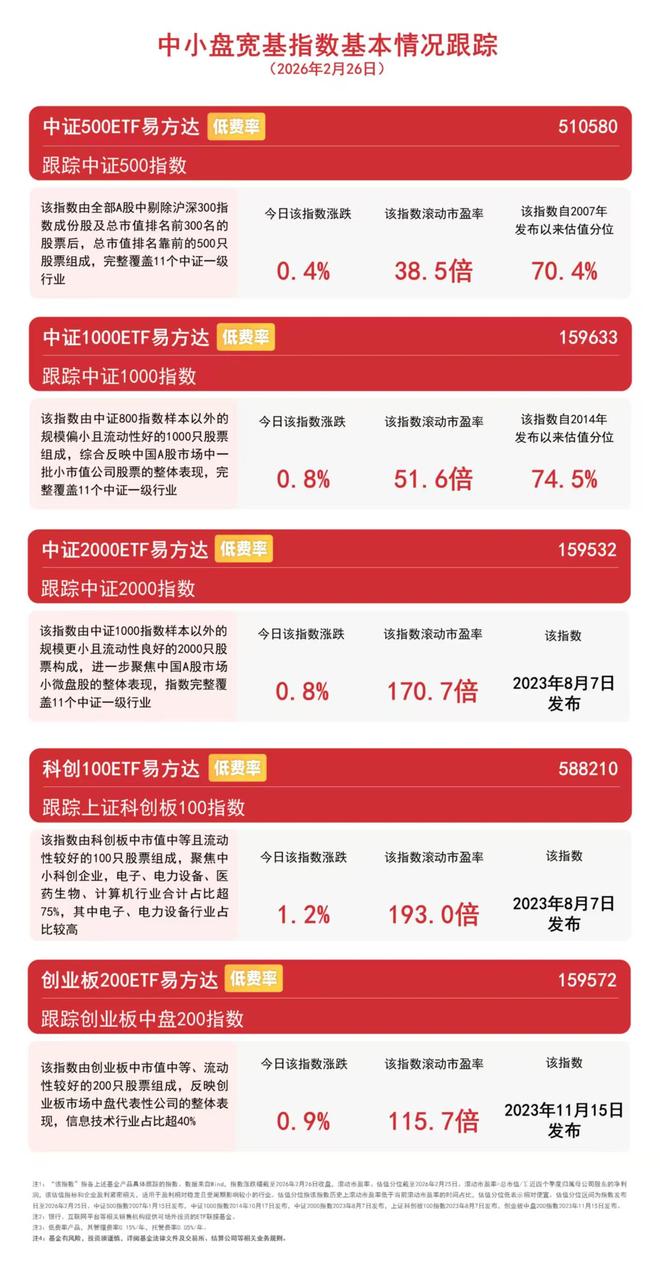
指数三连涨,关注中证500ETF易方达(510580)、中证1000ETF易方达(159633)后续表现
Mei Ri Jing Ji Xin Wen· 2026-02-26 11:41
Core Viewpoint - The major indices in the Chinese stock market, including the CSI 500, CSI 1000, CSI 2000, ChiNext Mid 200, and Sci-Tech 100, have shown positive performance with increases of 0.4% to 1.2%, marking a three-day consecutive rise in these indices [1]. Group 1: Index Performance - The CSI 500 Index increased by 0.4% [1] - The CSI 1000 Index and CSI 2000 Index both rose by 0.8% [1] - The ChiNext Mid 200 Index saw an increase of 0.9% [1] - The Sci-Tech 100 Index experienced a rise of 1.2% [1] Group 2: ETF Information - The CSI 500 ETF tracks the CSI 500 Index, which consists of 500 stocks with a total market capitalization ranking after excluding the top 300 stocks from the A-share market, with a rolling P/E ratio of 38.5 times and a valuation percentile of 70.4% since its inception in 2007 [2] - The CSI 1000 ETF tracks the CSI 1000 Index, composed of 1000 smaller, liquid stocks, with a rolling P/E ratio of 51.6 times and a valuation percentile of 74.5% since its inception in 2014 [2] - The CSI 2000 ETF tracks the CSI 2000 Index, which includes 2000 smaller stocks, with a rolling P/E ratio of 170.7 times [2] - The Sci-Tech 100 ETF tracks the Sci-Tech 100 Index, focusing on 100 medium-sized stocks from the Sci-Tech board, with a rolling P/E ratio of 193.0 times [2] Group 3: Sector Representation - The ChiNext Mid 200 Index reflects the overall performance of mid-cap representative companies in the ChiNext market, with the information technology sector accounting for over 40% of its composition [3]