规模导向

Search documents
近七成连锁超市2025年净利润实现同比增长
Jing Ji Guan Cha Wang· 2026-01-23 10:43
Core Insights - The overall operation of China's chain supermarkets is expected to show steady growth with significant differentiation by 2025, with total sales exceeding 400 billion yuan [1] - A notable recovery in profitability is indicated, with 67% of surveyed supermarkets expecting net profit to remain stable or grow, a significant increase from 25% in 2024 [1] - The performance of standard and community supermarkets is better than that of large supermarkets, with over half of the stores experiencing an increase in customer traffic and 72% reporting growth in online sales [1] Group 1 - The total sales of over 30,000 surveyed supermarkets are projected to exceed 400 billion yuan by 2025, with 58% of enterprises expecting sales to remain stable or grow year-on-year [1] - The proportion of supermarkets expecting net profit to remain stable or grow is 67%, a significant recovery from 25% in 2024, indicating an improvement in profitability [1] - More than half of the surveyed supermarkets reported an increase in customer traffic, and over 30% of enterprises achieved over 20% growth in online sales [1] Group 2 - For 2026, most supermarket enterprises plan to focus on steady progress, with over half aiming for growth through facility upgrades, regional deepening, or cross-regional expansion [2] - Key measures for channel optimization include improving product and channel efficiency, integrating online and offline operations, and upgrading store and organizational systems [2] - The industry is transitioning from a "scale-oriented" approach to a focus on "quality and efficiency" [2]
海量财经丨基金业的“冰与火”:当私募狂欢与公募沉默成本相遇
Sou Hu Cai Jing· 2025-12-15 12:40
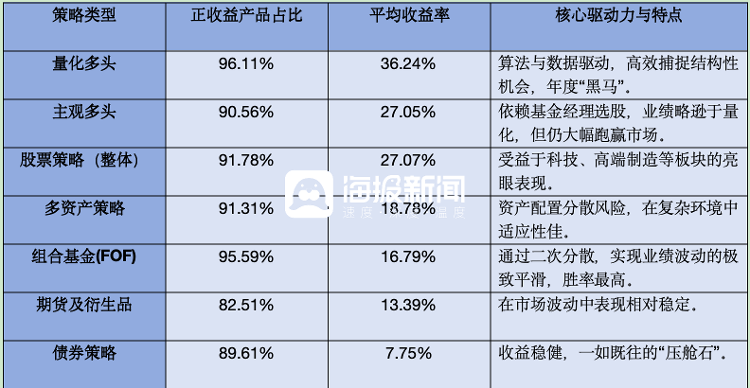
Core Viewpoint - The Chinese fund industry in 2025 presents a stark contrast, with private equity funds performing exceptionally well while public funds struggle significantly, revealing systemic issues in the industry after over two decades of rapid development [1] Performance Disparity: A True Reflection of the Market - In 2025, the structural market conditions of A-shares serve as a key differentiator for performance, leading to a stark contrast between public and private fund results [1] - Private equity securities products show strong profitability, with over 90% achieving positive returns and an average return rate of 22.61%, while stock strategies yield an impressive average return of 27.07% [2] Public Fund Struggles - Among 6,129 public active equity products that have been established for over three years, 60.5% failed to outperform their benchmarks [3] - A significant number of funds, 2,454, lagged their benchmarks by over 10 percentage points, indicating a consistent underperformance compared to market averages [3] Investor Losses: The Cost of Silence - The performance disparity results in real financial losses for investors, with previously celebrated fund managers delivering disappointing results [4] - For instance, a fund managed by Liu Yanchun reported a return of -23.05% over three years, while its benchmark yielded a positive 14.41%, resulting in a 37.46 percentage point gap [4] Corporate Profit vs. Investor Loss - Despite poor performance, some fund companies continue to distribute substantial dividends, creating a stark contrast with the losses faced by investors [5] - A leading fund company distributed nearly 83 billion yuan in dividends over ten years, while its products collectively lost 1,004 billion yuan in the same period [5] Structural Issues: Root Causes of Industry Ailments - The root of performance disparity lies in differing incentive mechanisms, with private funds typically using a performance-based compensation model that aligns managers' interests with those of investors [6] - In contrast, public funds often rely on management scale for fees, leading to a focus on growth rather than performance [6] - Only three out of 28 large-scale active equity funds managed to achieve excess returns while maintaining positive profits over the past three years [6] Regulatory Restructuring: From Scale-Oriented to Performance-Linked - In response to industry issues, regulators are implementing new performance assessment guidelines that tie fund managers' compensation directly to product performance and investor profits [10] - This shift is expected to drive significant changes in the industry, with many active equity fund managers adjusting their strategies to align more closely with benchmark indices [10] Market Trends: Shifts in Fund Flows - Under regulatory and market pressures, there is a noticeable change in fund flows, with private equity products showing a 90.66% positive return rate compared to public funds [12] - High-net-worth clients and institutional investors are increasingly turning to private equity, particularly quantitative strategy products, while ordinary investors are becoming more cautious and reevaluating their investment strategies [12]

年薪百万的基金经理,越来越难了?
Sou Hu Cai Jing· 2025-11-30 04:59
Core Viewpoint - The recent call by fund manager Cai Zhen for reducing the number of managed products reflects the challenges and transformations within the public fund industry, particularly in light of new regulations that will significantly reshape performance benchmarks and link them to manager compensation [1][4][15]. Group 1: Industry Challenges - Cai Zhen's statement highlights the pressure fund managers face due to managing multiple products, with his current management load reaching nearly 20 funds and a total management scale of 13.599 billion [4][9]. - The phenomenon of "one manager handling multiple funds" is prevalent, with approximately 290 fund managers managing over 10 main code funds each, indicating a systemic issue in the industry [9][10]. - The focus on scale over quality has led to a situation where fund managers are stretched thin, potentially harming long-term returns for investors [9][11]. Group 2: Regulatory Changes - New regulations set to take effect will bind fund performance directly to manager compensation, aiming to shift the industry focus from scale to investor interests [15][16]. - The new rules will penalize fund managers whose long-term performance significantly lags behind benchmarks, promoting a more sustainable investment approach [16][17]. - The shift from a scale-driven model to one that prioritizes returns is expected to challenge both fund managers and companies, necessitating a reevaluation of resource allocation and investment strategies [16][17].