言论边界

Search documents
第二波“TikTok难民”来了
财富FORTUNE· 2026-01-28 13:07
Core Viewpoint - The recent restructuring of TikTok's U.S. operations has led to significant user backlash, with accusations of censorship and content suppression emerging shortly after the transition to a new ownership structure [1][4][5]. Group 1: User Reactions and Censorship Claims - Users have reported that posts containing certain keywords are unable to be published on TikTok, leading to the trending hashtag TikTokCensorship on social media platforms [3]. - Prominent figures, including singer Billie Eilish, have expressed concerns that TikTok is "silencing our voices," highlighting a perceived decline in engagement for critical content [3]. - California Governor Gavin Newsom announced an investigation into TikTok following numerous user complaints about potential censorship related to political content [3]. Group 2: Ownership Structure and Data Management - TikTok has been split into two entities: one for the U.S. market and another for the rest of the world, with a new joint venture, TikTok USDS Joint Venture, established to manage U.S. operations [4][5]. - The new ownership structure includes significant stakes from American companies such as Oracle, Silver Lake, and the Abu Dhabi sovereign wealth fund, collectively holding approximately 80.1% of the new entity, while ByteDance retains a minority stake of 19.9% [4][5]. - All U.S. user data will be migrated to Oracle's cloud servers, with local oversight of content moderation and algorithm management [5]. Group 3: Historical Context and Political Implications - TikTok has faced scrutiny in the U.S. since 2020, being labeled a national security threat due to concerns over data privacy and potential influence from the Chinese government [6][7]. - Despite efforts like "Project Texas," which aimed to localize data and increase transparency, legislative pressure led to the requirement for a complete divestment from ByteDance [7]. - The new ownership's ties to political figures, particularly those aligned with former President Trump, raise concerns about potential biases in content moderation and algorithmic decisions, reminiscent of controversies surrounding other social media platforms [8].

澳大利亚枪击案余波未平,作家周环节被迫取消
Huan Qiu Shi Bao· 2026-01-13 23:01
Core Viewpoint - The cancellation of Palestinian-Australian writer Randa Abdallah Fattah's invitation to the Adelaide Festival has sparked significant controversy, leading to protests from numerous writers and participants [1][2] Group 1: Event Background - The Adelaide Festival Committee announced the cancellation on October 8, citing "cultural sensitivity" following a recent shooting incident at Bondi Beach [1] - The Adelaide Festival is Australia's largest literary event, with an expected attendance of 160,000 in 2025 [1] Group 2: Reactions and Consequences - Over 180 writers have withdrawn from the event in protest, and Louise Adler, the head of the festival's writers' program, resigned in opposition to the decision [1] - South Australian Premier Peter Malinauskas supported the cancellation, stating it was unwise to allow her participation after a racially motivated terror attack [2] - The Adelaide Festival Committee issued an apology regarding the manner of communication about the decision but maintained that it was not based on identity or suppression of dissent [2] Group 3: Leadership Changes - Following the controversy, all members of the Adelaide Festival Committee have resigned, and the South Australian government has appointed a new committee led by former chair Judy Potter [2] - Potter acknowledged the loss of the writers' program as a significant aspect of the festival moving forward [2]
《新商悟》出品
Sou Hu Cai Jing· 2025-12-08 08:45
Core Viewpoint - A New Oriental employee's open letter criticizing excessive overtime and chaotic work conditions has sparked significant discussion on social media, highlighting issues of work-life balance and employee rights within the company [1][3]. Group 1: Employee Concerns - The employee's letter titled "Don't Let the Educational Original Intention Be Wasted on Chaotic Overtime" describes a grueling work schedule of 9:30 AM to 9:30 PM, effectively a 996 work culture with only one day off, making the eight-hour workday a distant dream [3][5]. - The employee expressed disappointment that the company's initial promise of a respectful work environment and adherence to labor laws has been overshadowed by unrealistic performance targets and constant additional tasks [5]. Group 2: Company Response - Following the publication of the letter, it was quickly deleted, and the employee's account was suspended, indicating the company's strict stance on internal communications and employee grievances [6]. - New Oriental's management stated that there are established reporting mechanisms for employee concerns, suggesting that the public nature of the letter was inappropriate and would be addressed accordingly [6]. Group 3: Broader Implications - This incident raises questions about the boundaries of employee expression and the company's commitment to its stated values of "people-oriented" management, as highlighted in a previous email from the chairman [6]. - The chairman's earlier message about maintaining educational integrity and the company's responsibility towards its employees has also faced scrutiny, indicating a potential disconnect between corporate ideals and actual practices [6].


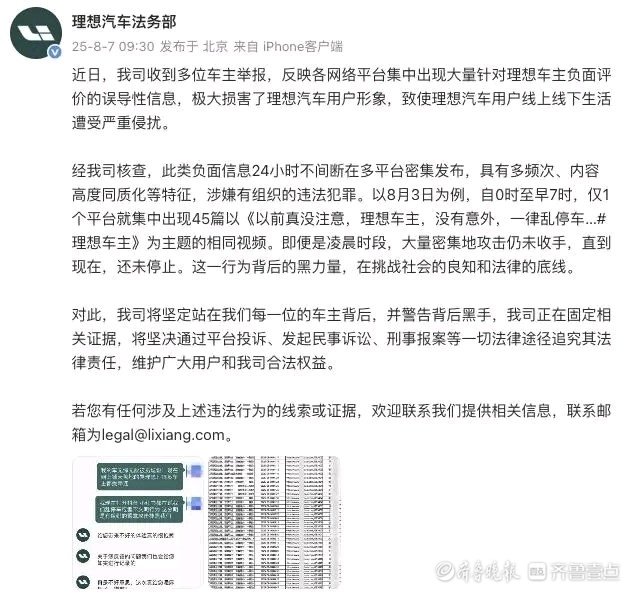
理想车主陷争议:哪些算监督?哪些是抹黑?
Qi Lu Wan Bao Wang· 2025-08-08 05:43
Core Viewpoint - The article discusses the negative public perception faced by users of Li Auto, highlighting how individual traffic violations have led to a broader stigmatization of the entire owner community, raising questions about the boundaries of social supervision and malicious defamation in the age of social media [1][4][9]. Group 1: Owner Experiences - Li Auto owners are experiencing increased scrutiny and harassment in real life due to negative online narratives, with some facing direct accusations from neighbors and other drivers based on generalized negative sentiments [1][2]. - Owners report feeling pressured to drive more cautiously, fearing that minor mistakes could lead to public shaming online, which has affected their social media usage and personal interactions [2][3]. Group 2: Online Discourse - Discussions surrounding Li Auto owners have escalated on various platforms, with many videos documenting traffic violations by individual owners, but these instances are often generalized to label the entire group negatively [4][6]. - The spread of content that uses absolute statements, such as "99% of Li Auto owners behave this way," contributes to the systemic labeling of the owner community, which is seen as unfair by many compliant drivers [4][10]. Group 3: Legal Perspectives - Legal experts emphasize the distinction between legitimate social supervision and malicious defamation, noting that objective documentation of violations without malicious intent is generally permissible [10][11]. - Actions that involve subjective malice, such as selectively targeting Li Auto owners for negative portrayal, can constitute defamation and violate the reputation of the automotive brand [10][11]. - The article also highlights the responsibilities of online platforms to manage and mitigate harmful content directed at specific groups, as failure to do so could result in legal repercussions [10][11].