财政和货币双宽松

Search documents
中金:若“乱象”事态超出预期 利多避险资产、资源品 科技逢低介入
智通财经网· 2026-01-26 00:27
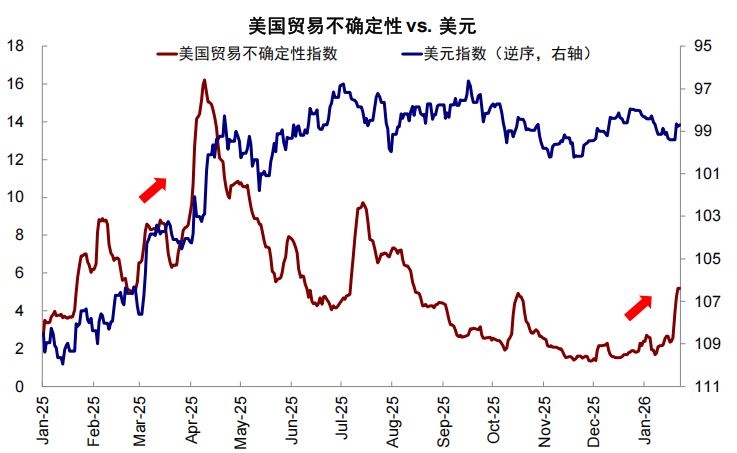
Group 1 - The core viewpoint of the report emphasizes the need to monitor key events related to Trump's policies, including potential tariffs and judicial rulings that could impact market stability [1][2] - The report indicates that the uncertainty surrounding U.S. policies has led to increased volatility in both the stock and bond markets, with a notable "triple hit" in the markets [2][4] - Trump's approach to challenging the existing international order is identified as a significant source of market volatility, with a focus on understanding the underlying intentions behind his policies [6][7] Group 2 - Trump's macro objectives are summarized as "increasing revenue," "reducing costs," and "bringing back manufacturing and capital" [7][41] - The strategy of increasing revenue through tariffs has shown significant short-term effects, with a reported 24.6% reduction in trade deficits from April to October 2025, and tariff revenues reaching $287 billion [8][10][9] - The report highlights that the actual effective tax rate from tariffs is 11.1%, which is below the theoretical rate, indicating that the impact on inflation has been manageable so far [14][22] Group 3 - The report discusses the limited effectiveness and significant backlash of Trump's cost-reduction strategies, particularly regarding the independence of the Federal Reserve [32][35] - It notes that the cost of servicing U.S. debt has approached $1 trillion, which is over 3.1% of GDP, despite attempts to influence interest rates through non-market methods [35][37] - The potential appointment of a new Federal Reserve chair is seen as a crucial factor in shaping market expectations and influencing cost reduction [38] Group 4 - The report indicates that manufacturing and capital are returning to the U.S. due to various incentives, including tax breaks and tariffs that compel foreign companies to invest domestically [41][42] - The share of U.S. manufacturing imports has decreased from 13.3% to 8.0%, reflecting a growing importance of domestic manufacturing [43] - Corporate investment has also increased, with fixed investment rising from 0.9% to 3.9% year-on-year, driven by equipment and intangible assets [45][47] Group 5 - The report warns of potential risks to foreign direct investment and U.S. Treasury securities due to ongoing challenges to the international order, which could lead to a "de-dollarization" trend [49][50] - Despite concerns, the narrative of de-dollarization has not yet materialized into significant actions, as foreign holdings of U.S. debt reached a new high of nearly $9.4 trillion [50] - The report emphasizes the importance of monitoring these trends closely, as instability in the Treasury market could have severe implications for the U.S. financial system [50]

【环球财经】2026年美股展望:泡沫论或加剧波动 保持谨慎乐观
Xin Lang Cai Jing· 2025-12-09 10:37
Group 1 - The core viewpoint of the articles indicates that while the U.S. stock market has reached historical highs in 2025, its performance has lagged behind other major markets, suggesting a cautious optimism for 2026 driven by AI and loose monetary policies [1][2]. - The technology sector, particularly the "seven giants," has significantly influenced the S&P 500, accounting for over 30% of its total market capitalization and contributing nearly 50% to market expansion since 2023 [2][3]. - There is a growing debate regarding the potential "AI bubble," with concerns that if AI demand does not meet expectations, high valuations may not be sustainable, leading to a possible market correction [2][3]. Group 2 - Predictions indicate a substantial decline in capital expenditure growth for major tech companies, from 48.8% in 2025 to 18.8% in 2026, and further down to 6.0% in 2027, reflecting a weakening growth momentum [3]. - Major financial institutions like Bank of America and BlackRock are questioning the "AI bubble" narrative, suggesting that the current AI investment wave is driven by genuine corporate investments and productivity growth rather than speculative bubbles [4][5]. - Analysts suggest that the market may continue to experience upward momentum in the first half of 2026 due to ongoing fiscal and monetary easing, but may face more policy uncertainties in the latter half of the year [5][6]. Group 3 - Investment strategies are recommended to focus on the core segments of the AI value chain, including large-scale cloud service providers and chip manufacturers, while also identifying undervalued companies that could benefit from the AI trend [6][7]. - The discussion around the AI narrative emphasizes the importance of understanding the boundaries and duration of potential bubbles, with a focus on improving risk-reward ratios in high-valuation tech stocks [6][7]. - The overall market sentiment suggests that while the AI-driven tech rally may persist, volatility is expected to increase, making it crucial for investors to manage trading rhythms effectively [7].