货币乘数效应

Search documents
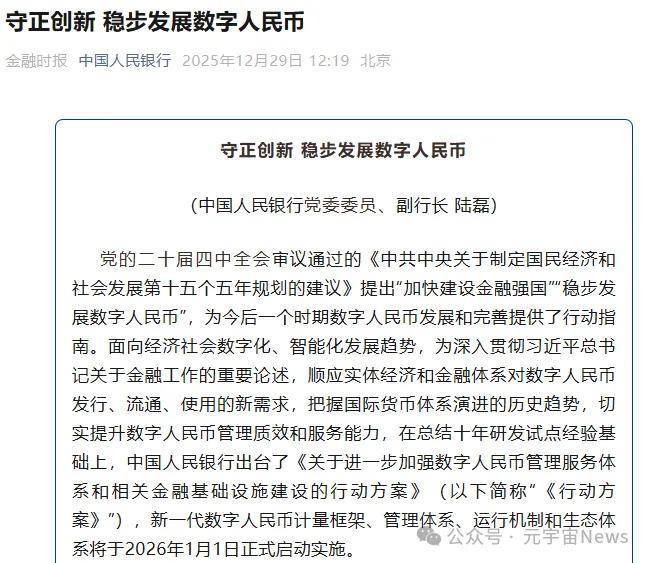
央行:数字人民币升级2.0版,2026年起钱包余额可计付利息
Sou Hu Cai Jing· 2025-12-29 09:03
Core Viewpoint - The digital renminbi is transitioning from "digital cash" to "digital deposit currency," allowing it to generate interest and participate in credit cycles, thus evolving into a complete financial infrastructure [1][3]. Group 1: Transition to Digital Deposit Currency - The digital renminbi will now be classified as a liability of commercial banks, allowing users to enjoy deposit insurance and earn interest, marking a shift from a mere payment tool to a value storage function [3]. - This change respects financial principles, as cash cannot earn interest due to its anonymity, while deposits can participate in economic cycles through bank credit [3]. Group 2: Hybrid Architecture - The digital renminbi features a "mixed architecture" that combines the advantages of an account system with the transparency and programmability of blockchain technology [4]. - This dual approach allows for practical solutions without blindly pursuing decentralization, focusing on real-world issues such as cross-border payments [5]. Group 3: Internationalization Efforts - As of November 2025, the digital renminbi has processed cross-border payments totaling 387.2 billion yuan, with a 95.3% share in the mBridge multilateral central bank digital currency platform [6]. - The Shanghai International Digital Renminbi Operations Center, launched in September 2025, aims to address the inefficiencies of traditional SWIFT systems through its "digital currency bridge" platform [6]. Group 4: Balancing Efficiency and Security - The upgrade of the digital renminbi faces challenges in balancing anonymous payments with anti-money laundering measures, offline transactions with system security, and technological advancements with risk prevention [7]. - The exploration of the digital renminbi transcends technical aspects, aiming to demonstrate that digital currencies can enhance traditional finance without necessarily disrupting it, potentially influencing the future of the global financial order [7].


稳市场稳预期|连平:三季度可能还有0.25到0.5个百分点的降准空间
Sou Hu Cai Jing· 2025-05-07 02:52
Group 1 - The People's Bank of China announced a 0.5 percentage point reduction in the reserve requirement ratio, expected to provide approximately 1 trillion yuan in long-term liquidity to the market [2] - From 2020 to 2024, the central bank has reduced the reserve requirement ratio by 1.5, 1.0, 0.5, 0.5, and 1.0 percentage points respectively, indicating a trend towards easing monetary policy [2] - The Chief Economist Forum's chairman highlighted that lowering the reserve requirement ratio can promote domestic demand recovery and accelerate structural adjustments [2] Group 2 - On a macro level, the reduction in the reserve requirement ratio is aimed at releasing more liquidity to meet the funding needs for investment and consumption expansion, as well as restoring confidence [3] - The growth of credit and social financing remains strong, with new credit expected to exceed 21 trillion yuan and social financing to exceed 36 trillion yuan by 2025, indicating a robust demand for liquidity [3] - On a micro level, financial institutions with ample funds can enhance the transmission of monetary policy, support credit allocation to key sectors, and alleviate liquidity pressures faced by private enterprises and local governments [3]