
货币体系重置

Search documents
张尧浠:我们正站在新旧文明周期的断层线上,黄金未来无法想象的价格是对于货币体系的重置和再次校准
Sou Hu Cai Jing· 2025-12-19 03:52
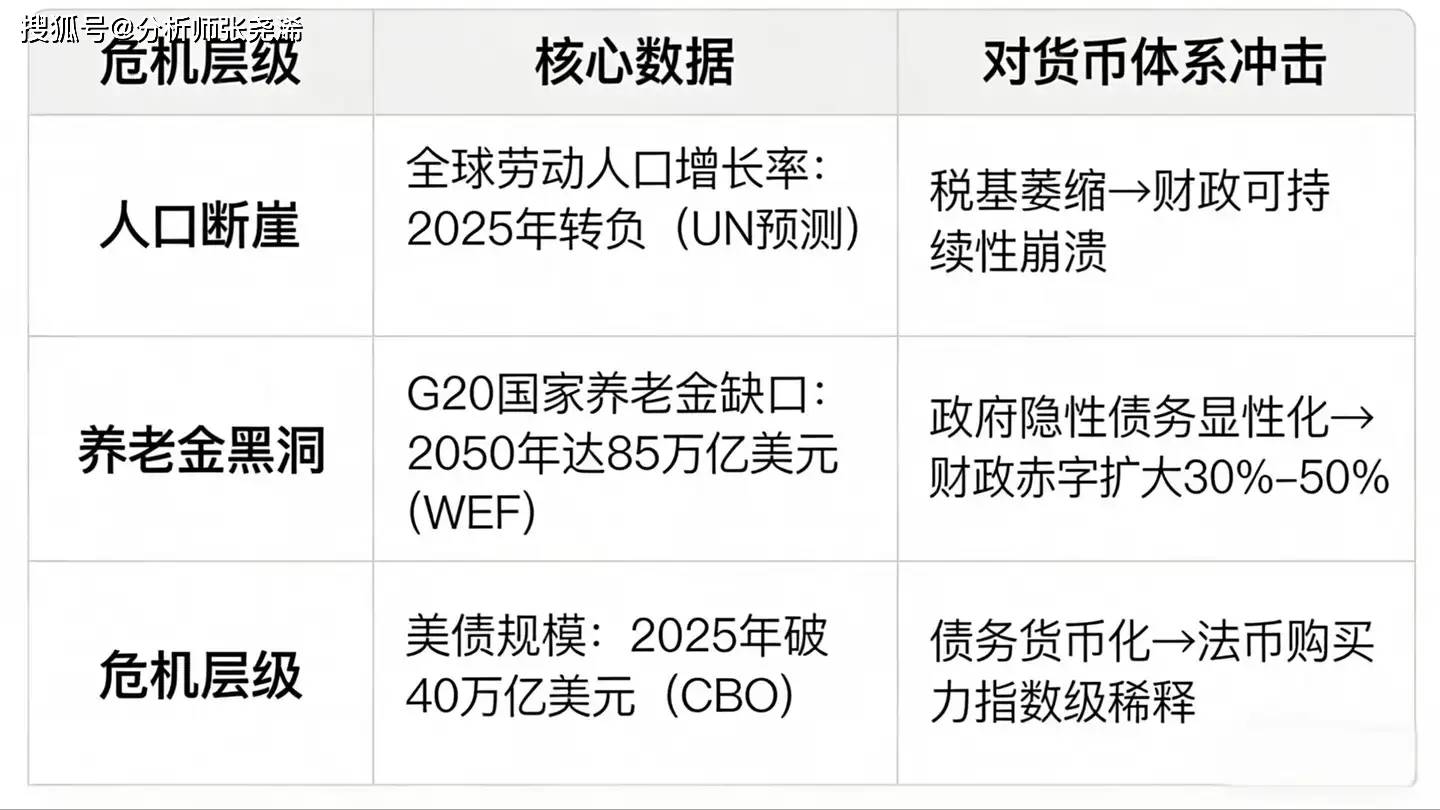
Core Viewpoint - The future price of gold is not merely about reaching a certain level but is tied to a reset and recalibration of the monetary system, indicating a significant shift in how assets are valued and perceived in relation to currency [1][6]. Group 1: Historical Context and Price Movements - Historical surges in gold prices have occurred during moments of monetary system failure rather than economic recessions, highlighting gold's role as a "pressure gauge" for the monetary system [1]. - Significant historical price jumps in gold occurred in 1933, 1971, and 2008, each corresponding to a breakdown in monetary credibility, with price increases of 40%, 70%, and over 180% respectively [1]. - The commonality in these instances is that gold's price increases (10-30 times) far exceeded inflation rates (2-3 times), indicating that the core driver was a reassessment of monetary credibility rather than mere inflation hedging [1]. Group 2: Structural Economic Challenges - The global economy faces three interrelated structural challenges: aging populations, pension fund insolvency, and uncontrolled sovereign debt, which collectively exacerbate long-term risks to fiscal sustainability and the monetary system [2][4]. - By 2050, G20 countries are projected to have a pension shortfall of $85 trillion, indicating a looming fiscal crisis [4]. - The U.S. national debt is expected to exceed $40 trillion by 2025, further stressing the fiscal landscape [4]. Group 3: Debt and Monetary Dynamics - Global sovereign debt is projected to reach $100 trillion by 2025, with interest payments consuming 4.2% of GDP, raising concerns about repayment capabilities [5]. - The U.S. debt interest-to-GDP ratio is expected to surpass 5.3%, indicating a potential crisis similar to the stagflation period of the 1980s [5]. - The ongoing geopolitical conflicts, such as the Russia-Ukraine war, are accelerating the depletion of pension reserves in affected countries, illustrating the fragility of pension systems under stress [5]. Group 4: Central Bank Gold Purchases - In 2023, global central banks purchased 1,136 tons of gold, marking the 14th consecutive year of net buying, with emerging markets accounting for 78% of this demand [5]. - The strategic intent behind these purchases includes providing super-sovereign credit guarantees for sovereign debt restructuring and experimenting with new monetary anchors [5]. - The formula for estimating future gold prices suggests a potential range of $15,000 to $60,000 per ounce based on global debt levels and gold coverage ratios, far exceeding current market expectations [5]. Group 5: Future Monetary System and Gold's Role - The transition to a new monetary system is anticipated, with major central banks directly purchasing government bonds, leading to a loss of price discovery for fiat currencies [5]. - Regional currency alliances are emerging, with initiatives like gold-backed digital currencies being tested in Southeast Asia and the Gulf region [5]. - The shift from physical gold to digital gold certificates is underway, with compliance-driven gold ETFs seeing significant growth [5]. Group 6: Investment Strategy Recommendations - The company suggests increasing gold allocation in investment portfolios from 5% to over 20% as a monetary reserve [6]. - Prioritizing physical gold holdings and central bank-level gold ETFs is recommended for future-proofing against monetary system changes [6]. - The timeframe for strategic positioning is advised to be before large-scale sovereign debt restructuring agreements, expected between 2028 and 2032 [6].

【财经分析】亚洲货币开启“夏季攻势” 货币体系重置“在路上”?
Xin Hua Cai Jing· 2025-05-06 09:05
Group 1 - The core viewpoint of the articles indicates that Asian currencies are experiencing a strong appreciation against the US dollar, driven by factors such as improved global market risk appetite, significant holdings of dollar assets by Asian exporters and insurers, and a slowdown in the US economy [1][2][3] - The offshore RMB has seen a substantial increase, with a rise of over 600 basis points on May 2 and more than 100 basis points on May 5, reaching a five-month high [2] - The New Taiwan Dollar has appreciated nearly 7% against the US dollar in recent trading days, marking its highest level since February 2023 [2] Group 2 - Global investors are adjusting their portfolios, leading to downward pressure on the US dollar, with non-US investors holding approximately $22 trillion in US assets, which constitutes about one-third of their total investment portfolio [3] - The performance of US tech stocks remains robust, but many companies express concerns about future prospects, leading investors to sell off US stocks at high prices [3] - The significant drop in oil prices has reduced import costs for Asian countries, potentially expanding trade surpluses and further supporting the appreciation of Asian currencies [3][5] Group 3 - Analysts suggest that the long-term downtrend of the US dollar is unlikely to reverse fundamentally, with weakened confidence in US assets and limited potential for dollar rebounds [4][5] - The ongoing fiscal and current account deficits in the US are seen as constraints on the dollar's strength, while foreign investors are reducing their holdings of US assets [5] - The global rebalancing of asset allocation may just be beginning, as non-US governments are likely to stimulate their economies through fiscal policies, promoting capital repatriation [5]