贸易对象多元化

Search documents
从极限施压到政策转向,美国对巴西关税“急转弯”的背后
Sou Hu Cai Jing· 2026-01-23 07:37
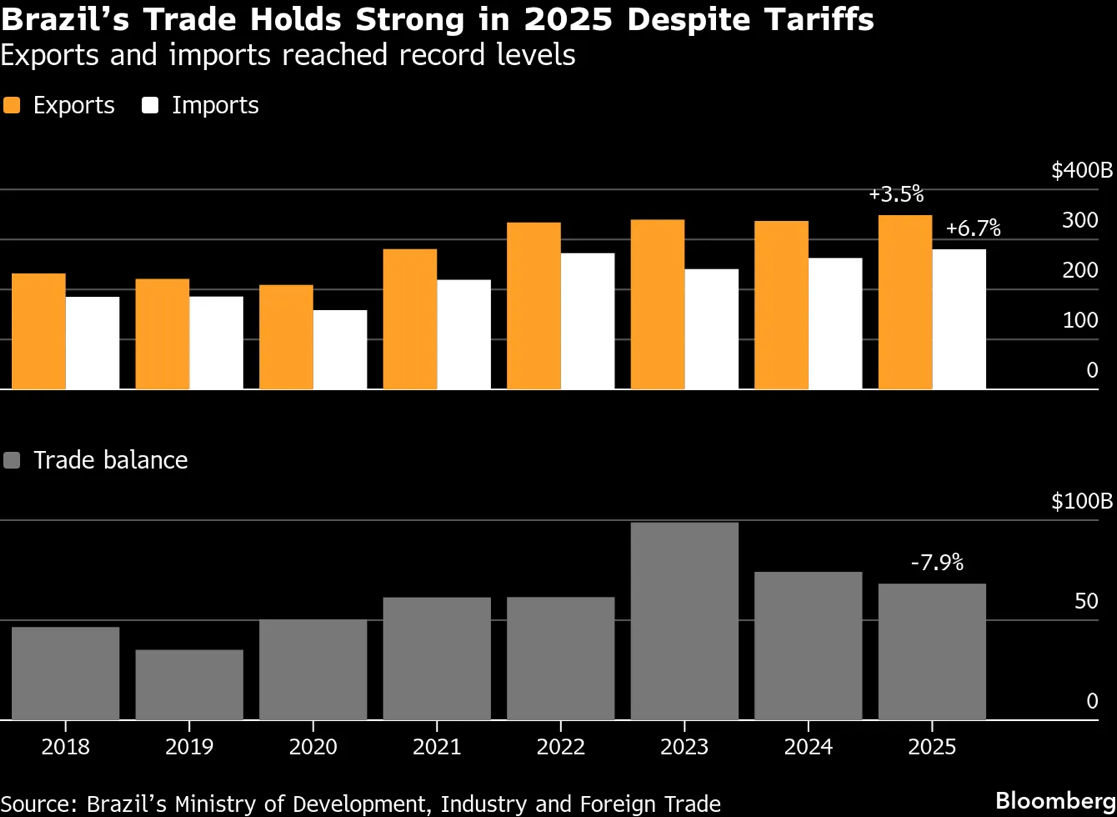
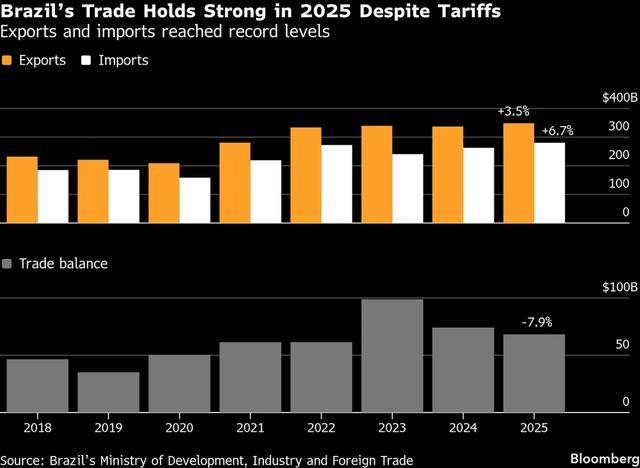
Core Viewpoint - The U.S. government's imposition of high tariffs on Brazil has led to significant policy adjustments, with Brazil successfully diversifying its trade partners and achieving record export levels despite the tariffs [1][2][6]. Group 1: U.S. Tariff Policy and Brazil's Response - In July 2025, the U.S. announced a 40% additional tariff on certain Brazilian goods, raising the total tariff rate on some exports to 50% [2][5]. - Contrary to expectations, Brazil's exports reached a historical high of $348.7 billion in 2025, marking a 3.5% increase from 2024 [2]. - Brazil's coffee export revenue hit $15.586 billion in 2025, a 24.1% increase from 2024, despite facing challenges such as reduced export volumes and increased U.S. tariffs [4][5]. Group 2: Factors Influencing U.S. Tariff Adjustments - The U.S. faced domestic supply shortages for coffee and beef, leading to increased prices and consumer dissatisfaction, which pressured the government to reconsider its tariff strategy [6][8]. - The U.S. domestic food price inflation was around 3%, with coffee prices rising by 21% and beef prices by nearly 14% year-on-year [6][8]. - The political landscape in the U.S. showed declining approval ratings for the current administration, with only about one-third of respondents approving of the handling of economic issues [8]. Group 3: Brazil's Trade Diversification Efforts - Brazil's government implemented measures such as fiscal support and price guarantees to mitigate the impact of U.S. tariffs, while also seeking to expand into new markets [5][10]. - Exports to China increased by 28.6% from August to November 2025 compared to the same period in 2024, while exports to the U.S. decreased by 25.1% [5]. - The signing of a free trade agreement between the Southern Common Market (Mercosur) and the European Union on January 17, 2026, is expected to enhance Brazil's trade relations and economic growth [1][11][13].

拉美观察丨从极限施压到政策转向 美国对巴西关税 “急转弯”的背后
Yang Shi Xin Wen· 2026-01-23 07:14
Group 1 - The core viewpoint of the articles highlights the impact of the U.S. tariff policies on Brazil, particularly the imposition of a 40% additional tariff on certain Brazilian goods, which has led to significant adjustments in trade dynamics and Brazil's response strategies [1][6][13] - Brazil's exports reached a historical high of $348.7 billion in 2025, marking a 3.5% increase from 2024, despite the U.S. tariffs, showcasing Brazil's ability to diversify its trade partners [2][5] - The signing of a free trade agreement between the Southern Common Market (Mercosur) and the European Union on January 17, 2026, is a significant step towards creating one of the world's largest free trade areas, aiming to eliminate tariffs on over 90% of goods [1][14][16] Group 2 - The U.S. tariff policy has been influenced by domestic inflation concerns and the need to address consumer dissatisfaction due to rising food prices, particularly for coffee and beef, which are heavily imported from Brazil [6][7][10] - Brazil's coffee export revenue reached $15.586 billion in 2025, a 24.1% increase from 2024, despite a 33.9% drop in coffee imports from the U.S., indicating a shift in market dynamics with Germany becoming the largest consumer [5][6] - The ongoing geopolitical tensions and the unpredictability of U.S. trade policies have prompted Brazil to strengthen its trade diversification strategies and seek new markets, particularly in Europe, Asia, and Africa [13][16]