资本公积金转增注册资本

Search documents
鼎和财险的转型阵痛与挑战:从“电网自保”到市场化求生
Hua Xia Shi Bao· 2025-11-24 09:20
Core Viewpoint - The recent transfer of 6.5% equity from Southern Power Grid Finance Co. to Southern Power Grid Industrial Finance Holding Group highlights the ongoing changes in the ownership structure of Dinghe Property Insurance, which is facing challenges in its market-oriented transformation despite a history of profitability [2][4]. Group 1: Ownership and Financial Performance - Dinghe Property Insurance, established in 2008, has seen its premium income grow from 121 million to 7.535 billion by 2024, maintaining a net profit streak for over a decade [3]. - The company’s net profits from 2021 to 2024 were 1.026 billion, 1.082 billion, 1.225 billion, and 700 million respectively, indicating fluctuations in profitability [3]. - Related party transactions with power sector stakeholders contributed significantly to premium income, amounting to 2.593 billion, 2.826 billion, and 3.06 billion from 2021 to 2023, representing 47.40%, 44.49%, and 45.13% of total premium income [3]. Group 2: Market Position and Challenges - The unique ownership structure of Dinghe Property Insurance provides stable business sources but limits its market development potential [4]. - The company initiated a mixed-ownership reform in 2021, raising 6.451 billion through the introduction of three strategic investors, changing its status from a wholly-owned subsidiary to a diversified equity entity [4]. - The company’s capital base was recently increased from 4.643 billion to 6 billion through a capital reserve conversion, a rare practice in the industry [5]. Group 3: Management and Strategic Direction - Dinghe Property Insurance has experienced stability in management, with only four chairpersons and five general managers over 17 years, reflecting a reliance on shareholder-appointed executives [5][6]. - The introduction of a market-oriented management system in 2020 marked a significant shift, with the first externally recruited general manager, Jin Peng, breaking the previous internal leadership pattern [6]. - The current leadership transition to Liu Dong, an experienced insurance professional, signals a commitment to further professionalize operations [6]. Group 4: Risk Exposure and Future Goals - The company faces significant risks due to its close ties to the power sector, as evidenced by increased claims from natural disasters in 2024, leading to a 29.41% rise in claims expenditures to 4.268 billion [7]. - Dinghe Property Insurance set an ambitious "10020" development goal for 2025, aiming for 10 billion in premium income and 2 billion in net profit, but is currently falling short of these targets [8]. - The company’s cost structure has been under pressure, with claims expenses constituting 65% of total expenditures in 2024, alongside rising commission and management costs [8]. Group 5: Market Independence and Future Transformation - Dinghe Property Insurance has yet to demonstrate its ability to operate independently from its shareholder support, raising questions about its market expansion capabilities [9]. - The challenge lies in balancing the advantages of shareholder resources while establishing a competitive market position, crucial for the company's future development [9].


年内险企密集增资,打响偿付能力“保卫战”
Sou Hu Cai Jing· 2025-05-19 10:18
Core Viewpoint - The insurance industry in China is undergoing a "capital replenishment" phase as companies increase registered capital and issue bonds to enhance solvency amid a declining interest rate environment [1][8]. Group 1: Capital Increase Activities - Three insurance companies, Dinghe Property Insurance, Guofu Life, and China United Life, announced capital increase plans totaling approximately 2.678 billion yuan within three days [1]. - As of May 18, the total approved capital increase for the year reached 3.673 billion yuan, combined with 49.6 billion yuan in bond issuance, bringing the total capital replenishment to over 53 billion yuan, significantly higher than the previous year's 14 billion yuan [1][8]. - Dinghe Property Insurance plans to increase its registered capital from approximately 4.643 billion yuan to 6 billion yuan through a capital reserve conversion, amounting to about 1.357 billion yuan [1][2]. Group 2: Different Capital Increase Methods - The capital reserve conversion method allows companies to increase registered capital without changing total shareholder equity or diluting existing shareholders' stakes, thus saving cash flow [2]. - In contrast, equity capital increases involve issuing new shares or transferring existing shares, which can alter the company's ownership structure and potentially dilute existing shareholders [2]. Group 3: Regulatory and Market Context - The insurance industry faces pressure on liability reserves and solvency adequacy due to ongoing interest rate declines, necessitating external capital replenishment through shareholder increases and bond issuances [8][9]. - The implementation of stricter capital recognition standards under the second phase of the solvency regime has raised minimum capital requirements, further emphasizing the need for capital support as insurance business scales up [9]. Group 4: Future Strategies for Insurance Companies - To effectively navigate the solvency "defense battle," insurance companies should optimize internal management and enhance operational efficiency to improve self-accumulation capabilities [9]. - Strengthening risk management and asset allocation is crucial to ensure effective use and appreciation of capital, moving away from past capital utilization models towards more scientific and efficient business structuring [9].
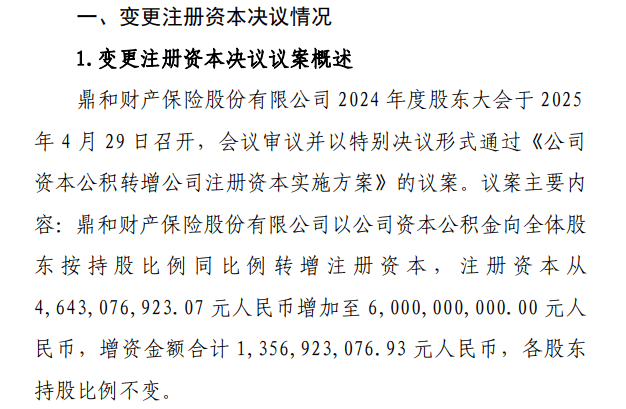
“左手倒右手”增资13.57亿元,鼎和财险以资本公积金转增注册资本
Hua Xia Shi Bao· 2025-05-16 10:58
Core Viewpoint - Dinghe Property Insurance has announced an increase in registered capital from 4.643 billion to 6 billion yuan through capital reserve conversion, totaling 1.357 billion yuan, which requires regulatory approval to take effect [2][3]. Group 1: Capital Increase Method - The capital increase is achieved by converting accumulated capital reserves into registered capital, maintaining the total equity of shareholders and avoiding cash flow involvement, thus saving company cash [2][3]. - This method is uncommon in the industry and does not dilute existing shareholders' equity [2][3]. Group 2: Company Performance - Dinghe Property Insurance has shown significant growth in premium income, increasing from 121 million yuan at inception to 7.535 billion yuan in 2024, with net profits consistently positive over the past decade [5][6]. - The company aims to achieve a target of 10 billion yuan in premiums and 2 billion yuan in net profit by 2025, although it is currently behind schedule [5][6]. Group 3: Shareholder Support and Market Position - The company benefits from strong support from its electric power shareholders, with related party transactions contributing significantly to premium income [6]. - The primary insurance product is auto insurance, which has faced underwriting losses since 2020, reflecting broader challenges in the auto insurance market for smaller companies [6][7]. Group 4: Future Strategies - Dinghe Property Insurance is exploring new business opportunities in the renewable energy sector, aiming to provide tailored insurance products for new energy enterprises and electric vehicle users [7]. - The appointment of a new general manager with extensive experience in leading insurance companies is expected to bring fresh perspectives to the company's development [7].

资本公积转增注册资本,百亿目标“攻坚”期,鼎和财险另类增资意欲何为
Bei Jing Shang Bao· 2025-05-15 13:44
Core Viewpoint - The insurance company Dinghe Property Insurance Co., Ltd. is opting for a capital increase through capital reserve conversion amid a general "capital shortage" in the industry, planning to increase its registered capital by 1.357 billion yuan to support its ambitious performance targets for 2025 [1][3][5] Capital Increase Details - On May 14, Dinghe announced a capital increase from 4.643 billion yuan to 6 billion yuan through capital reserve conversion, totaling 1.357 billion yuan, with no change in shareholder ratios [3][4] - This method of capital increase is uncommon in the insurance industry, as it does not involve new funds entering the company, but rather an internal adjustment of equity structure [3][5] Performance Goals and Challenges - Dinghe has set a target of achieving 10 billion yuan in premium income and 2 billion yuan in net profit by 2025, but it currently faces significant challenges in reaching these goals [1][7][8] - The company's net profit has decreased to 700 million yuan in 2024, down from around 1 billion yuan in previous years, indicating a struggle to meet its ambitious targets [7][8] Business Performance and Market Conditions - Dinghe's car insurance business, which generated 2.7 billion yuan in premium income in 2024, has been unprofitable for several years, with a loss of approximately 74.62 million yuan in 2024 [10][11] - The competitive landscape in the car insurance market has intensified, leading to reduced profit margins due to aggressive pricing strategies among insurers [10][11] Strategic Recommendations - To improve profitability in the car insurance sector, it is suggested that Dinghe leverage advanced technologies for risk assessment, implement strict claims management, and enhance customer engagement through value-added services [11]