资金扩散效应

Search documents
期货收评:钯期货涨超4%,线材涨超3%,铂期货、PVC涨超2%;沪锡跌超3%,沥青、沪镍、低硫燃油、菜油跌超2%
Sou Hu Cai Jing· 2025-12-16 07:24
Group 1: Macro Perspective - The Federal Reserve's FOMC meeting on December 11 resulted in a rate cut of 25 basis points to 3.5-3.75%, with a commitment to purchase $40 billion in short-term government bonds monthly starting December 12 to maintain liquidity [2] - The market's expectation of continued monetary easing by the Federal Reserve has not changed, leading to a weaker dollar and supporting the overall price increase of precious metals [2] - Following new highs in gold and silver prices, funds have shifted towards relatively undervalued platinum and palladium, driving a rebound in these metals [2] Group 2: Supply and Demand Dynamics - South Africa's ongoing electricity crisis, maintenance of aging mines, and declining production capacity are disrupting global platinum and palladium supply [2] - Geopolitical factors are also affecting Russian supply, contributing to the overall supply disturbances of platinum and palladium [2] - On the demand side, weak demand for traditional automobiles negatively impacts platinum and palladium [2] Group 3: Market Performance - As of December 16, domestic main contracts showed mixed results, with palladium rising over 4% and platinum futures, PVC increasing over 2% [3] - In contrast, Shanghai tin fell over 3%, while asphalt, nickel, low-sulfur fuel oil, and rapeseed oil dropped over 2% [3] - The performance of platinum is slightly better than that of palladium, indicating a potential for further price increases in both metals [4]

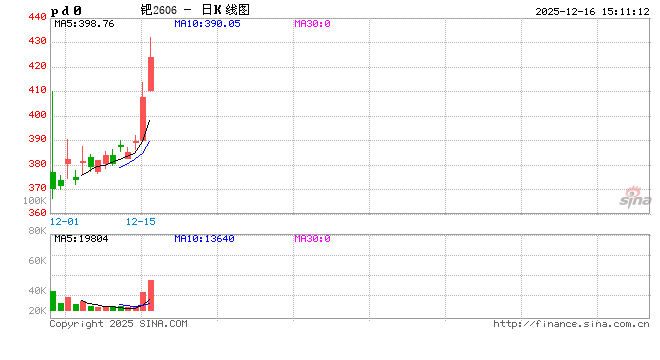
收评|国内期货主力合约涨跌互现 钯期货涨超4%
Xin Lang Cai Jing· 2025-12-16 07:07
Group 1 - The core viewpoint of the article highlights the mixed performance of domestic futures contracts, with palladium futures rising over 4% and rebar increasing over 3%, while other commodities like tin and asphalt saw declines of over 2% [2][6]. Group 2 - Analysts from Huatai Futures attribute the rise in platinum and palladium prices to a "spillover effect" from funds, driven by macroeconomic factors such as the Federal Reserve's recent interest rate cut and ongoing liquidity measures [4][8]. - The Federal Reserve's FOMC meeting on December 11 resulted in a 25 basis point rate cut to a range of 3.5-3.75%, with a commitment to purchase $40 billion in short-term government bonds monthly to maintain liquidity, which has led to expectations of a weaker dollar and supported the overall rise in precious metal prices [4][8]. - Supply disruptions in platinum and palladium are exacerbated by ongoing power crises in South Africa, maintenance of aging mines, and geopolitical issues affecting Russian supply, while demand from traditional automotive sectors remains weak [4][8].

华泰期货:铂、钯期货又涨了,后市怎么看?
Xin Lang Cai Jing· 2025-12-16 01:42
Group 1: Market Performance - The main platinum futures contract PT2606 hit the limit up, with a daily increase of 7.00%, closing at 482.4 yuan/gram, marking its first limit up since listing [2][7] - The main palladium futures contract PD2602 reached a high of 413.65 yuan/gram, closing at 407.6 yuan/gram, with an increase of 4.73% [2][7] - Domestic market performance significantly outperformed the international market, with NYMEX platinum and palladium futures both increasing by around 3% as of December 15, 15:00 Beijing time [2][8] Group 2: Price Differentials - The price differential between domestic and international platinum was approximately 14 yuan/gram, while for palladium it was around 45 yuan/gram, considering the import VAT for platinum [2][7] - There is a potential for narrowing of these price differentials if NYMEX night trading experiences a rebound, given the absence of night trading in the domestic market [2][8] Group 3: Macro Factors - The Federal Reserve's FOMC meeting on December 11 resulted in a 25 basis point rate cut to 3.5-3.75%, with a commitment to purchase 40 billion USD of short-term government bonds monthly starting December 12 to maintain liquidity [8] - The market's expectation of continued monetary easing from the Federal Reserve has not changed, leading to a weaker dollar, which supports the overall price increase of precious metals [8] Group 4: Supply and Demand Dynamics - Ongoing power crises in South Africa, maintenance of aging mines, and declining production capacity are disrupting global platinum and palladium supply [3][8] - Geopolitical factors affecting Russian supply also contribute to these disruptions, while weak demand from traditional automotive sectors negatively impacts platinum and palladium [3][8] - Overall, the supply shortage of platinum is more severe, leading to better performance of platinum prices compared to palladium, with further price increases for both metals still likely [3][8]