资金炒作

Search documents
商品氛围急转直下,胶价跟随回落
Zhong Xin Qi Huo· 2026-02-03 00:56
1. Report Industry Investment Rating No specific investment rating for the entire industry is provided in the report. However, individual outlooks for each commodity are as follows: - Oils and Fats: Soybean oil, palm oil, and rapeseed oil are all expected to trade sideways [6]. - Protein Meal: Both soybean meal and rapeseed meal are expected to trade sideways [9]. - Corn and Starch: Expected to trade weakly with a sideways bias [12]. - Hogs: Expected to trade weakly with a sideways bias in the short - term, with potential for a turnaround in H2 2026 [13]. - Natural Rubber: Expected to trade strongly with a sideways bias [17]. - Synthetic Rubber: Expected to trade strongly with a sideways bias in the medium - term [19]. - Cotton: Expected to trade strongly with a sideways bias in the long - and medium - terms [20]. - Sugar: Expected to trade weakly with a sideways bias in the long - and medium - terms [21]. - Pulp: Expected to trade sideways [22]. - Double - Gum Paper: Expected to trade weakly with a sideways bias [24]. - Logs: Expected to trade strongly with a sideways bias in the short - term [25]. 2. Core Viewpoints - The overall sentiment in the commodity market has turned negative recently, affecting the prices of various agricultural products. - Different agricultural products are influenced by a combination of macro factors, supply - demand fundamentals, and seasonal patterns [1][6][8]. 3. Summary by Commodity Oils and Fats - **View**: Macro sentiment has weakened, leading to a significant correction in oil prices. - **Logic**: Crude oil decline and overall commodity market weakness have affected sentiment. For soybeans, Argentina's drought may reduce production, while the US biodiesel policy is yet to be finalized. Palm oil lacks new positive news after the previous rally. Rapeseed oil supply is expected to gradually recover. - **Outlook**: Soybean oil, palm oil, and rapeseed oil are expected to trade sideways. Consider buying on dips for hedging [6]. Protein Meal - **View**: Market sentiment is weak, and both soybean and rapeseed meals are trading lower. - **Logic**: Internationally, the macro environment has cooled, and the US soybean export is weak, while Brazil's harvest is increasing. Domestically, the spot price of soybean meal is under pressure, and the supply of rapeseed meal is expected to improve. - **Outlook**: Both soybean and rapeseed meals are expected to trade sideways [8][9]. Corn and Starch - **View**: Pre - holiday stocking is coming to an end, and both futures and spot prices are trading weakly. - **Logic**: Downstream stocking is almost finished, and policy - grain auctions have lower trading rates. There are marginal negative factors such as increased upstream sales, sufficient downstream inventory, and the impact of imported grains. - **Outlook**: Expected to trade weakly with a sideways bias [9][11][12]. Hogs - **View**: At the beginning of the month, the slaughter volume is slightly reduced, but inventory pressure remains. - **Logic**: In the short - term, large hogs will be slaughtered as the Spring Festival approaches. In the medium - term, supply will be excessive until April 2026. In the long - term, supply pressure may ease after May 2026. Demand and inventory show certain changes. - **Outlook**: Expected to trade weakly with a sideways bias in the short - term, with potential for a turnaround in H2 2026 [13]. Natural Rubber - **View**: The commodity atmosphere has turned negative, and rubber prices have followed suit. - **Logic**: The previous rally was driven by macro factors, and there has been no change in fundamentals. The current trading is mainly influenced by macro factors. Supply is relatively abundant, and the demand has not seen large - scale restocking. The most obvious negative factor is rapid inventory accumulation. - **Outlook**: Although fundamental variables are limited, market attention has increased, and the market is expected to trade strongly with a sideways bias [15][16][17]. Synthetic Rubber - **View**: The medium - term logic remains unchanged. - **Logic**: The market was affected by the overall commodity sentiment, but the medium - term core logic of tight supply of butadiene in H1 2026 remains. - **Outlook**: The supply - demand situation of butadiene is expected to improve, but short - term adjustments are needed. It is expected to trade strongly with a sideways bias in the medium - term [19]. Cotton - **View**: It has adjusted downward following macro expectations, but the downward space is expected to be limited. - **Logic**: Supply - side processing is nearing completion, demand is weakening as the Spring Festival approaches, and inventory is still accumulating but at a slower pace. In the long - term, the market is expected to be tight - balanced in 25/26, and the planting area in Xinjiang is expected to decline. - **Outlook**: Expected to trade strongly with a sideways bias in the long - and medium - terms. Consider buying on dips [20]. Sugar - **View**: It is expected to trade weakly with a sideways bias in the long - and medium - terms. - **Logic**: The global sugar market is expected to have a surplus in the 25/26 season, with major producers expected to increase production. - **Outlook**: Consider short - selling on rallies [21]. Pulp - **View**: While most commodities have declined significantly, pulp has shown resistance. - **Logic**: The overall commodity market has affected pulp, but its decline is relatively limited. Demand is seasonally weakening, and there are more negative factors, but the increase in import costs provides some support. - **Outlook**: Expected to trade sideways [22]. Double - Gum Paper - **View**: The decline in the commodity market has put pressure on double - gum paper. - **Logic**: The market is following the macro trend. Before the Spring Festival, there is no clear upward or downward driver, with abundant supply, weak demand, and reduced cost support. - **Outlook**: Expected to trade weakly with a sideways bias [24]. Logs - **View**: The fundamentals have improved marginally, and the market is trading strongly. - **Logic**: The expected increase in the next - period foreign quotation and the decrease in arrivals at major ports have led to a stronger spot market. There are also potential positive factors in the delivery aspect. - **Outlook**: Expected to trade strongly with a sideways bias in the short - term [25]. 4. Commodity Index Data - On February 2, 2026, the comprehensive index of CITICS Futures commodities was 2420.95, down 3.75%. The commodity 20 index was 2773.66, down 4.55%, and the industrial products index was 2312.70, down 2.62%. - The agricultural products index was 936.74 on February 2, 2026, with a daily decline of 0.79%, a 5 - day decline of 0.76%, a monthly increase of 0.40%, and a YTD increase of 0.40% [185][187].
寒潮继续推升天然?价格,化?产业向好预期推升利润扩张
Zhong Xin Qi Huo· 2026-01-23 01:18
1. Report Industry Investment Rating No specific industry investment rating is provided in the report. 2. Core Viewpoints of the Report - The cold wave has pushed up natural gas prices, with US natural gas futures soaring to their highest level since 2022, and the HH natural gas price is expected to set a record for the largest weekly increase since 1990. The cold wave may disrupt natural gas production in southern US and increase demand, while its impact on shale oil production is expected to be limited [1]. - Crude oil prices remain stable, natural gas prices rise, and chemical product prices rebounded significantly on Thursday. The chemical industry chain is relatively dull, with the ethane - cracking ethylene plant and US propane prices being positively affected. The prices of PTA and styrene in the aromatic hydrocarbon sector are supported by market expectations of profit expansion in the chemical industry chain, but considering the large idle capacity of most chemical products, the probability of continuous profit expansion is low [1]. - Overall, the energy and chemical market is expected to fluctuate, with crude oil still facing geopolitical risks [2]. 3. Summary by Relevant Catalogs 3.1 Market Outlook - **Crude Oil**: Supply pressure persists, with high inventories of crude oil and refined products in the US. The impact of the cold wave and supply disruptions in Kazakhstan are temporary, and future price support depends on geopolitical factors. The outlook is for a volatile market [7]. - **Asphalt**: The price of asphalt futures has risen with the strength of crude oil. However, the supply of Venezuelan oil may increase in the long - term, which will be a major negative factor. Currently, asphalt is overvalued, and its medium - to - long - term valuation is expected to decline. The outlook is for a volatile market [7][8]. - **High - Sulfur Fuel Oil**: There is an expectation of a significant increase in heavy oil supply, which will put long - term pressure on high - sulfur fuel oil. Although the geopolitical premium has returned, the high floating storage in the Asia - Pacific region and the substitution of fuel oil by natural gas and photovoltaic energy are long - term negative factors. The outlook is for a volatile market [8]. - **Low - Sulfur Fuel Oil**: The sharp increase in natural gas prices may support low - sulfur fuel oil. However, it faces challenges such as a decline in shipping demand, substitution by green energy, and high - sulfur fuel oil. Currently, its valuation is low, and it is expected to fluctuate with crude oil. The outlook is for a volatile market [10]. - **PX**: Driven by market sentiment, PX prices are expected to be volatile and slightly stronger in the short term, but its own structural weakness restricts its upward space. PXN is expected to range between $300 - 350 per ton [11]. - **PTA**: Due to increased capital attention, PTA prices have risen significantly. Although the supply - demand pattern is expected to accumulate inventory, the processing fee has improved, and it is expected to be volatile and slightly stronger in the short term [11]. - **Pure Benzene**: Factors such as port destocking, downstream profit - locking, potential tariff cancellation, and the need for a price increase in the aromatic hydrocarbon sector have led to a slightly stronger and volatile trend in pure benzene prices [13][14]. - **Styrene**: Export disruptions, geopolitical factors, and the overall warm commodity atmosphere have led to a short - term strong and volatile trend in styrene prices. If there is no unexpected significant increase in supply or major negative news from crude oil, this trend will continue [15]. - **Ethylene Glycol**: Affected by capital and the cold wave, ethylene glycol prices have rebounded with reduced positions. Although there is seasonal inventory accumulation pressure, short - term prices are expected to fluctuate within a range [15][17]. - **Short - Fiber**: Driven by cost and market sentiment, short - fiber prices have strengthened, and downstream replenishment has increased. The price is expected to follow the upstream trend with slightly pressured processing fees [19]. - **Polyester Bottle Chips**: The resonance of cost and improved supply - demand has led to profit expansion. The price is expected to fluctuate with raw materials, and the support for the processing fee has increased [21]. - **Methanol**: The inland market is weak, and the coastal market has both long and short factors. Methanol is expected to fluctuate within a range [23]. - **Urea**: With good new order transactions at low prices, urea prices have stabilized and are expected to fluctuate. The market is currently in a stalemate [24]. - **LLDPE**: The cold wave in the US and the strong chemical market sentiment have driven the price rebound, but the upward space may be limited. The short - term outlook is for a volatile market [28]. - **PP**: Driven by the chemical market sentiment, PP prices are expected to fluctuate in the short term. Attention should be paid to the impact of profit changes on maintenance plans [29]. - **PL**: Supply has tightened, and PL prices are expected to be volatile in the short term [30]. - **PVC**: Short - term "export rush" may support PVC prices, but the long - term supply - demand outlook is under pressure. The price is expected to be volatile [32]. - **Caustic Soda**: With low valuation and weak expectations, caustic soda prices are expected to be weak and volatile [33]. 3.2 Variety Data Monitoring 3.2.1 Energy and Chemical Daily Indicator Monitoring - **Inter - period Spreads**: Different varieties have different inter - period spread values and changes, such as Brent (M1 - M2: 0.71, unchanged), Dubai (M1 - M2: 0.36, - 0.02), etc. [34]. - **Basis and Warehouse Receipts**: Each variety has corresponding basis values, changes, and warehouse receipt quantities, for example, asphalt (basis: - 162, change: - 75, warehouse receipts: 45820 tons) [35]. - **Inter - variety Spreads**: There are various inter - variety spread values and changes, like 1 - month PP - 3MA (- 358, + 10), 1 - month TA - EG (1630, + 180), etc. [36]. 3.2.2 Chemical Basis and Spread Monitoring The report also provides basis and spread monitoring for various chemicals such as methanol, urea, styrene, etc., but specific data summaries are not detailed here [37][49][61]. 3.3 Commodity Index - **Comprehensive Index**: The comprehensive index, specialty index, and sector index all showed certain increases on January 22, 2026. For example, the commodity index increased by 0.69% to 2444.59, the energy index increased by 1.46% to 1124.89, etc. [276][277].
白银杀疯了!3年飙涨4倍!很多人还在排队等上车?
凤凰网财经· 2026-01-15 14:52
Core Viewpoint - The article highlights the remarkable surge in silver prices, which have increased significantly due to supply-demand imbalances, macroeconomic policies, and industrial demand, positioning silver as a key investment opportunity in the current market [2][8]. Supply and Demand Dynamics - The global silver market has faced a structural shortage, with a projected supply gap of 3,700 tons by 2025, marking a ten-year high. This shortage is exacerbated by the fact that approximately 70-72% of silver is produced as a byproduct of mining other metals, making it difficult to increase silver production in the short term [10][11]. - Major silver-producing countries are experiencing production declines due to various factors, including political instability in Peru and sanctions affecting Russia, while new mining projects in Australia are insufficient to offset declines from older mines [10][11]. Industrial Demand and Macroeconomic Factors - Industrial demand for silver has exploded, with over 60% of silver consumption now coming from industrial applications, particularly in the photovoltaic sector, which is expected to demand 0.61 million tons by 2025 [14]. - The macroeconomic environment, characterized by expectations of continued interest rate cuts by the Federal Reserve, has created a favorable backdrop for silver investments, driving down the holding costs of non-yielding assets like silver [15]. Market Sentiment and Investment Trends - The market has seen a significant influx of investment, with net physical investment in silver projected to reach approximately 6,400 tons by 2025. This surge in interest has led to a dramatic increase in silver prices, with a notable 3.56% rise in a single day [17]. - There is a stark divide among institutional forecasts regarding silver prices, with optimistic projections suggesting a target of $100 per ounce in the near term, while more conservative views highlight potential volatility and profit-taking among investors [18]. Conclusion - The current silver market is characterized by a combination of strong fundamental support from supply-demand dynamics and industrial growth, alongside speculative investment behavior. Investors are advised to approach the market with caution, considering both the potential for high returns and the inherent volatility associated with silver investments [19].


镍日报-20251231
Jian Xin Qi Huo· 2025-12-31 01:49
Report Overview - Report Title: Nickel Daily Report [1] - Date: December 31, 2025 [2] - Research Team: Non-ferrous Metals Research Team, including Yu Feifei, Zhang Ping, and Peng Jinglin [3] 1. Report Industry Investment Rating - Not provided in the report 2. Core Viewpoints - On the 30th, the Shanghai nickel price rose significantly again, with the main contract reaching a maximum of 134,480 yuan/ton and closing at 132,390 yuan/ton, a increase of 3.86%. The total position increased by 18,000 lots to 346,000 lots. Driven by the news of the reduction of the Indonesian RKAB quota, the speculation sentiment of funds is still rising, and the fluctuation range of nickel prices has increased [7]. - Driven by the sharp rise in nickel prices, the prices of other products in the industrial chain are also rising. The NPI quotation increased by 2.5 to 914.5 yuan/nickel point on the 30th, which is regarded as a short - term rebound. The nickel salt price increased by 20 to 27,575 yuan/ton, and the short - term price will continue to rise [7]. - Affected by a series of news speculations such as the reduction of the Indonesian RKAB quota and the revision of the nickel reference price HPM, combined with the amplification of macro and precious metal fluctuations, the speculation sentiment of long - position funds in the nickel market remains high. It is expected that the nickel price will continue to rise before the quota is finalized. It is recommended to wait and see and participate cautiously [7]. 3. Summary by Directory 3.1行情回顾与操作建议 - On the 30th, the Shanghai nickel price rose sharply, and the speculation sentiment of funds was heating up. The prices of NPI and nickel salt in the industrial chain also increased. The NPI price increase is regarded as a short - term rebound, and the nickel salt price will continue to rise in the short term [7]. - Affected by news speculations and market fluctuations, the long - position funds' speculation sentiment in the nickel market remains high. It is expected that the nickel price will have upward elasticity before the quota is finalized. It is recommended to wait and see and participate cautiously [7]. 3.2行业要闻 - From January to November, China's automobile production and sales exceeded 31 million, with a year - on - year increase of over 10%. The production and sales of new energy vehicles were close to 15 million, with a year - on - year increase of over 30%. The export of new energy vehicles was 2.315 million, a year - on - year increase of 100% [8] - The Indonesian government plans to reduce the nickel ore production target in the 2026 RKAB to about 250 million tons, a significant decrease from the 379 million tons in 2025. The final implementation method is still unclear [10]. - The London Metal Exchange (LME) plans to implement new position limit rules from July next year, covering key contracts such as aluminum, copper, lead, nickel, tin, and zinc futures, as well as related options and trading settlement contracts [10]
多重因素共振 沪锡创三年半新高【12月4日SHFE市场收盘评论】
Wen Hua Cai Jing· 2025-12-04 07:53
Core Viewpoint - Tin prices have surged significantly, reaching a peak of 323,700 yuan/ton, the highest since April 2022, before retracting slightly. The main contract closed up 2.23% at 316,230 yuan/ton, driven by supply-demand imbalances in the tin market and geopolitical tensions affecting supply chains [1]. Group 1: Supply Dynamics - The core logic supporting the rise in tin prices is the supply-demand imbalance, with the resumption of tin mining in Myanmar's Wa region lagging behind expectations and renewed supply disruptions from the Democratic Republic of Congo (DRC) exacerbating the global tin shortage [1]. - Tin ingot exports from Indonesia have largely returned to normal, with over 6,500 tons exported in November [1]. - Ongoing conflicts in the eastern DRC have heightened concerns about supply chain stability and increased logistics risks [1]. Group 2: Demand Trends - In early November, there was a notable decline in downstream consumption, with photovoltaic demand remaining stable but production expectations for home appliances in December significantly lower than November [2]. - Downstream enterprises reported a marked decrease in order volumes and slower inventory turnover, with many companies adopting a cautious approach to high prices and refraining from large-scale stocking [2]. - Overall consumption this year has slightly decreased compared to previous years, contributing to a weak supply-demand scenario [2]. Group 3: Market Sentiment and Future Outlook - The recent unexpected drop in U.S. ADP data has led investors to believe that the Federal Reserve will likely cut interest rates, causing the U.S. dollar index to fall below 99, which has positively impacted the overall non-ferrous metals market [2]. - The upcoming Central Economic Work Conference in December is expected to shift focus back to policy expectations, influencing market dynamics [2]. - While tensions in the eastern DRC continue to raise supply concerns, the market has already priced in some of these risks, indicating that new catalysts will be needed to further drive prices upward [2].
第四套人民币大全套全同号精装版收藏品深度解析
Sou Hu Cai Jing· 2025-11-05 03:39
Overview - The article discusses the deep analysis of a highly collectible set of the fourth edition of the Renminbi, which includes a complete set of all same-numbered notes in a premium edition, issued by the People's Bank of China, with a limited release of only 99 sets priced at 98,000 yuan [1][7]. Core Value Analysis - Historical significance and scarcity due to withdrawal from circulation: The fourth edition of the Renminbi represents a key historical transition in China's economy and has been officially withdrawn from circulation since 2018, leading to a decrease in its availability and an increase in value due to supply-demand dynamics [3][6]. - Same-numbered rarity: The set features notes with identical serial numbers, which are extremely rare and highly sought after by collectors, further enhancing its value [6]. - Rich variety and potential as "king of notes": The collection includes all nine denominations and 14 versions of the fourth edition, including rare 1980 versions of 50 yuan and 100 yuan, which are already valued over 10,000 yuan each [6][7]. - Top condition and authoritative certification: The notes have been rated 69 out of 70 by a professional grading agency, indicating excellent preservation, and come with a certification from the People's Bank of China, ensuring authenticity and limiting the risk of counterfeiting [5][7]. Investment and Collection Prospects - Hotspot for capital speculation: Recent trends indicate that certain denominations, such as the 2 yuan note, have gained significant attention, while the 1980 versions of 50 yuan and 100 yuan show strong appreciation potential [7]. - Long-term holding value: As a "closed currency type," the limited availability of the complete same-numbered set (only 99 sets) suggests that its value will likely increase over time, aligning with the principle that scarcity drives appreciation [7]. - Target audience: The collectible appeals to high-end collectors seeking extreme rarity and perfect condition, asset allocators looking for alternative investments to hedge against inflation, and history enthusiasts interested in the cultural significance of the notes [7].
热景生物连亏股价涨5倍严重背离 第三股东套现2亿第二股东拟接力
Chang Jiang Shang Bao· 2025-06-30 00:22
Core Viewpoint - After a significant increase in stock price, major shareholders of Hotgen Biotech (688068.SH) plan to reduce their holdings to cash out [2][11]. Shareholder Reduction Plans - Shareholder Zhou Xin intends to reduce his holdings by no more than 1.94% of the company's total shares, equating to 180,000 shares, within three months [3][4]. - Zhou Xin currently holds 7.34% of Hotgen Biotech's shares, amounting to 680,660 shares [4]. - If the maximum reduction is executed at the closing price of 137.30 CNY per share on June 25, Zhou Xin could cash out approximately 247 million CNY [5][6]. Historical Context of Shareholder Reductions - Zhou Xin's planned reduction follows a similar pattern observed in 2021, where he and other shareholders executed high-level cash-outs after stock price surges [8][12]. - In 2021, Zhou Xin reduced his holdings from 10.35% to 8.48%, cashing out approximately 102 million CNY at prices ranging from 36.89 to 199.5 CNY per share [10]. Recent Performance and Financials - Hotgen Biotech's stock price has surged approximately fivefold from 23.08 CNY per share on September 23, 2024, to 137.30 CNY per share on June 25, 2024 [7]. - The company has experienced significant financial distress, reporting a loss of 191 million CNY in 2024 and a further loss of 24 million CNY in the first quarter of the same year [17][18]. - Revenue has declined sharply from 35.57 billion CNY in 2022 to 5.11 billion CNY in 2024, marking a decrease of 84.78% year-on-year [17]. Business Operations and Market Position - Hotgen Biotech specializes in in vitro diagnostics (IVD) and has seen fluctuating performance due to the COVID-19 pandemic, with revenues peaking at 5.14 billion CNY in 2020 [15][16]. - The company has been involved in the development of various COVID-19 testing products, which initially drove significant revenue growth [15]. - However, as the pandemic subsided, the company's revenue and net profit have sharply declined, leading to concerns about its future profitability [17][18]. Research and Development Trends - The company's R&D investment has been decreasing, with expenditures dropping from 191 million CNY in 2022 to 113 million CNY in 2024 [18]. - Despite the decline in financial performance, the company has invested in several innovative pharmaceutical companies, although these ventures have yet to yield profits [18].

现货铂金单日大跌6%,“黄金平替”炒作情绪强烈
Di Yi Cai Jing· 2025-06-29 12:42
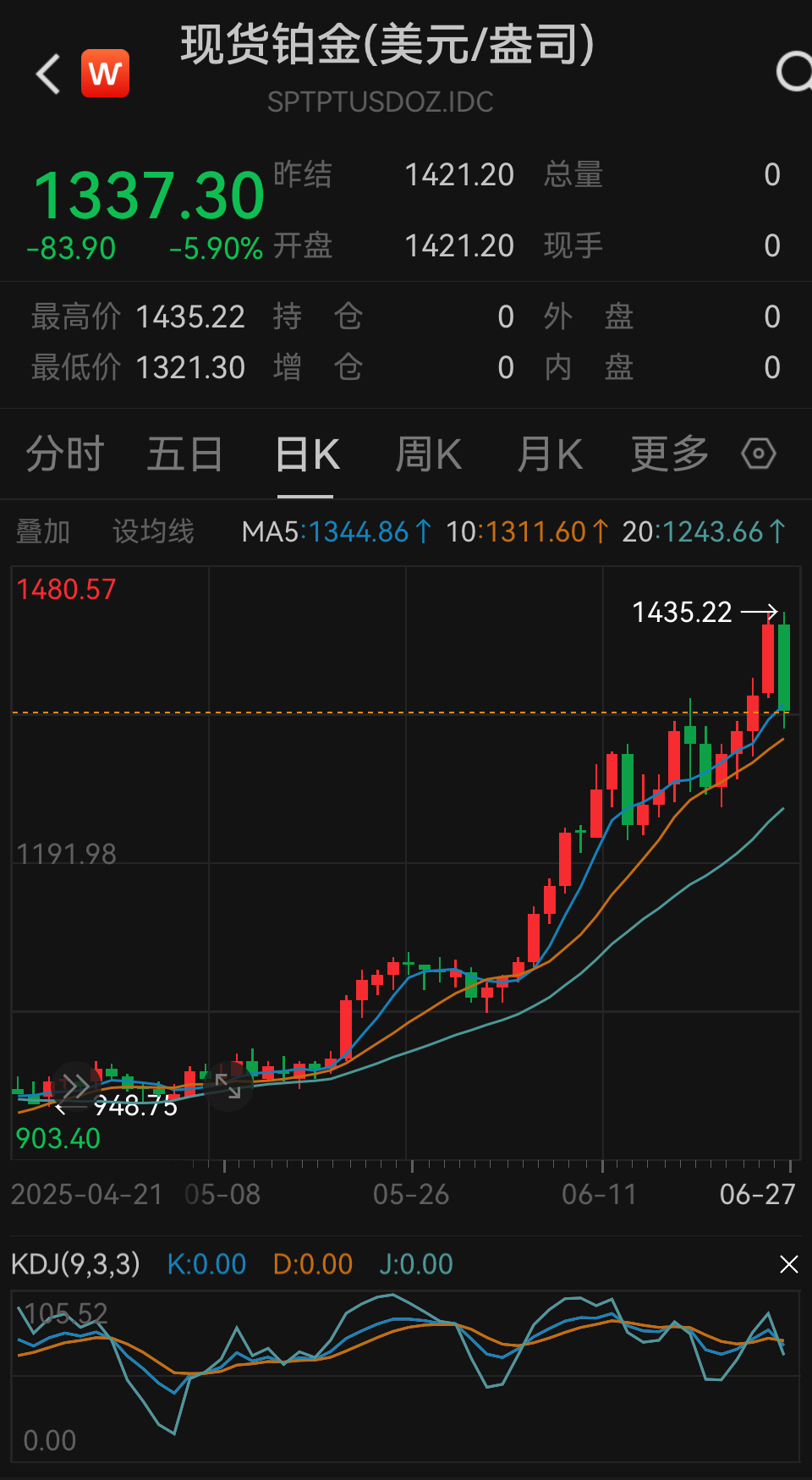
Core Viewpoint - Platinum prices have experienced significant volatility, with a notable drop of 5.90% on June 27, 2023, closing at $1,337.30 per ounce, despite a year-to-date increase of 47.93% [1][4][9] Group 1: Market Performance - Platinum has become one of the best-performing precious metals in the first half of the year, driven by investment overflow from rising gold prices, which increased by approximately 24% during the same period [4][5] - The price of platinum surged dramatically, with a cumulative increase of 42.49% from May 20 to June 26, 2023, reaching an intraday high of $1,435.22 per ounce on June 27 [6][9] Group 2: Supply and Demand Dynamics - The World Platinum Investment Council reported a 10% year-on-year decline in global platinum supply to 45 tons in Q1 2023, while demand rose by 10% to 71 tons, indicating a supply-demand imbalance [6] - Investment demand for platinum surged by 28% quarter-on-quarter to 14 tons, with monetary demand increasing by 17% year-on-year to 2 tons [6] Group 3: Investor Sentiment and Market Risks - Industry insiders suggest that the recent price surge is driven by speculative trading and the push for platinum as a substitute for gold, with a cautionary note on potential volatility in the future [7][8] - Analysts express a cautious outlook on future price movements, indicating that the recent sharp increases and subsequent declines may lead to further fluctuations [8] Group 4: Market Behavior and Recovery - Despite the rising prices, the platinum recycling market remains subdued, with recovery prices around 200 yuan per gram, significantly lower than current market prices [5] - Retail sales of platinum jewelry are lagging behind gold, with consumers often preferring K-gold due to shorter processing times and similar pricing [5]
“严重异常波动”难阻资金抢筹 成飞集成缘何走出“九连板”?
2 1 Shi Ji Jing Ji Bao Dao· 2025-05-19 10:31
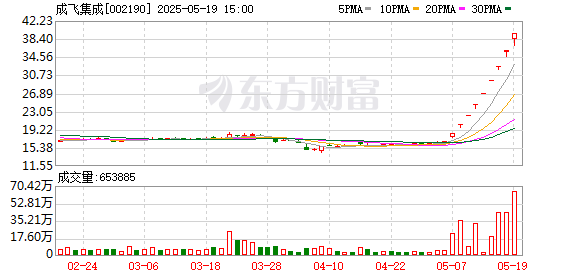
Core Viewpoint - Chengfei Integration (002190.SZ) has experienced a significant stock price surge, with a cumulative increase of 135.8% since May 7, 2023, driven by heightened market interest in the J-10CE fighter jet and its recent operational success [2][6]. Group 1: Company Overview - Chengfei Integration's main business is focused on automotive parts and tooling, with only 1.74% of its revenue coming from aviation parts in 2024 [4][3]. - The company has faced challenges in its aviation parts business, with a 57.8% year-on-year decline in revenue to 0.41 billion yuan due to delayed customer demand and increased market competition [4][3]. - The gross margin for Chengfei Integration's aviation parts business was -57.41% in 2024, a significant drop of 75.22 percentage points year-on-year [4]. Group 2: Market Dynamics - Despite Chengfei Integration's low "aviation content," it has attracted speculative trading due to its smaller market capitalization of 60 billion yuan compared to AVIC Chengfei's 158.5 billion yuan [7][8]. - The stock price of Chengfei Integration has been more volatile, with 83.28% of trades conducted by individual investors, compared to a more institutional investor base for AVIC Chengfei [9][8]. - The trading rules allow for a 10% daily price limit for Chengfei Integration, making it easier for the stock to trend upwards compared to AVIC Chengfei, which has a 20% limit [8][7].