跨境水资源管理

Search documents
墨西哥与美国达成一项新的水资源协议
Jing Ji Guan Cha Wang· 2026-02-03 20:15
Core Viewpoint - The United States and Mexico have reached a new water resource agreement, with Mexico committing to deliver at least 350,000 acre-feet of water annually to the U.S. to support agricultural needs in southern Texas [1] Group 1: Agreement Details - Mexico will create a detailed plan to fully repay the accumulated water debt from the previous cycle [1] - The agreement is a result of discussions between U.S. President Trump and Mexican President Sinbloom, emphasizing the need to address long-standing cross-border water management issues [1] Group 2: Historical Context - The U.S. and Mexico share a border of over 3,000 kilometers, with 65% defined by international rivers [1] - Historical agreements from the late 19th century to the 1950s have placed significant water supply obligations on Mexico, leading to a "water debt" [1] - According to a 1944 treaty, Mexico is required to supply one-third of the water from the Rio Grande every five years [1] Group 3: Current Challenges - As of July 2023, Mexico has only met approximately 40% of its water delivery obligations to the U.S. for the 2020-2025 period due to water shortages [1] - Increased water supply demands have led to civil unrest in northern Mexico, highlighting the tensions surrounding water resource management [1]
毛里塔尼亚、马里、塞内加尔三国启动跨境水资源、气候安全与和平巩固项目
Shang Wu Bu Wang Zhan· 2026-01-20 17:18
Core Viewpoint - The project aims to enhance cross-border water resource management, climate security, and peace consolidation among Mauritania, Mali, and Senegal, funded by the United Nations Peacebuilding Fund with a budget of $7 million [1] Group 1: Project Overview - The initiative is launched by the Minister of Economic and Development of Mauritania, Sidya, in Nouakchott [1] - The project will be implemented jointly by UNICEF and the International Organization for Migration (IOM) over a period of 24 months [1] - It is designed to leverage water resources as a key tool for promoting cooperation, consolidating peace, and enhancing resilience to climate change in the border regions of the three countries [1] Group 2: Beneficiaries and Coverage - The project is expected to directly benefit over 151,000 people and indirectly benefit more than 535,000 individuals [1] - It will cover specific regions in Mauritania (Guidimaka, Gorgol, Assaba, and West Hod) as well as areas in Mali (Kayes) and Senegal (Tambacounda, Matam, and Kédougou) [1] Group 3: Action Plan Components - The action plan includes the construction or rehabilitation of climate-resilient water infrastructure [1] - It will establish community-level water conflict management mechanisms [1] - A climate risk early warning system will also be set up as part of the project [1]
美墨水争端引避险观望 沪金震荡偏弱至950
Jin Tou Wang· 2025-12-09 07:00
Group 1 - Gold futures are currently trading around 951.34 yuan per gram, with a decline of 0.95%, having reached a high of 958.50 yuan and a low of 950.60 yuan [1] - The short-term outlook for gold futures appears bearish, with key resistance levels identified between 960 yuan and 1020 yuan per gram, and important support levels between 894 yuan and 950 yuan per gram [4] - Since October, gold prices have experienced a strong upward trend, quickly rising to around the 950 yuan mark, but have recently entered a phase of consolidation, trading within a narrow range of 945 to 950 yuan [4] Group 2 - The dispute over water supply between the U.S. and Mexico highlights challenges in cross-border water resource management amid climate change, potentially exacerbating trade tensions between the two countries [3] - Trump has accused Mexico of failing to fulfill its water supply obligations under the 1944 treaty, claiming a deficit of over 9.8 billion cubic meters, and has demanded the release of approximately 2.47 billion cubic meters by December 31 [3] - Mexico has responded by emphasizing the impact of prolonged drought on its water resources and the need to prioritize domestic water needs, indicating practical difficulties in meeting the obligations [3]
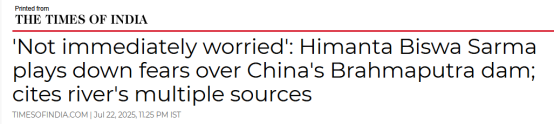
雅江水电站动工,印度为何如此平静?
Hu Xiu· 2025-08-01 12:16
Group 1 - India has historically been concerned about China's water resource development plans on the Yarlung Tsangpo River, but its recent reaction to the Yarlung hydropower project has been unexpectedly calm compared to previous responses [1][3] - The Indian government and media have previously viewed such projects as potential threats to India's water security, emphasizing the need for transparency and information sharing [3][9] - The current response from India reflects a shift in media coverage, which has become more objective and less alarmist, indicating a possible thaw in India-China relations [10][19] Group 2 - The Yarlung Tsangpo project is primarily aimed at enhancing China's domestic energy security and reducing reliance on foreign energy sources, rather than serving geopolitical interests [4][5] - The project is expected to significantly boost China's clean energy capacity and contribute to its carbon neutrality goals, while also fostering regional economic growth and job creation [6][17] - China has established a mature communication framework with India regarding cross-border water resource management, which has facilitated ongoing dialogue and cooperation [7][8][16] Group 3 - The project employs advanced engineering techniques and adheres to high ecological standards, aiming to minimize environmental impact while ensuring safety and efficiency [15][12] - China's commitment to responsible water resource management is demonstrated through its history of sharing hydrological data with India, even during periods of tension [11][16] - The recent diplomatic engagements between China and India suggest a mutual interest in stabilizing relations and collaborating on issues such as climate change and energy security [18][19]