
跨省协同

Search documents
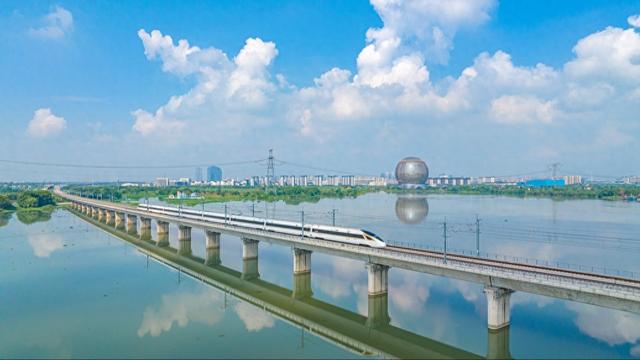
长三角议事厅·周报|沪苏湖高铁跑出跨省成果转化加速度
Xin Lang Cai Jing· 2026-02-02 09:46
Core Insights - The Yangtze River Delta (YRD) railway construction has achieved significant milestones, with operational railway mileage exceeding 15,400 kilometers and high-speed rail reaching over 8,100 kilometers by the end of 2025 [1] - The opening of the Hu-Su-Hu high-speed railway has transformed commuting dynamics, reducing travel time between Shanghai and Huzhou to just 30 minutes, facilitating a new model of urban living and industrial collaboration [1][3] - The four regions of Shanghai, Jiangsu, Zhejiang, and Anhui have unveiled action plans for industrial transformation, focusing on advanced manufacturing, artificial intelligence, and robotics, which are interconnected through the railway network [1][4] Group 1: Railway Impact - The Hu-Su-Hu high-speed railway has transported over 33.6 million passengers in its first year, increasing daily train pairs from 80 to 111.5 [1] - Travel times have been significantly reduced, with journeys from Shanghai to Suzhou taking as little as 26 minutes, enhancing business operations and collaboration [3] - The railway has enabled a "time compression" effect, allowing for more efficient cross-city business activities and innovation processes [3][4] Group 2: Industrial Collaboration - The high-speed railway has facilitated a new operational model for companies, allowing for strategic positioning across different provinces, as exemplified by the rise of Zhejiang Dongfang Kema Electronics [4] - The integration of physical connectivity with policy collaboration is creating a tightly-knit industrial network across the YRD [1][4] - The establishment of remote virtual windows for administrative services aims to streamline cross-province operations, enhancing the efficiency of business processes [5][6] Group 3: Policy and Infrastructure Development - The YRD has initiated the "Long Triangle Qingwu Jia High-tech Industrial Development Zone," covering 49.16 square kilometers and focusing on high-tech industries [9] - The region is also seeing significant investments in infrastructure, such as the completion of the Shanghai Haoyi Automotive R&D base, which aims to enhance collaboration in the automotive design sector [9][10] - The Long Triangle International Innovation Challenge has facilitated 126 technology cooperation agreements, amounting to 592 million yuan, promoting industrial innovation [9] Group 4: Future Directions - The YRD is working towards overcoming institutional barriers to enhance cross-province collaboration, focusing on data sharing and mutual recognition of licenses [5][6] - The establishment of industry alliances is crucial for creating a structured approach to industrial collaboration, with 19 alliances formed by 2024 [7] - The integration of supply chains within a 4-hour industrial circle is being emphasized, with a focus on aligning production capabilities across the region [7][8]

“春风”送岗,下好就业先手棋
Xin Lang Cai Jing· 2026-01-25 22:24
Group 1 - The "Spring Breeze Action" in Guizhou Province has launched a large-scale recruitment event, with 220 quality enterprises offering 23,000 job positions, showcasing a collaborative effort between labor-exporting and labor-importing regions [1] - This year's "Spring Breeze Action" features significant characteristics such as "five provinces linkage" and "intelligent empowerment," enhancing cooperation in labor collaboration, employment services, skills training, and labor rights protection [1] - The initiative aims to stabilize employment by utilizing AI employment service machines for resume diagnostics and mock interviews, targeting the peak employment service period before the Spring Festival [1] Group 2 - Guizhou Province has established 135 labor cooperation stations outside the province to ensure stable employment for approximately 6 million workers who work outside the province [1] - From 2021 to November 2025, Guizhou has achieved a total of 3.1048 million new urban jobs, facilitated the re-employment of 751,200 unemployed individuals, and assisted 373,500 individuals facing employment difficulties [1] - The "Spring Breeze Action" reflects a long-term commitment to employment stabilization policies, contributing to cumulative effects in job creation and support for vulnerable employment groups [1]
长三角议事厅·周报|沪苏同城化:硬联通之后,还需算四本账
Xin Lang Cai Jing· 2025-12-22 07:57
Core Insights - The integration of Shanghai and Suzhou has reached a significant milestone with improved transportation links, but the next phase focuses on smoother operational integration rather than just speed [1][2][3] - The recent proposal by the Jiangsu Provincial Party Committee emphasizes the need for Suzhou to transition from merely learning from Shanghai to fully integrating with it, highlighting the importance of addressing discrepancies in standards, interests, and assessments [1][2] Group 1: Hard Connectivity Achievements - The Shanghai Metro Line 11 has been extended to Kunshan, and high-speed rail travel between Suzhou North Station and Shanghai Hongqiao has been reduced to approximately 23 minutes [1] - The combined GDP of Shanghai and Suzhou is projected to exceed 8 trillion yuan in 2024, with Shanghai at 5.39 trillion yuan and Suzhou at 2.67 trillion yuan [1] Group 2: Soft Frictions in Integration - The main challenges in the integration process are categorized into three types of "soft frictions": differences in standards and processes, difficulties in benefit distribution, and structural constraints from assessment and competition logic [2][3] - The fragmentation in standards and processes leads to increased hidden costs for businesses operating across cities, as multiple recognitions and submissions are required [2] Group 3: Institutional Tools for Collaboration - Effective solutions to the identified soft frictions involve creating executable, assessable, and replicable institutional tools rather than merely increasing coordination meetings [4][5] - The Long Triangle Ecological Green Integration Development Demonstration Zone has successfully transformed cross-provincial collaboration from project-based to rule-based, addressing common bottlenecks with a practical "toolbox" approach [4] Group 4: Focus on Public Welfare - The integration's success is also measured by its impact on public welfare, with initiatives to streamline cross-city services such as social security transfers and public housing loans, aiming for completion within three working days [5] - The establishment of a unified social security card system aims to enhance daily experiences of integration by covering various services like transportation and library access [5] Group 5: Expanding Institutional Frameworks - The current focus should be on expanding successful practices from pilot projects into a broader institutional product library, allowing for systematic operation rather than isolated breakthroughs [6] - The goal is to align evaluation standards and regulatory measures across regions, facilitating smoother project approvals and enhancing the overall experience of integration for residents and businesses [6] Group 6: National Demonstration Significance - The Shanghai-Suzhou integration serves as a national model for cross-provincial collaboration, emphasizing the need for both speed and clarity in operational processes [7] - The ongoing investment in infrastructure, such as the 600 billion yuan allocated for railway construction in the Yangtze River Delta during the 14th Five-Year Plan, supports this integration effort [7]