
进口替代效应

Search documents
量减价稳:11月中国苯酐出口市场结构分析
Sou Hu Cai Jing· 2025-12-22 11:31
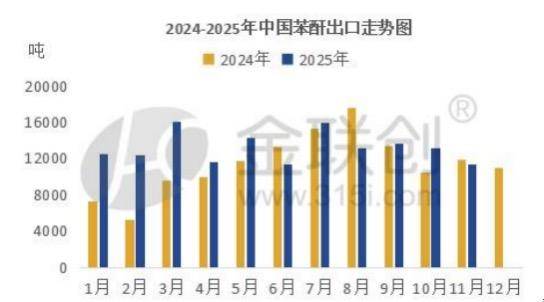
Export Data Analysis - In November 2025, China's anhydride exports continued to decline month-on-month but showed significant year-on-year growth, with an export volume of 11,300 tons, a slight decrease of 4.8% year-on-year and a 13.6% decrease month-on-month. The average export price was $775.29 per ton, marking a low point for the year [3] - Cumulative exports from January to November reached 145,400 tons, representing a year-on-year increase of 15.36%, indicating that the overall export scale remains high. Despite the month-on-month decline in November, the absolute scale is still at a relatively good historical level, reflecting a stable demand foundation in overseas markets [3] - The decline in export prices aligns with the overall weakening of the global chemical market and intensified competition, showing that domestic companies are maintaining export competitiveness through pricing strategies [3] Import Data Analysis - In November 2025, China's anhydride imports showed a decline in both volume and price, with an import volume of 274.96 tons, a month-on-month decrease of 15.3% and a year-on-year decrease of 47.6%. The average import price was $1,023.83 per ton, reflecting a drop from previous periods [8] - Cumulative imports from January to November totaled 3,360 tons, down 6.3% from 3,586.5 tons in the same period of 2024. The significant reduction in import volume is primarily due to sufficient domestic supply and enhanced import substitution effects [8] - The sources of imports are highly concentrated, with South Korea accounting for 71% of total imports, followed by Taiwan at 27%, together making up over 98% of imports. The main receiving areas are concentrated in Guangdong and Shanghai [8]

“增长滤镜”下的东盟消费潜力再评估
Yin He Zheng Quan· 2025-10-14 08:57
Group 1: ASEAN Consumption Potential - ASEAN's consumption scale is projected to grow, with GDP growth rates expected to be 4.9% in 2024 and 4.0% in 2025, reflecting a steady economic outlook[6] - The region's consumption growth is driven by a rising middle class and a young population, with significant increases in consumer spending expected in durable goods sectors like jewelry and automobiles[6] - The optimistic expectations for ASEAN's consumption potential may reflect either genuine growth or an overly optimistic "growth filter" effect from global capital[6] Group 2: Import Dynamics - Local production in ASEAN struggles to meet mid-to-high-end consumer demand, leading to a notable "import substitution effect" where imports fill the supply-demand gap[6] - Countries like Singapore and Malaysia exhibit strong import demand, with significant growth in durable consumer goods, indicating a shift towards higher value-added products[6] - The import growth rates for key ASEAN markets are projected at 10.6% for Singapore and 8.7% for Malaysia, showcasing robust external absorption capabilities[23] Group 3: Future Outlook - The key to transforming consumption into economic growth lies in developing a local consumption-oriented manufacturing system and enhancing the capacity for high-value products[6] - By 2030, ASEAN's GDP is expected to grow at rates of 2.9% to 4.7%, indicating a potential for sustained economic expansion driven by consumer demand[6] - The region's consumption market is entering a critical phase of upgrading, with a projected increase in the share of final consumption expenditure in GDP, currently at 66%[17]