迭代

Search documents
逐渐边缘的主观多头
远川投资评论· 2025-12-10 07:23
Core Viewpoint - The recent draft of the "Guidelines for Performance Assessment Management of Fund Management Companies" has sparked significant discussion in the public fund industry, particularly due to its stipulation that fund managers with performance below the benchmark by over 10% for three years and negative profit margins must see a salary reduction of at least 30% [2][3]. Group 1: Impact on Fund Managers - Nearly a thousand active equity fund managers have underperformed the benchmark by over 10% in the past three years, including notable figures like Zhang Kun and Ge Lan [2]. - Concerns about talent loss in public funds are rising, as private equity firms offer more attractive compensation structures [2][4]. - The shift towards quantitative private equity is reshaping the landscape, with a focus on performance stability becoming paramount for high-net-worth individuals [9]. Group 2: Performance Comparison - In 2023, the CSI 300 index rose by 16% and the Hang Seng index by 26%, yet subjective long-only funds have not seen a corresponding increase in net subscriptions [6]. - Subjective long-only funds achieved a 33.88% increase, but this was outperformed by quantitative strategies, which saw increases of 54.74% and 46.86% for specific indices [6][12]. - The evolving preferences of wealth management clients indicate a shift towards quantitative strategies, which are perceived as more stable and reliable [9][15]. Group 3: Strategic Evolution - The fundamental difference between subjective and quantitative strategies lies in their narratives; subjective strategies focus on mean reversion, while quantitative strategies emphasize iteration and adaptability [9][10]. - Quantitative private equity has evolved from linear models to more complex non-linear models, enhancing their ability to adapt and recover from market downturns [10][12]. - The ability of quantitative firms to offer a diverse range of products tailored to various risk appetites is a significant advantage over traditional subjective strategies [12][13]. Group 4: Future of Subjective Strategies - The future of subjective long-only strategies may require deeper asset research and more selective client engagement to remain competitive [20][21]. - The pressure on subjective fund managers to justify their investment choices is increasing, particularly in light of the performance of quantitative strategies [15][20]. - The need for a longer investment horizon and a more stable funding structure is critical for subjective managers to achieve long-term success [14][21].





“学习如何学习”,这是所有技能背后的核心技能
3 6 Ke· 2025-11-07 07:11
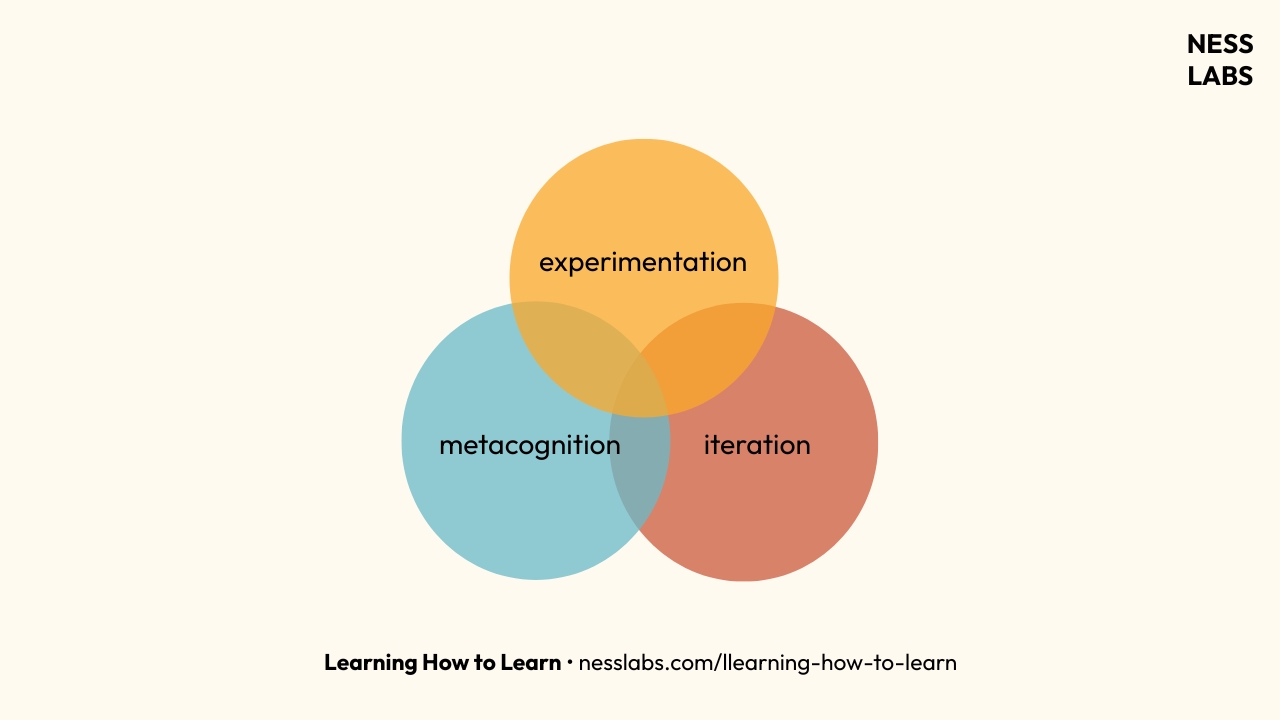
Core Insights - The article emphasizes the importance of learning how to learn in a rapidly changing world where skills become obsolete quickly [1][8] - Traditional education focuses on memorization rather than teaching individuals how to think and design their own learning paths [1][8] Group 1: Modern Learning Paradox - Understanding how the brain learns is increasingly important, as it operates in two distinct modes that work together to help acquire new knowledge [2] - The abundance of information can hinder learning, making it difficult to filter valuable content [2] - Artificial intelligence is reshaping learning dynamics, reducing the importance of memorizing facts and increasing the need for asking the right questions and evaluating AI-generated answers [2] Group 2: Learning Strategies - "Learning how to learn" can be distilled into three core practices that yield cumulative effects over time [3][6] - The three practices are experimentation, metacognition, and iteration, which help individuals actively engage in their learning process [6] - Experimentation involves designing small experiments to gather data on what methods work best for the individual [6] - Metacognition is the practice of observing one's own thought processes to understand how to handle uncertainty [6] - Iteration allows for adjustments after each experiment, leading to a continuous growth cycle [6] Group 3: Focus and Divergence - Focus mode refers to the active concentration state, while divergent mode allows for free-flowing thoughts [7] - Both modes are essential for effective learning and creativity [7] Group 4: Conclusion - In a world where knowledge evolves faster than individuals can keep up, the most valuable skill is not what one knows, but how one learns [8] - Maintaining curiosity and purpose through experimentation, reflection, and adjustment is crucial for personal growth [8]