通用机器人策略

Search documents
卢宗青团队新作:人类先验打底,统一动作对齐,通用机器人模型正在落地
雷峰网· 2026-02-02 10:21
Core Insights - The article discusses the challenges and advancements in the robotics industry, particularly focusing on the transition from machine learning models to real-world applications, emphasizing the importance of stability and reliability in deployment [2][3][31]. Group 1: Structural Challenges in Robotics - The robotics industry faces three structural barriers: morphological fragmentation, data cost and coverage, and deployment system issues, which hinder the generalization of robotic strategies [2][3]. - Morphological fragmentation leads to difficulties in data sharing among different robotic forms, requiring retraining when switching platforms [2]. - The high cost and scarcity of real-world robotic data limit the ability to cover long-range tasks and complex interactions, making cross-morphology generalization challenging [2][3]. Group 2: Research and Development of Being-H0.5 - The research team led by Lu Zongqing introduced the Being-H0.5 model, which aims to create a more stable and generalizable robotic control strategy by leveraging human-centric data and addressing the aforementioned barriers [3][4]. - The model utilizes a unified state-action space to overcome inconsistencies in action definitions across different hardware, facilitating knowledge sharing and transfer [4][24]. - The UniHand-2.0 dataset, comprising over 35,000 hours of data, serves as a foundation for training, integrating human hand operation data and robotic manipulation data to enhance the model's performance [13][23]. Group 3: Experimental Results and Performance - Experimental results indicate that while specialist models perform slightly better, the generalist Being-H0.5 model shows comparable performance, particularly in long-horizon and bimanual tasks, which are critical for assessing deployment stability [9][10]. - In real robot experiments, the generalist model demonstrated significant improvements in long-horizon and bimanual tasks, highlighting its potential for stable deployment in complex environments [9][10]. - The model achieved an average success rate of 98.9% on the LIBERO benchmark and 53.9% on the RoboCasa benchmark, showcasing its robustness in both simulated and real-world scenarios [14][15]. Group 4: Deployment Mechanisms and Stability - The introduction of mechanisms like MPG (Motion Policy Generation) and UAC (Unified Action Control) is crucial for ensuring the stability of the model during deployment, particularly for long-range and bimanual tasks [17][18]. - The absence of these mechanisms leads to significant performance degradation, emphasizing the importance of stability in real-world applications [17][18]. - The research highlights that achieving reliable deployment requires addressing both action distribution constraints and asynchronous control issues [33]. Group 5: Implications for Future Robotics - The findings suggest that cross-morphology unified action learning is feasible, allowing multiple robots to share the same strategy without extensive retraining [30]. - Human hand video and action data are essential for developing generalist models, providing a natural action prior that enhances generalization and transferability across different robotic forms [30]. - The work underscores the need for a comprehensive approach that integrates data, alignment, generation, and deployment stability to advance the field of general robotic intelligence [30].


手把手带你入门机器人学习,HuggingFace联合牛津大学新教程开源SOTA资源库
机器之心· 2025-10-26 07:00
Core Viewpoint - The article emphasizes the significant advancements in the field of robotics, particularly in robot learning, driven by the development of artificial intelligence technologies such as large models and multi-modal models. This shift has transformed traditional robotics into a learning-based paradigm, opening new potentials for autonomous decision-making robots [2]. Group 1: Introduction to Robot Learning - The article highlights the evolution of robotics from explicit modeling to implicit modeling, marking a fundamental change in motion generation methods. Traditional robotics relied on explicit modeling, while learning-based methods utilize deep reinforcement learning and expert demonstration learning for implicit modeling [15]. - A comprehensive tutorial provided by HuggingFace and researchers from Oxford University serves as a valuable resource for newcomers to modern robot learning, covering foundational principles of reinforcement learning and imitation learning [3][4]. Group 2: Learning-Based Robotics - Learning-based robotics simplifies the process from perception to action by training a unified high-level controller that can directly handle high-dimensional, unstructured perception-motion information without relying on a dynamics model [33]. - The tutorial addresses challenges in real-world applications, such as safety and efficiency issues during initial training phases, and high trial-and-error costs in physical environments. It introduces advanced techniques like simulator training and domain randomization to mitigate these risks [34][35]. Group 3: Reinforcement Learning - Reinforcement learning allows robots to autonomously learn optimal behavior strategies through trial and error, showcasing significant potential across various scenarios [28]. - The tutorial discusses the "Offline-to-Online" reinforcement learning framework, which enhances sample efficiency and safety by utilizing pre-collected expert data. The HIL-SERL method exemplifies this approach, enabling robots to master complex real-world tasks with near 100% success rates in just 1-2 hours of training [36][39]. Group 4: Imitation Learning - Imitation learning offers a more direct learning path for robots by replicating expert actions through behavior cloning, avoiding complex reward function designs and ensuring training safety [41]. - The tutorial presents advanced imitation learning methods based on generative models, such as Action Chunking with Transformers (ACT) and Diffusion Policy, which effectively model multi-modal data by learning the latent distribution of expert behaviors [42][43]. Group 5: Universal Robot Policies - The article envisions the future of robotics in developing universal robot policies capable of operating across tasks and devices, inspired by the emergence of large-scale open robot datasets and powerful visual-language models (VLMs) [52]. - Two cutting-edge VLA models, π₀ and SmolVLA, are highlighted for their ability to understand visual and language instructions and generate precise robot control commands, with SmolVLA being a compact, open-source model that significantly reduces application barriers [53][56].

探究下VLA模型泛化差的原因......
具身智能之心· 2025-08-20 00:03
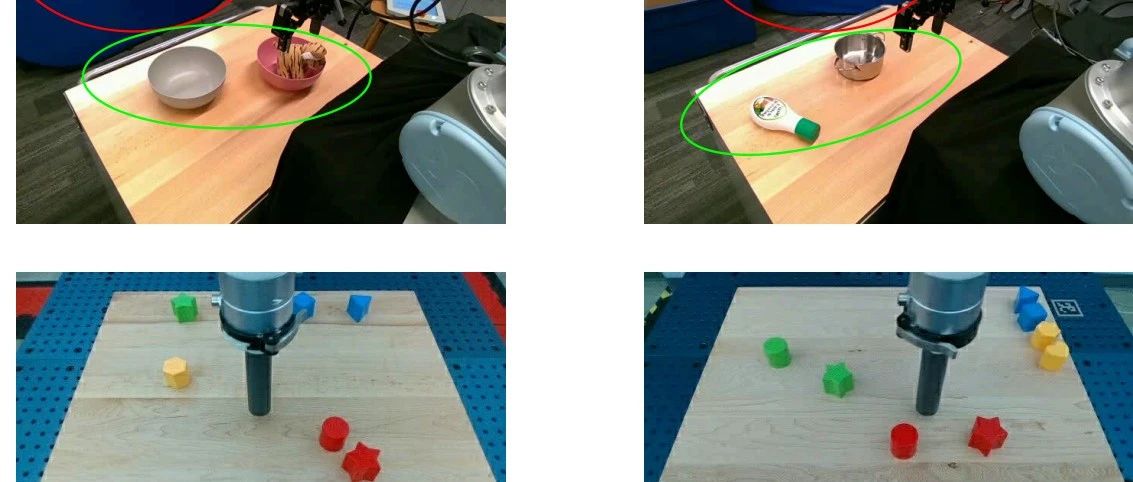
Core Insights - The article discusses the limitations of generalist robot policies in terms of their generalization capabilities, particularly focusing on the issue of shortcut learning [2][5] - It identifies shortcut learning as a key factor hindering generalization, stemming from the reliance on task-irrelevant features [2] - The research highlights two main reasons for shortcut learning: limited diversity within individual sub-datasets and significant distribution differences between sub-datasets, leading to data fragmentation [2] Dataset Analysis - The study specifically examines the Open X-Embodiment (OXE) dataset, which is composed of multiple sub-datasets collected independently under different environments and robot forms [2][5] - The inherent structure of large-scale datasets like OXE contributes to the challenges in generalization due to the aforementioned issues of diversity and fragmentation [2] Recommendations - The findings provide important insights for improving data collection strategies for robots, aiming to reduce shortcut learning and enhance the generalization capabilities of generalist robot policies [2] - In scenarios where acquiring new large-scale data is impractical, the article confirms that carefully selected data augmentation strategies can effectively mitigate shortcut learning in existing offline datasets [2]