
通胀与失业风险

Search documents
国际银多空继续交锋 会议纪要显美储鸽派倾向
Jin Tou Wang· 2025-12-31 03:29
Group 1 - The international silver market is currently experiencing a bearish trend, with prices trading below $75.24, having opened at $76.23 and reaching a high of $76.40 and a low of $74.23, reflecting a decrease of 1.67% to $74.91 as of the report [1] - Investors are focusing on the Federal Reserve's December meeting minutes due to a lack of significant market catalysts and generally low trading volumes, with current market expectations being more dovish than indicated by the Fed's dot plot [2] - The minutes reveal significant internal divisions within the Fed, with the highest number of dissenting votes in 37 years, indicating a complex policy outlook despite market optimism [2] Group 2 - The silver market is expected to see continued volatility, with resistance levels identified between $78 and $80.5, while short-term support is noted in the $73 to $73.5 range, with a critical level at $70 [2] - The ability of silver prices to maintain above $70 will determine the extent of any potential declines, with a significant drop below $70 potentially leading to further declines towards $84 and $48.6 [2]
美联储会议纪要:多数官员支持进一步降息 但政策路径分歧显著
Sou Hu Cai Jing· 2025-12-30 21:05
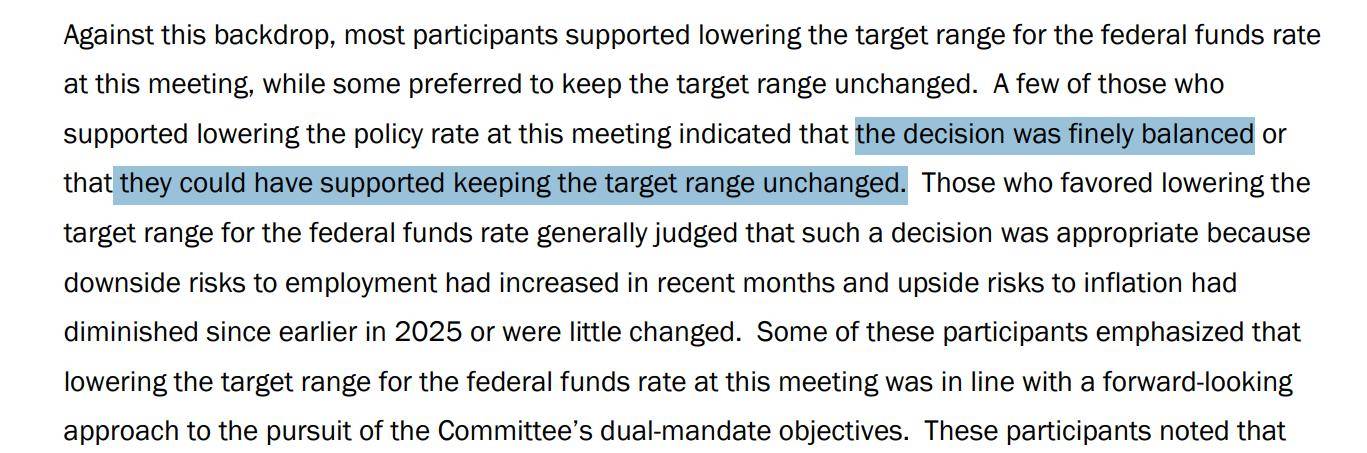
Core Viewpoint - The Federal Reserve's December meeting minutes reveal significant internal divisions regarding interest rate cuts, indicating that the decision-making process is more complex than the voting results suggest [1][2]. Group 1: Interest Rate Decisions - The Federal Reserve lowered the federal funds rate by 25 basis points to a target range of 3.50% to 3.75%, with a voting outcome of 9 in favor and 3 against, marking the highest number of dissenting votes since 2019 [1]. - Some officials expressed that the decision to lower rates was delicate, with some indicating they could have supported maintaining the current rate [1]. - The minutes highlighted that due to a government shutdown, key inflation and employment data were missing, complicating the decision-making process [1]. Group 2: Future Rate Expectations - The minutes indicate a split among officials regarding future rate cuts, with most believing that if inflation decreases as expected, further cuts may be appropriate [2]. - The average expectation among 19 officials is for a 25 basis point cut in 2026, followed by another cut in 2027, bringing the federal funds rate close to 3%, which is considered a neutral position for economic growth [2]. - There is significant disagreement among officials, with six explicitly opposing the December rate cut [2]. Group 3: Inflation and Employment Risks - The minutes reflect internal divisions on whether inflation or unemployment poses a greater risk to the economy, with many officials advocating for a more neutral policy stance to prevent significant deterioration in the labor market [3]. - Some officials warned that further rate cuts while inflation remains high could be misinterpreted as a weakening commitment to the 2% inflation target [3]. Group 4: Upcoming Meetings and Data - The next Federal Reserve meeting is scheduled for January 27-28, where more economic data will be available, and the nomination for the next Fed chair is likely to be announced [4].

打脸特朗普!鲍威尔重申不急降息 称经济仍好、不确定性极高 拒绝因关税抢先行动
Hua Er Jie Jian Wen· 2025-05-07 21:46
Core Viewpoint - The Federal Reserve has decided to pause interest rate cuts, emphasizing a cautious approach to economic risks, particularly regarding unemployment and inflation, amidst ongoing trade tensions and tariff impacts [1][5][6]. Group 1: Federal Reserve's Monetary Policy - The Federal Reserve's current monetary policy is described as having a moderate or slightly restrictive stance, with no immediate pressure to cut rates [3][4]. - Powell stated that the Fed is not in a rush to adjust interest rates and will remain patient while monitoring economic data [1][3]. - The Fed acknowledges increased risks of rising unemployment and inflation, but it is unclear which poses a greater concern [1][2]. Group 2: Economic Outlook and Trade Policy - Powell indicated that if high tariffs persist, it could lead to rising inflation, slowing economic growth, and increasing unemployment rates [2][5]. - The Fed's ability to achieve its dual mandate of price stability and maximum employment may be hindered by ongoing trade policies [5][8]. - Powell noted that the uncertainty surrounding trade policies is high, and businesses are delaying investment decisions due to this uncertainty [5][12]. Group 3: Inflation and Consumer Behavior - Powell mentioned that inflation is currently low and stable, with no immediate need for action from the Fed [9][12]. - There is a potential disconnect between consumer sentiment surveys and actual consumer spending, which is another reason for the Fed to remain observant [12]. - The impact of tariffs on inflation could be temporary or more persistent, but currently, the effects have not yet materialized [7][8]. Group 4: Government Debt and Fiscal Policy - Powell warned that the current trajectory of government debt growth is unsustainable, although the debt level itself is not at an unsustainable level [13]. - The Fed does not require fiscal policy advice from Congress, just as Congress does not provide monetary policy advice to the Fed [13].