酒企全国化战略

Search documents
伊力特换帅!留给新任董事长的还有哪些难题?
Nan Fang Du Shi Bao· 2025-12-16 10:54
Core Viewpoint - The leadership change at Yili Te, a leading liquor company in Xinjiang, occurs during a critical period of performance decline and industry adjustment, with new chairman Li Qiang facing significant challenges in stabilizing the company and addressing long-term structural issues. Company Performance and Challenges - Yili Te has faced continuous revenue and profit declines, with significant gaps between set targets and actual performance over the past three years. The revenue targets for 2022, 2023, and 2024 were set at 2.35 billion, 2.5 billion, and 2.8 billion yuan, respectively, but actual revenues fell short by 727 million, 269 million, and 597 million yuan. Profit targets also showed substantial discrepancies, with gaps of 309 million, 22 million, and 91 million yuan [2][3]. - In the first three quarters of 2025, the company reported a revenue of 1.299 billion yuan, a year-on-year decline of 21.46%, and a net profit of 137 million yuan, down 43.06%. The third quarter alone saw a revenue drop of 29.44% and a net loss of 25.3 million yuan, marking the first quarterly loss since the company went public [2][3]. Strategic Transformation Efforts - Yili Te has attempted to reform its strategy by focusing on key markets such as Xi'an and Lanzhou, and implementing a new marketing model combining direct sales, partnerships, and recommendations. These efforts led to a more than 60% increase in direct sales revenue in the first half of the year, but the third-quarter data indicated that these reforms have not yet mitigated the impact of macroeconomic conditions and industry cycles [3][4]. National Expansion Challenges - As a regional liquor company, Yili Te struggles with national expansion, facing stiff competition from established brands in major markets. The company’s brand recognition and cultural narrative do not compete effectively with stronger brands in regions like East and South China, where it is often viewed as a "local specialty product" [5][6]. - The company’s market share in Xinjiang remains strong, accounting for approximately 84% of total revenue, but even this core market has shown signs of weakness, with a 12.66% year-on-year revenue decline. The sales in markets outside Xinjiang plummeted by 49.88% [3][6]. Industry Context and Competitive Landscape - The Chinese liquor industry is undergoing significant restructuring, entering a phase of stock competition that is unfavorable for regional leaders like Yili Te. The "Matthew Effect" is intensifying, with national brands like Moutai and Wuliangye dominating the high-end market and encroaching on the mid-range segments traditionally occupied by regional brands [6][7]. - Changing consumer behaviors, with a shift towards rational and selective purchasing, further challenge regional brands. The trend of "drinking less, but drinking better" favors well-known brands, squeezing the market space for regional products [7][8]. - The traditional distribution channels are under pressure from high inventory levels and cautious dealer sentiments, while new online sales channels present complex challenges that require time and resources for adaptation [7][8]. Leadership Transition and Future Outlook - The new chairman, Li Qiang, faces a multifaceted challenge: stabilizing declining performance, alleviating channel pressures, and rebuilding team and market confidence in the short term, while also defining a clear national strategy and upgrading products and branding in the long term [8].

今世缘三季度净利润下降近五成,江苏省内收入下滑拖累业绩
Nan Fang Du Shi Bao· 2025-10-31 05:00
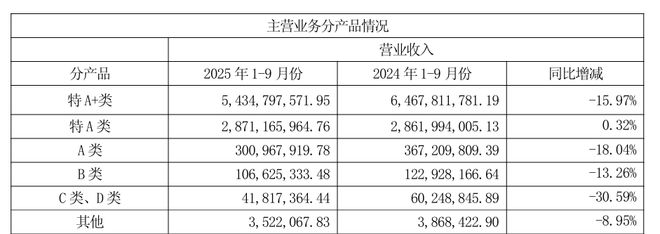
Core Viewpoint - Jiangsu Mingjiu Jinshiyuan reported a significant decline in revenue and net profit for the first three quarters of 2025, indicating challenges in the regional liquor market and increased competition [1][3]. Financial Performance - For the first three quarters of 2025, Jinshiyuan's revenue was 8.88 billion yuan, a year-on-year decrease of 10.7%, while net profit attributable to shareholders was 2.55 billion yuan, down 17.4% [1]. - In Q3 alone, revenue dropped to 1.93 billion yuan, a decline of 26.8%, and net profit fell to 320 million yuan, down 48.7% [1]. Product Performance - The revenue breakdown by product for the first three quarters shows: - Special A+ products: 5.43 billion yuan, down 15.97% - Special A products: 2.87 billion yuan, up 0.32% - A products: 301 million yuan, down 18.04% - B products: 106 million yuan, down 13.26% - C and D products: 42 million yuan, down 30.59% - Other products: 400,000 yuan, down 8.95% [2][3]. Market Dynamics - Jinshiyuan's Special A+ products accounted for 61.2% of total revenue, indicating reliance on high-end market segments [3]. - The company primarily operates in Jiangsu province, where it faces intense competition, particularly from Yanghe, leading to a decline in market share [3][4]. - Revenue from Jiangsu province decreased by 12.4% to 7.96 billion yuan, while revenue from outside the province was stable at 804 million yuan, showing limited growth in national expansion efforts [4]. Sales and Distribution - Sales expenses for the first three quarters reached 1.61 billion yuan, an increase of 5.5% [5]. - The number of distributors decreased by 84, with a significant reduction of 80 in the provincial market, highlighting challenges in maintaining distribution networks [5].