重大风险转移

Search documents
新兴市场拨备激增拖累盈利 收购失败后毕尔巴鄂银行(BBVA.US)增长后劲面临质疑
智通财经网· 2026-02-05 08:20
Core Viewpoint - BBVA reported fourth-quarter profits in line with analyst expectations, with net profit increasing by 4.1% to €2.53 billion (approximately $2.98 billion), despite increased provisions in key markets like Turkey and Mexico offsetting revenue growth [1] Financial Performance - Net interest income reached €26.28 billion, reflecting a year-on-year growth of 4.0% [1] - Provisions increased by 19% compared to the previous year, impacting overall profitability [1] - Adjusted earnings per share were €1.78, up from €1.68 in the same period last year [1] Strategic Focus - Following the failed acquisition of Sabadell Bank, BBVA is concentrating on developing its existing business and announced a €3.96 billion share buyback plan to return excess capital to investors [1] - Since the acquisition failure in mid-October, BBVA's stock price has risen by approximately 40%, as investors prefer dividends over uncertain acquisitions [1] Market Concerns - The failed acquisition has reignited market concerns regarding BBVA's exposure in emerging markets, particularly in Venezuela, Turkey, and Mexico, which are significant contributors to the increased provisions [2] - Analysts expect the bank's return on equity to rise to around 20% this year, up from 19.3% last year, although this outlook includes cost guidance for Spain that is "significantly higher" than current analyst expectations [2] Competitive Landscape - BBVA's leadership faced setbacks compared to larger competitors like Santander Bank, which recently announced a $12 billion acquisition of Webster Financial and reported better-than-expected fourth-quarter profits along with a €5 billion share buyback plan [3][4]

AI巨头狂借债,华尔街忙自保:酝酿风险转移、狂买违约互换
Zhi Tong Cai Jing· 2025-12-05 14:03
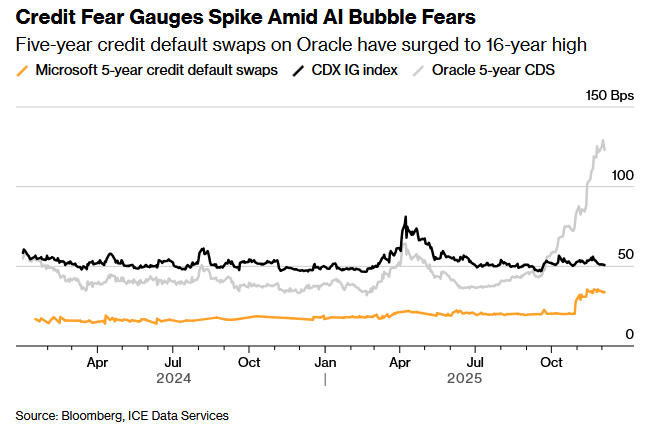
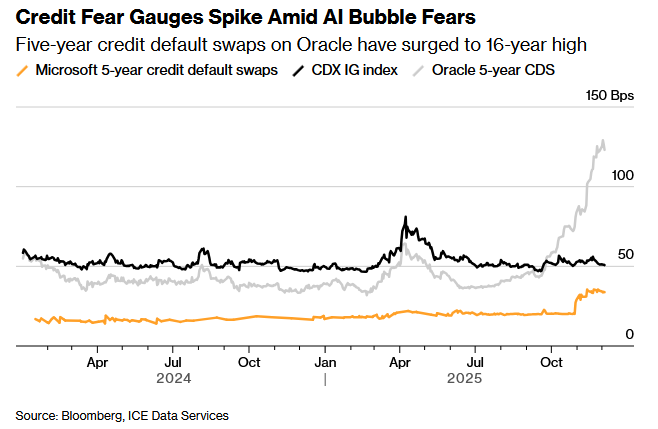
Core Insights - Wall Street is preparing to provide substantial loans to AI giants while simultaneously seeking to protect itself from potential bubbles fueled by this financing [1][4] - The cost of using derivatives to protect Oracle's debt from default has surged to the highest level since the 2008 financial crisis [1] - Major tech companies, including Oracle, Meta, and Google, are expected to issue over $6.46 trillion in bonds by 2025 to fund AI capital expenditures [4] Group 1: Investment Trends - The anticipated investment in AI technology is projected to exceed $5 trillion as companies compete to build data centers and infrastructure [4] - Morgan Stanley is considering using Significant Risk Transfer (SRT) to mitigate some of its exposure to tech borrowers [1][8] - The recent surge in credit default swap (CDS) trading volume for Oracle reached approximately $8 billion, significantly higher than the $350 million level from the previous year [5] Group 2: Market Dynamics - The urgency to reduce risk exposure is evident as banks utilize various tools, including credit derivatives and complex bonds, to transfer the risks associated with the AI investment boom [4][9] - The scale of recent debt issuances has intensified the urgency for banks, with $10 billion transactions previously seen as significant now considered minor for companies with trillions in market value [8] - Banks are exploring new products to offload credit risks associated with large tech companies, with private equity firms like Ares Management Corp. looking to take on some of this risk [9]






AI巨头狂借债,华尔街忙自保:酝酿风险转移、狂买违约互换......
智通财经网· 2025-12-05 13:58
Core Insights - Wall Street is preparing to provide substantial loans to AI giants while simultaneously seeking to protect itself from potential bubbles fueled by this financing [1][4] - The urgency to reduce risk exposure is evident across the credit market, with Oracle's debt protection costs reaching the highest levels since the 2008 financial crisis [1][4] Group 1: AI Investment Landscape - Major tech companies, including Oracle, Meta Platforms, and Google, are expected to issue over $6.46 trillion in bonds by 2025 to fund AI capital expenditures [4] - These companies, along with utilities and other sectors, are projected to invest at least $5 trillion in building data centers and infrastructure to support transformative AI technologies [4] - The scale of these investments necessitates participation in nearly all major debt markets, with Morgan Stanley noting that returns on these tech investments may take years to materialize [4] Group 2: Risk Management Strategies - Banks are increasingly turning to credit derivatives to mitigate risk exposure, with Oracle's credit default swap trading volume surging to approximately $8 billion, compared to $350 million in the same period last year [5] - Morgan Stanley is considering a Significant Risk Transfer (SRT) transaction to offload part of its risk exposure related to data center loans, which could provide default protection for 5% to 15% of a specified loan portfolio [7][8] - Private equity firms, including Ares Management Corp., are attempting to take on some of the risk exposure linked to data centers through SRT transactions [8] Group 3: Market Dynamics - The recent surge in debt issuance has heightened urgency among investors, with a $10 billion bond sale previously considered significant now viewed as minor in the context of companies with trillions in market value [7] - The cost of five-year credit default swaps for Microsoft has increased to approximately $34,000 for $10 million of debt, indicating wider spreads compared to other AAA-rated companies [6] - Banks are exploring new products to offload credit risks associated with large tech companies, with Citadel Securities facilitating trading for corporate bonds from these firms [8]