信用关联票据

Search documents
SRT热潮背后:美国写字楼成“雷区”,欧洲银行高价转移商业地产风险
Zhi Tong Cai Jing· 2026-01-19 14:00
Group 1 - Investors are increasingly inclined to hedge against the deteriorating commercial real estate loans exceeding €200 billion (approximately $232.5 billion) held by European banks, despite the high costs involved [1] - Deutsche Pfandbriefbank AG (PBB) has entered the Significant Risk Transfer (SRT) market to offload its exposure to U.S. commercial real estate debt, marking a significant transaction that indicates substantial spread returns for investors providing insurance for high-risk loans [1][2] - The SRT transaction involved over 20 institutions, with about two-thirds submitting non-binding bids, driven by the small size of the reference loan portfolio, which is concentrated in U.S. office properties, some of which are already in the second stage of credit risk [1] Group 2 - The SRT transaction priced over 15 percentage points above the borrowing benchmark, contrasting with the average premium of less than 10 percentage points for most SRT transactions in the past year [2] - PBB retains a first loss share equivalent to approximately 3% of the total reference portfolio, indicating a significant risk retention strategy [2] - The SRT mechanism allows banks to enhance capital adequacy while reducing reliance on less favorable financing methods, thus providing more room for new loan issuance and capital operations [3] Group 3 - European banks have significantly reduced non-performing loans over the past decade, yet problem commercial real estate exposures remain a major vulnerability in the financial sector, with €221 billion in commercial real estate loans classified as stage two by the European Central Bank [4] - PBB holds a BBB- credit rating from S&P Global Ratings, which is at the lowest end of the investment-grade spectrum, with a negative outlook due to potential risks during its business model transition [4]
AI巨头狂借债,华尔街忙自保:酝酿风险转移、狂买违约互换
Zhi Tong Cai Jing· 2025-12-05 14:03
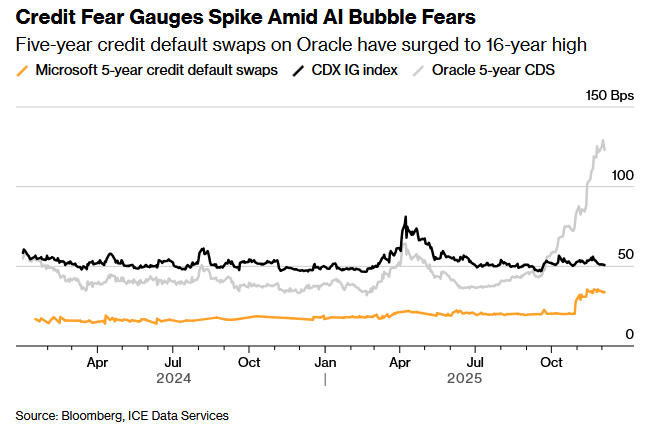
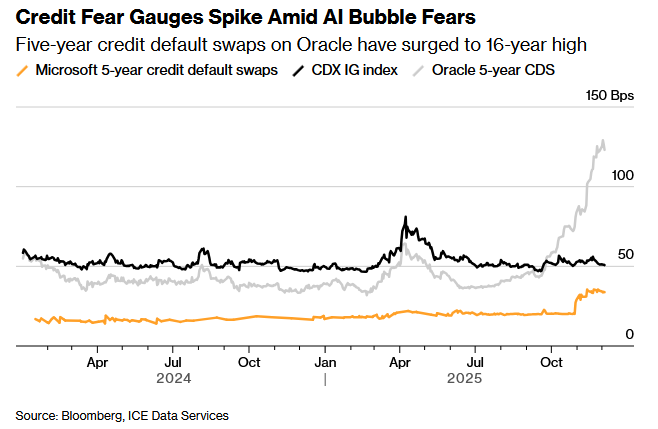
Core Insights - Wall Street is preparing to provide substantial loans to AI giants while simultaneously seeking to protect itself from potential bubbles fueled by this financing [1][4] - The cost of using derivatives to protect Oracle's debt from default has surged to the highest level since the 2008 financial crisis [1] - Major tech companies, including Oracle, Meta, and Google, are expected to issue over $6.46 trillion in bonds by 2025 to fund AI capital expenditures [4] Group 1: Investment Trends - The anticipated investment in AI technology is projected to exceed $5 trillion as companies compete to build data centers and infrastructure [4] - Morgan Stanley is considering using Significant Risk Transfer (SRT) to mitigate some of its exposure to tech borrowers [1][8] - The recent surge in credit default swap (CDS) trading volume for Oracle reached approximately $8 billion, significantly higher than the $350 million level from the previous year [5] Group 2: Market Dynamics - The urgency to reduce risk exposure is evident as banks utilize various tools, including credit derivatives and complex bonds, to transfer the risks associated with the AI investment boom [4][9] - The scale of recent debt issuances has intensified the urgency for banks, with $10 billion transactions previously seen as significant now considered minor for companies with trillions in market value [8] - Banks are exploring new products to offload credit risks associated with large tech companies, with private equity firms like Ares Management Corp. looking to take on some of this risk [9]






AI巨头狂借债,华尔街忙自保:酝酿风险转移、狂买违约互换......
智通财经网· 2025-12-05 13:58
Core Insights - Wall Street is preparing to provide substantial loans to AI giants while simultaneously seeking to protect itself from potential bubbles fueled by this financing [1][4] - The urgency to reduce risk exposure is evident across the credit market, with Oracle's debt protection costs reaching the highest levels since the 2008 financial crisis [1][4] Group 1: AI Investment Landscape - Major tech companies, including Oracle, Meta Platforms, and Google, are expected to issue over $6.46 trillion in bonds by 2025 to fund AI capital expenditures [4] - These companies, along with utilities and other sectors, are projected to invest at least $5 trillion in building data centers and infrastructure to support transformative AI technologies [4] - The scale of these investments necessitates participation in nearly all major debt markets, with Morgan Stanley noting that returns on these tech investments may take years to materialize [4] Group 2: Risk Management Strategies - Banks are increasingly turning to credit derivatives to mitigate risk exposure, with Oracle's credit default swap trading volume surging to approximately $8 billion, compared to $350 million in the same period last year [5] - Morgan Stanley is considering a Significant Risk Transfer (SRT) transaction to offload part of its risk exposure related to data center loans, which could provide default protection for 5% to 15% of a specified loan portfolio [7][8] - Private equity firms, including Ares Management Corp., are attempting to take on some of the risk exposure linked to data centers through SRT transactions [8] Group 3: Market Dynamics - The recent surge in debt issuance has heightened urgency among investors, with a $10 billion bond sale previously considered significant now viewed as minor in the context of companies with trillions in market value [7] - The cost of five-year credit default swaps for Microsoft has increased to approximately $34,000 for $10 million of debt, indicating wider spreads compared to other AAA-rated companies [6] - Banks are exploring new products to offload credit risks associated with large tech companies, with Citadel Securities facilitating trading for corporate bonds from these firms [8]