重点行业产能治理政策

Search documents
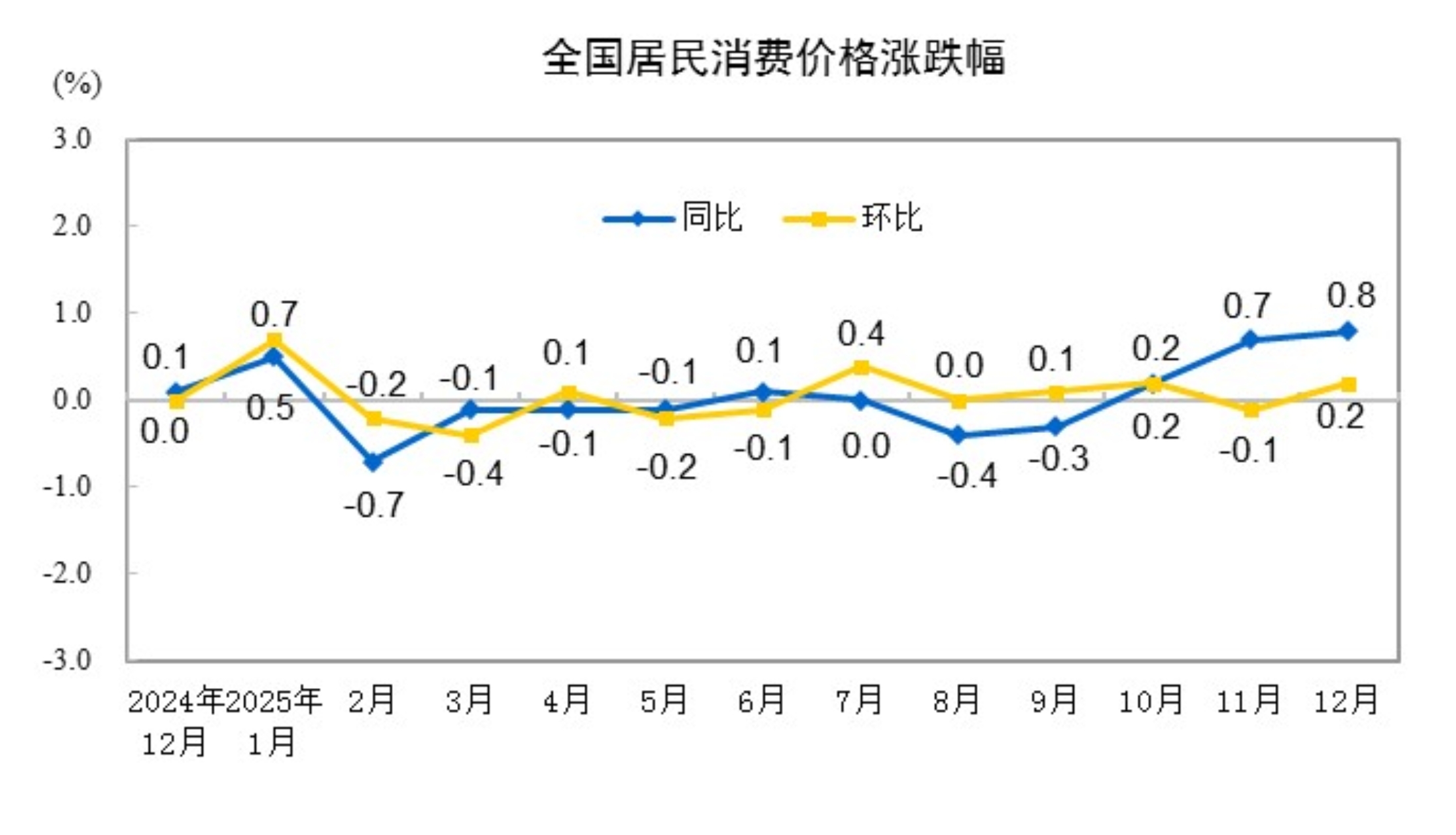
2025年12月CPI同比上涨0.8% 扩内需促消费政策继续显效
Chang Jiang Shang Bao· 2026-01-12 04:54
Group 1: CPI Analysis - In December 2025, the Consumer Price Index (CPI) increased by 0.8% year-on-year, marking the highest level since March 2023, with a month-on-month increase of 0.2% [2][3] - The rise in CPI was driven by increased consumer demand due to the upcoming New Year holiday, with prices for communication tools, baby products, entertainment durable goods, and household appliances rising between 1.4% and 3.0% [2] - Food prices contributed significantly to the CPI increase, with a year-on-year rise of 1.1%, particularly driven by fresh vegetables and fruits, which saw price increases of 18.2% and 4.4% respectively [3][4] Group 2: PPI Analysis - The Producer Price Index (PPI) showed a month-on-month increase of 0.2% in December 2025, marking three consecutive months of growth, with the year-on-year decline narrowing to 1.9% [6][7] - The improvement in PPI is attributed to enhanced supply-demand dynamics in the industrial sector, supported by ongoing capacity governance policies and the positive impact of international commodity prices [6][7] - Key industries such as coal mining and lithium-ion battery manufacturing experienced price increases, indicating a recovery in industrial production and demand [6][7] Group 3: Sector-Specific Insights - The prices in the coal mining and washing industry increased by 1.3% and 0.8% respectively, continuing a five-month upward trend, while prices in the new energy vehicle manufacturing sector shifted from decline to increase [6][7] - The digital economy, new materials, and green transition sectors showed strong performance, with prices for external storage devices and components rising by 15.3% and for biomass liquid fuels by 9.0% [7] - Consumer spending in cultural and quality goods has surged, leading to price increases in related manufacturing sectors, such as a 23.3% rise in the price of arts and crafts products [7]

解读:2025年12月份CPI同比涨幅继续扩大 PPI同比降幅收窄
Guo Jia Tong Ji Ju· 2026-01-09 03:00
Group 1: CPI Analysis - The Consumer Price Index (CPI) increased by 0.2% month-on-month and 0.8% year-on-year, with the core CPI rising by 1.2% year-on-year, indicating a recovery in consumer demand as New Year's approaches [1][2][3] - The month-on-month increase in CPI was primarily driven by rising prices of industrial consumer goods, excluding energy, which rose by 0.6%, contributing approximately 0.16 percentage points to the CPI increase [2] - Food prices rose by 1.1% year-on-year, with significant increases in fresh vegetables (18.2%) and fresh fruits (4.4%), contributing approximately 0.17 percentage points to the year-on-year CPI increase [3] Group 2: PPI Analysis - The Producer Price Index (PPI) rose by 0.2% month-on-month, marking the third consecutive month of increase, with the growth rate expanding by 0.1 percentage points compared to the previous month [4] - The month-on-month PPI increase was supported by improved supply-demand dynamics, with notable price increases in coal mining (1.3%) and lithium-ion battery manufacturing (1.0%) [4] - Year-on-year, the PPI decreased by 1.9%, but the decline rate narrowed by 0.3 percentage points, reflecting positive changes in certain industries due to ongoing macroeconomic policies [4]
国家统计局:12月CPI同比上涨0.8% PPI环比涨幅扩大
Guo Jia Tong Ji Ju· 2026-01-09 01:47
Group 1: Consumer Price Index (CPI) Insights - In December 2025, the national Consumer Price Index (CPI) increased by 0.8% year-on-year, with urban areas rising by 0.9% and rural areas by 0.6% [1][3][22] - Food prices rose by 1.1%, while non-food prices increased by 0.8%. The prices of consumer goods went up by 1.0%, and service prices saw a 0.6% increase [1][3][24] - The core CPI, excluding food and energy, rose by 1.2%, marking a continuous increase for four months [22][24] Group 2: Producer Price Index (PPI) Insights - In December 2025, the Producer Price Index (PPI) decreased by 1.9% year-on-year, but the decline was narrower than the previous month by 0.3 percentage points. Month-on-month, the PPI increased by 0.2%, with the growth rate expanding by 0.1 percentage points [12][13][27] - The prices of industrial producers' outgoing products were influenced by a 2.1% decline in production materials, which affected the overall PPI level [16][21] - The prices of coal mining and washing, as well as lithium-ion battery manufacturing, showed positive changes, with respective increases of 1.3% and 1.0% month-on-month [25][27] Group 3: Price Changes in Specific Categories - In December, the prices of food, tobacco, and alcohol rose by 0.8% year-on-year, contributing approximately 0.24 percentage points to the CPI increase [6][22] - Fresh vegetable prices surged by 18.2%, while fresh fruit prices increased by 4.4%, significantly impacting the CPI [6][24] - The prices of industrial producer inputs, particularly in the construction materials and non-metallic categories, saw a decline of 6.4% year-on-year [19][21] Group 4: Overall Economic Context - The expansion of domestic demand and consumption policies continued to show effects, with increased consumer demand leading to a rise in the CPI [22][23] - The overall industrial production prices reflected a mixed trend, with some sectors experiencing price increases due to improved supply-demand structures [25][27] - The overall economic environment is characterized by a combination of rising consumer prices and declining producer prices, indicating a complex economic landscape [22][27]