量化股票策略

Search documents
友山基金:在不确定性的浪潮中锚定理性
Qi Huo Ri Bao Wang· 2025-12-23 01:47
Core Insights - The article highlights the journey of Jin Yan, the Chief Investment Officer of YouShan Fund, emphasizing his unique blend of mathematical rigor and human insight in navigating the complexities of financial markets [1][2]. Group 1: Career Path and Investment Philosophy - Jin Yan transitioned from academia to investment banking, driven by the allure of quantitative finance and the opportunities it presented, ultimately choosing to pursue a career in the financial industry over a stable academic position [2]. - He acknowledges the importance of both a solid theoretical framework and psychological resilience in achieving investment success, while also recognizing the role of luck in the investment process [2]. Group 2: Daily Operations and Market Engagement - As a fund manager, Jin Yan begins his day by monitoring global market trends, a habit developed over decades, and maintains a focus on key information during trading hours [3]. - His work involves a continuous engagement with market dynamics, including meetings, roadshows, and risk management reviews, reflecting a commitment to staying informed and responsive [3]. Group 3: Investment Strategy and Market Dynamics - Jin Yan's experience in both investment banking and hedge funds has shaped his investment style, highlighting differences in execution and risk management based on the nature of capital sources [4]. - He notes that certain strategies, like Commodity Trading Advisor (CTA) strategies, perform better in the Chinese market due to the unique participant structure and local pricing mechanisms [5]. - The significant impact of policy variables in the Chinese market necessitates a deep understanding of national economic policies, which must align with investment strategies [6]. Group 4: Risk Management and AI Integration - Jin Yan emphasizes the critical nature of risk management in investment, viewing it as a dual challenge that involves both measurable risks and human behavioral biases [7][8]. - He shares key risk management principles, including decisive actions during significant drawdowns and the importance of institutional arrangements to mitigate emotional decision-making [8]. Group 5: Future Outlook and Investment Opportunities - Looking ahead, Jin Yan anticipates a resilient U.S. economy and a continued low-interest-rate environment, which he believes will positively influence global markets [9]. - He identifies potential investment opportunities in fixed income, equities, and commodities, particularly highlighting the ongoing relevance of quantitative strategies in a fluctuating market [9].
第十九届HED中国峰会·深圳即将启幕
Xin Lang Ji Jin· 2025-10-28 10:03
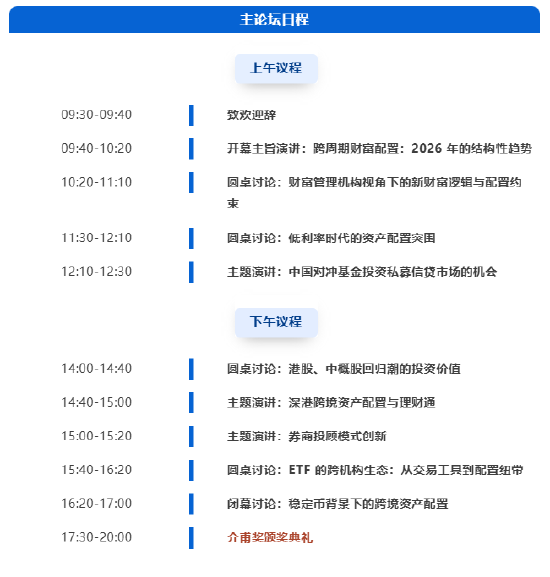
Core Insights - The 19th HED China Summit will be held in Shenzhen on January 15, 2026, focusing on the integration of private equity and wealth management [1] - The event will gather over 400 decision-makers from private equity funds, brokerages, banks, trusts, family offices, and wealth platforms to facilitate high-quality development in the asset management industry [1] Agenda Highlights - The morning session includes a welcome speech, keynote addresses on wealth allocation trends for 2026, and discussions on new wealth logic and asset allocation strategies in a low-interest-rate environment [2] - Afternoon sessions will cover topics such as investment value in Hong Kong and mainland stocks, cross-border asset allocation, and innovations in brokerage advisory services [2] - The event will conclude with discussions on the ecosystem of ETFs and cross-border asset allocation in the context of stablecoins [2] Additional Sessions - The agenda features discussions on innovative stock strategies, the application of AI in quantitative stock strategies, and the evolution of investment strategies in a low-interest-rate environment [4][5] - Keynote speeches will address the investment opportunities arising from the global interest rate decline and the challenges and opportunities for investment funds [5]

打卡一家上海地区黑马私募:量化私募业绩榜Top2,以复合策略追求超额收益
私募排排网· 2025-10-22 00:00
Core Viewpoint - The article highlights the significance of small to medium-sized private fund managers in the industry, focusing on Shanghai Jinwang Private Fund Management Co., Ltd. as a case study for its unique investment strategies and strong performance in the quantitative investment space [3][4]. Company Overview - Shanghai Jinwang Private Fund Management Co., Ltd. was established in 2012 and specializes in secondary market securities investment, employing strategies such as quantitative stock selection, multi-asset strategies, and long-only stock strategies, emphasizing a balance between returns and risks [4]. - As of September 2025, Jinwang Fund ranks second in average returns among quantitative private funds with a management scale of 0-5 billion, showcasing strong performance in the Shanghai region [4]. Core Team - The core team consists of members with over ten years of quantitative investment experience, including a research team of 3-4 members and a subjective long-only team of 2-3 members, all from prestigious domestic universities with extensive practical strategy research and investment experience [8]. Representative Strategies and Products - **Quantitative Composite Long Strategy**: This strategy combines various approaches, including CTA, stock, and convertible bond strategies, aiming for high returns during market uptrends while minimizing losses during downturns [14][15]. - The strategy architecture allocates 40%-60% to stock strategies, 20%-30% to convertible bond strategies, and 20%-30% to CTA strategies, with a dynamic adjustment mechanism to optimize performance based on market conditions [15]. - **Representative Product**: Jinwang Nuo Cheng Jin Qu Fund, which is designed for investors optimistic about the long-term prospects of the Chinese capital market and can tolerate significant volatility [16][17]. Core Advantages - The quantitative strategies employed by Jinwang Fund demonstrate strong long-term sustainability and replicability, with a focus on achieving stable excess returns on top of market beta [20][21]. - The multi-strategy approach allows for high return elasticity and a diversified asset allocation, which helps in reducing the impact of strategy decay [22].