金发女孩状态

Search documents
黄金与美元“脱钩”加剧
第一财经· 2026-02-03 11:12
Core Viewpoint - The traditional inverse relationship between gold and the US dollar is breaking down, with significant discrepancies in their price movements observed recently [3][4]. Group 1: Price Movements - Over the past complete trading cycle (260 trading days), the ratio of gold price increase to dollar price decrease reached 7.2 times, and in a six-month view, this ratio escalated to 31 times [4]. - The dollar index fell from 107.96 to 97.42, a decrease of 9.76%, while gold prices surged from $2875 per ounce to $4905, an increase of over 70% during the same period [7]. - In a six-month observation, the dollar index dropped by 1.38%, but gold prices skyrocketed by 42.84%, further emphasizing the divergence [7]. Group 2: Pricing Models - The sensitivity of gold prices to the dollar index and real interest rates has significantly decreased, indicating a failure of traditional pricing models [7]. - Current pricing models are criticized for omitting key variables, particularly geopolitical risk premiums, which are essential for accurately assessing gold prices [8]. - Complex non-linear models may capture the growth of these premiums but fail to quantify the extent of gold price overvaluation or predict future price directions [8]. Group 3: Market Predictions - Major banks have raised their gold price forecasts, with Société Générale and Deutsche Bank predicting prices could reach $6000 per ounce this year, while Morgan Stanley anticipates a rise to $5700 [9]. - UBS highlights gold's strong performance as a hedge and diversification tool, suggesting that ongoing macroeconomic uncertainties will support gold's attractiveness [9]. - Citibank warns that while geopolitical and economic risks currently support gold investments, about half of these risks may dissipate later in the year [10].


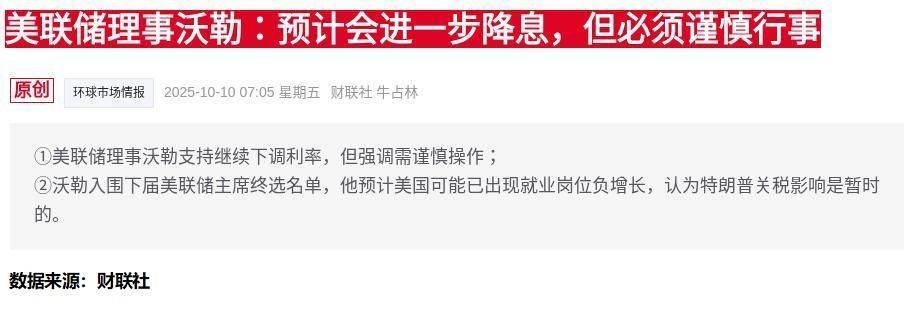
降息预期撕裂市场,30年老手这样应对
Sou Hu Cai Jing· 2025-10-12 23:31
Core Insights - The divergence in opinions among Federal Reserve officials reflects varying interpretations of economic conditions and highlights the differences in information processing capabilities among different investor groups [1][3][6] Group 1: Market Reactions to Policy Changes - Significant market movements often precede public announcements, indicating that institutional investors act on information before it reaches retail investors [3][6] - The phenomenon known as "information ladder effect" suggests that institutional investors are always a few steps ahead of retail investors, utilizing various methods to capture underlying market trends [6][8] Group 2: Investment Strategies and Data Analysis - The nature of capital flows is crucial in understanding market reactions; not all positive news leads to positive stock performance, as some rebounds may be driven by speculative trading while others indicate institutional accumulation [8] - The increasing complexity of the market, with over 30% of trading being algorithmic, emphasizes the importance of analyzing trading behavior data to understand true market dynamics [8][9] Group 3: Focus on Capital Flows - Attention should be directed towards how different asset classes respond to varying economic conditions, particularly in scenarios of moderate growth and controlled inflation [8] - The ability to filter out noise and focus on data-driven insights is essential for making informed investment decisions in an information-saturated environment [8]