金融启蒙

Search documents
从房地产到互联网,下一个十年的财富密码藏在哪里?
虎嗅APP· 2026-02-19 03:24
Core Insights - The article discusses how technology, capital, and ambition are reshaping financial order, particularly through platforms like Roblox, which serve as a new financial education space for the younger generation [4][5][11]. Group 1: Financial Education and Youth Engagement - Roblox is emerging as a significant platform for financial literacy among the younger generation, allowing them to learn about income, expenses, and profit through practical engagement [11][13]. - The platform has paid over $1 billion to creators from March 2024 to March 2025, marking a 31% year-over-year increase, with top creators earning around $1 million annually [11][12]. - Traditional financial institutions are recognizing the need to engage with younger users in their digital spaces, as evidenced by TD Bank's launch of a financial education game on Roblox [14][15]. Group 2: Changing Perceptions of Assets - The relationship between the younger generation and virtual assets has fundamentally changed, with many viewing digital currencies and virtual items as equivalent to traditional assets [19][23]. - A significant portion of Generation Z owns or has owned cryptocurrencies, with 51% indicating such ownership, while traditional bank account ownership has fallen below 50% [23][24]. - The definition of "real" assets is being redefined, as virtual items increasingly influence real-world purchasing decisions [24][25]. Group 3: Economic Models and Business Structures - Roblox operates as a comprehensive economic system, acting as a creator, central bank, payment gateway, and market regulator, which distinguishes it from traditional gaming companies [34][35]. - The platform's business model involves significant upfront costs, with approximately 49% of revenue going to creators and platform fees before it can be recognized as income [35][36]. - The current losses of Roblox are seen as a strategic choice to build a long-term user base and economic ecosystem, similar to early-stage payment platforms like Alipay [36][37]. Group 4: Future Implications - The shift in financial education from physical to digital realms signifies a new economic paradigm, where traditional valuation models may no longer apply [38][39]. - Understanding how the younger generation defines assets will be crucial for predicting future wealth flows and economic trends [39][40].


萌娃变身“小小银行家” 浙商银行合肥瑶海支行解锁金融启蒙新路径——“小小银行家 福启成长路”主题活动圆满落幕
Zhong Guo Jin Rong Xin Xi Wang· 2026-01-28 09:21
Core Viewpoint - The "Little Bankers" themed event organized by Zhejiang Commercial Bank's Yaohai Branch successfully combined financial education, red culture, and traditional customs, providing youth with practical financial skills and fostering patriotism and cultural heritage in a festive atmosphere [1][2][3]. Group 1: Financial Education - The event featured an immersive experience where children learned about banking operations through hands-on activities, such as using smart counters and cash windows, which helped them develop a direct understanding of banking processes [1]. - A practical session on identifying counterfeit currency was conducted, where children learned to recognize security features of the new RMB, enhancing their financial safety awareness [2]. Group 2: Red Culture Education - The event included a "Red Classroom" segment where staff shared inspiring stories related to revolutionary figures, instilling a sense of patriotism and respect for historical sacrifices among the children [2]. Group 3: Traditional Culture - The "New Year Blessing" segment allowed children to engage in traditional practices by creating "Fu" characters, which not only connected them with cultural heritage but also expressed their wishes for the upcoming year [3]. - The event concluded with a group photo and gifts for the children, marking a meaningful experience that combined financial knowledge, red education, and traditional culture [3]. Group 4: Future Initiatives - The branch plans to continue its commitment to social responsibility by developing more innovative and rich public welfare activities aimed at enhancing financial education for youth, thereby contributing to a harmonious financial environment [3].

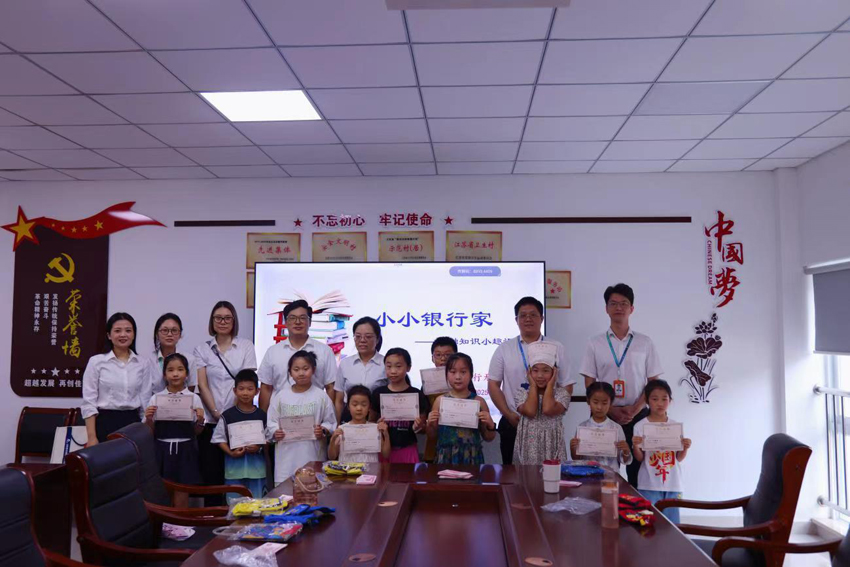
张家港农商银行无锡分行“小小银行家”活动走进社区
Jiang Nan Shi Bao· 2025-09-11 13:47
Group 1 - The core activity involved a financial enlightenment course for children in the Banjiao community, organized by Zhangjiagang Rural Commercial Bank's Wuxi branch, aimed at introducing basic financial knowledge to kindergarten and elementary school students [2] - The course covered the origin and development of currency, engaging children with stories and images, which sparked their interest in understanding where money comes from [2] - A significant part of the lesson focused on recognizing the features of the Renminbi, including watermarks, security lines, and color-changing ink, enhancing children's ability to identify counterfeit money [2] Group 2 - The practical aspect of the course included a "counting money skills show," where a bank staff member demonstrated professional counting techniques, impressing the children [3] - Children participated in a "counting battle" experience, learning and mimicking standard counting gestures under the guidance of bank staff, simulating the daily tasks of a bank teller [3] - Each child received a beautifully printed "Little Banker" certificate as a special gift, which brought joy and pride to the participants [3]
王巍:论金融博物馆的创新模式及未来机遇 | 金融人文
清华金融评论· 2025-03-13 10:43
Core Viewpoint - The article discusses the evolution of financial museums in China, emphasizing the shift from traditional object display to concept dissemination, highlighting the innovative "Museum 2.0" model that integrates public welfare, education, and digitalization [1][3]. Innovative Model: From "Object Display" to "Concept Dissemination" - Financial museums have transitioned from a focus on physical collections to a model centered on the dissemination of financial concepts, addressing the urgent social need for financial education [3][6]. - The establishment of 13 themed financial museums across major cities in China, including Beijing, Shanghai, and Hong Kong, showcases various aspects of the financial ecosystem, filling a gap in the domestic market [3][4]. Digitalization and Cross-Industry Integration - Financial museums are adopting a dual operation model of "physical + digital," utilizing online platforms and virtual environments to extend their reach and enhance visitor engagement [7]. - The Wuhan Financial Museum's online opening in March 2020 attracted 7 million visitors in a single day, demonstrating the potential of digital engagement [7]. Public Welfare Operation Model - The financial museums operate on a "free admission, market operation" principle, collaborating with government and financial institutions for funding and support [8]. - Revenue is generated through various activities, including themed forums, training, and merchandise sales, ensuring sustainability without heavy reliance on government funding [8]. Social Impact: Financial Enlightenment and Urban Cultural Reconstruction - The museums have hosted over 50 special exhibitions, attracting more than 8 million visitors, and have engaged in community outreach to promote financial literacy [9]. - The integration of financial education into local culture has positioned these museums as cultural landmarks, contributing to urban identity and economic development [10]. International Influence: Global Expression of Chinese Financial Culture - The establishment of the International Federation of Financial Museums (IFFM) has enhanced the global presence of Chinese financial culture, with participation from over 30 countries [11]. - Collaborative exhibitions with international institutions have helped to reshape perceptions of Chinese finance on the global stage [11]. Sustainable Development Practice: DSR Model - The DSR model (Driving Force-State-Response) is utilized to analyze the evolution of financial museums, focusing on audience needs and technological advancements as driving forces [12][13]. - Continuous assessment of current challenges and the implementation of innovative strategies are essential for the museums' growth and relevance in the digital age [14][15].