
金融转型

Search documents
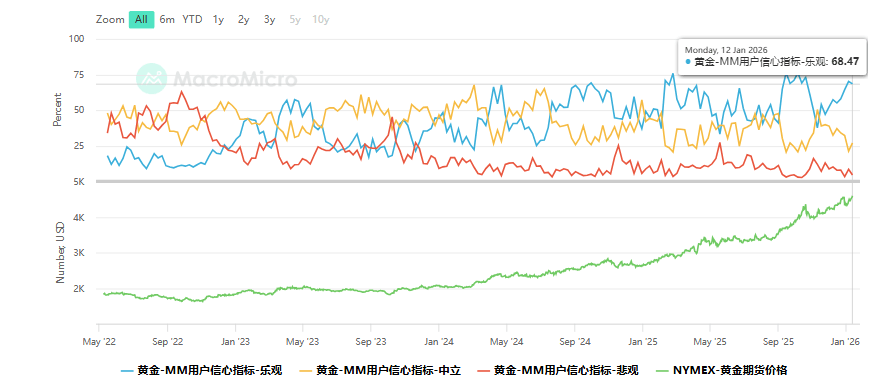
现货黄金首次站上 4600 美元大关,新年首月累涨 280 美元,驱动因素是什么?后续还会涨吗?
Sou Hu Cai Jing· 2026-01-12 03:19
Core Viewpoint - The current market dynamics are driven by supply-demand control, geopolitical tensions, and inflation expectations, leading to a persistent upward trend in prices despite potential volatility [1][6]. Group 1: Market Dynamics - The market is experiencing a controlled upward trend due to supply-demand manipulation and geopolitical factors, with ETFs and retail investors continuously buying in [1]. - The supply of gold is constrained, with global gold supply growth projected at only 2.1% in 2025, the lowest in nearly a decade, while mining output is under pressure [11]. - The demand for gold is robust, driven by central bank purchases, private investments, and industrial applications, with significant increases in ETF holdings and gold bar investments [11]. Group 2: Geopolitical Factors - Recent military actions by the U.S. against Venezuela have heightened global credit concerns, leading to a surge in gold prices by over 4% within a week [5]. - Ongoing tensions in the Middle East and U.S. military posturing have increased gold's appeal as a safe-haven asset [5][6]. Group 3: Monetary Policy and Economic Indicators - The Federal Reserve's expected continuation of a loose monetary policy, with interest rates projected to remain low, is a key driver for gold price increases [8]. - The U.S. fiscal deficit is anticipated to exceed $2 trillion in 2026, raising concerns about the dollar's creditworthiness [9]. Group 4: Price Projections - Short-term forecasts suggest gold prices may rise to between $4,600 and $4,700 per ounce within a month, with $4,500 acting as a support level [14]. - Long-term predictions from major financial institutions like Goldman Sachs and JPMorgan estimate gold prices could reach $4,900 and $5,055 per ounce, respectively, with extreme scenarios suggesting prices could touch $6,000 [15].

深蓝媒体智库沙龙|探路AI金融:安全底座上的转型机遇
Bei Jing Shang Bao· 2025-08-03 04:56
Group 1 - The financial industry is undergoing a transformation driven by generative AI, raising questions about safety, stability, and trust [1] - A salon titled "AI Financial Double-Edged Sword: Finding Transformation Opportunities from Safety Bottom Line" was successfully held in Shanghai, gathering executives and scholars to discuss balancing AI financial safety and innovation [1] - The deep penetration of generative AI in finance is described as a "revolution of efficiency," reshaping the industry ecosystem [2] Group 2 - One of the core challenges of financial transformation is information asymmetry, necessitating transparent and efficient information flow among investors, enterprises, and regulatory bodies [2] - Financial media, such as Beijing Business Daily, plays a crucial role in bridging information gaps and building industry trust through in-depth reporting and data analysis [2] - Beijing Business Daily's influence in the financial sector is characterized by two main features: in-depth content production across various financial segments and diversified communication formats, including multimedia products [3]
以特色化专业化服务展金租风采 访湖北金租党委书记、董事长汤建
Jin Rong Shi Bao· 2025-06-25 03:15
Core Viewpoint - Hubei Financial Leasing Co., Ltd. has developed unique operational models over ten years, focusing on serving the real economy and adapting to regulatory changes while achieving significant growth in assets and profits [1][2]. Group 1: Company Growth and Performance - Since its establishment, Hubei Financial Leasing has achieved a cumulative investment of over 200 billion yuan, serving 120,000 clients [1]. - Total assets increased from 3.1 billion yuan in 2015 to 71.1 billion yuan by the end of 2024, a 22-fold growth; total profit rose from 23 million yuan to 1 billion yuan, a 42-fold increase; and net assets grew from 3 billion yuan to 8.2 billion yuan, a 1.73-fold increase [1]. - As of March 2025, total assets reached 82.44 billion yuan, with a non-performing financing lease asset ratio of 1.01% and a provision coverage ratio of 326.22%, indicating healthy asset quality [2]. Group 2: Strategic Transformation and Compliance - The company has adapted to new regulatory requirements by focusing on strategic transformation, enhancing risk management, and optimizing internal control systems [2][3]. - Hubei Financial Leasing has identified three key areas for development: new energy, transportation logistics, and high-end equipment, while implementing a differentiated business strategy [3]. Group 3: Business Model and Product Development - The company has launched nearly 20 billion yuan in direct leasing business, with direct leasing balance accounting for 16.86% as of March 2025, an increase of 8.75 percentage points year-on-year [4]. - The photovoltaic sector has become the first to exceed 10 billion yuan in investment, with cumulative investment reaching 11.315 billion yuan [4]. Group 4: Risk Management and Internal Control - Hubei Financial Leasing emphasizes asset quality as a cornerstone of sustainable development, implementing a three-line defense strategy for risk management [5]. - The company utilizes big data for risk monitoring and has established a comprehensive internal audit system to ensure compliance and effective risk management [5]. Group 5: Commitment to ESG and Social Responsibility - The company integrates ESG principles into its operations, contributing to rural revitalization and supporting the "dual carbon" goals through innovative financing solutions [7]. - Investments in green finance have reached 24.632 billion yuan, with significant contributions to clean energy and environmental protection projects [6][7]. Group 6: Future Outlook and Strategic Focus - Hubei Financial Leasing aims to maintain a focus on serving the real economy, with plans to ensure that at least 50% of its business investments are within Hubei province [8]. - The company is committed to enhancing its core competitiveness and achieving over 50% of new direct leasing investments by 2026 [8].