
风险处置

Search documents
【银行】日本90年代银行危机及风险处置——海外银行镜鉴日本系列之二(王一峰/赵晨阳)
光大证券研究· 2026-01-04 11:33
Core Viewpoint - The article analyzes the evolution of Japan's banking crisis in the 1990s, highlighting the stages of crisis development, causes, reforms, and the subsequent recovery of the real estate and banking sectors [4][5][6][7]. Group 1: Stages of the Banking Crisis - The banking crisis in Japan during the 1990s can be divided into three stages: 1. Following the "Plaza Accord," the Bank of Japan significantly lowered interest rates, leading to increased speculation in the stock and real estate markets as investment returns weakened in the real economy [4]. 2. In the early 1990s, policies shifted to burst the asset bubble, severely damaging the balance sheets of households and businesses, with risks accumulating [4]. 3. The increase in "special loans" and deteriorating asset quality, compounded by the Asian financial crisis, led to risks spreading from small to large institutions [4]. Group 2: Causes of the Crisis - The main causes of the banking crisis include: 1. The wave of financial liberalization intensified "disintermediation," with a lax regulatory environment and aggressive operational styles among institutions, leading to increased stock investments and a focus on real estate lending [5]. 2. The main bank system created a strong bond between banks and enterprises, hindering the timely disposal of problematic assets and increasing risk contagion [5]. 3. The "escort fleet" mechanism resulted in a lack of risk isolation among institutions, with strong administrative protection hindering the clearance of non-performing assets [5]. Group 3: Reforms Post-Crisis - The post-crisis period saw two major phases of concentrated reforms aimed at risk disposal: 1. The late 1990s financial "big bang" reforms abandoned government protection, established the Financial Supervisory Agency, and improved regulatory effectiveness, alongside legal processes for handling failing institutions [6]. 2. The "Financial Revitalization Plan" focused on the disposal of non-performing assets and initiated business rectification for poorly performing institutions, while the government used "preferred shares with conversion rights" to enhance market operations and expedite capital recovery [6]. Group 4: Structural Recovery in Real Estate - In the post-crisis era, Japan's real estate sector experienced structural recovery with regional differentiation: - Major urban areas like Tokyo, Osaka, and Nagoya saw net population inflows, supporting the real estate market, with a rapid recovery in apartment transaction volumes and prices [7]. - The development of REITs in the early 21st century improved financing channels for real estate companies, enhancing transaction liquidity [7]. - Leading real estate firms shifted from a heavy asset and capital model to a more refined approach, increasing the proportion of light asset and light cycle businesses while expanding into overseas markets [7]. Group 5: Changes in Banking Operations - The banking sector in Japan post-crisis exhibited five key characteristics: 1. The pace of scale expansion slowed, with a focus on defensive asset allocation, increasing the proportion of high liquidity and low-risk assets [8]. 2. Different types of banks showed varied asset allocation behaviors, with urban banks diversifying their business structures and increasing overseas asset allocations [8]. 3. The liability side showed a clear trend towards savings and demand deposits, with a widening duration gap in asset-liability management [8]. 4. Overseas investment styles remained conservative, primarily focusing on investment-grade corporate bonds, with a relatively weak stability in funding sources [8]. 5. The contribution of fee-based and intermediary business revenues increased, with urban banks showing a distinct advantage [8]. Group 6: Lessons from Risk Disposal and Development - Four key lessons can be drawn from Japan's experience in risk disposal and post-crisis development: 1. Risk evolution is characterized by time lags, non-linearity, and diffusion, with regulatory laxity exacerbating crises [10]. 2. Excessive reliance on fiscal injections and administrative restructuring for non-performing asset disposal has slowed the establishment of market competition mechanisms [10]. 3. Caution is needed in overseas expansion regarding geopolitical, exchange rate, and maturity mismatch risks, necessitating dynamic hedging mechanisms for global asset allocation [10]. 4. In an aging and low-interest environment, institutional innovation is required to reshape the financial intermediary function and break inefficient equilibria [10].



银监法修订草案新增“整顿组”,风险处置框架更趋系统完善
券商中国· 2026-01-01 07:51
Core Viewpoint - The revised draft of the Banking Supervision Law aims to enhance risk management and regulatory measures in the banking sector, introducing a more systematic approach to risk disposal and shareholder supervision, while maintaining the overall direction established in the previous draft [1][2]. Group 1: Risk Disposal Framework - The revised draft introduces a "restructuring group" as an intermediary layer between early intervention and takeover, creating a comprehensive risk disposal framework that includes restructuring, rectification, takeover, and revocation [1]. - Article 55 of the revised draft allows the banking regulatory authority to dispatch a restructuring group to monitor the operations of financial institutions facing significant risks, with a six-month timeline to restore normal operations before further actions are taken [2]. Group 2: Financial Risk Prevention - The revised draft enriches the tools for preemptive risk management, facilitating early identification, warning, exposure, and disposal of risks, aligning with the "14th Five-Year Plan" which emphasizes strengthening financial regulation [2][3]. - The People's Bank of China reported a significant reduction in high-risk small and medium-sized banks, indicating effective risk management through various measures such as mergers and market exits [3]. Group 3: Market-Oriented Solutions - The ongoing reform of small and medium-sized financial institutions has seen increased involvement from major state-owned banks, which are acquiring and restructuring smaller banks to mitigate risks [4]. - The revised draft allows for more flexibility in market-oriented acquisitions during the takeover process, including measures for asset and liability transfers [5][6].

盯住“关键人”!银监法修订草案公开
Zhong Guo Jing Ying Bao· 2025-12-30 16:44
Core Viewpoint - The draft amendment to the Banking Supervision Law aims to address regulatory gaps and risk points in the banking sector by expanding the regulatory scope to include new types of licensed financial institutions and enhancing oversight of major shareholders and actual controllers [1][2]. Regulatory Scope Expansion - The draft amendment includes financial holding companies, wealth management companies, and consumer finance companies under its regulatory framework, thereby unifying regulatory standards and eliminating disputes regarding applicability [2][3]. - It extends supervision to major shareholders and actual controllers to combat issues such as improper control and related-party transactions that have led to significant risks in the banking sector [2][3]. Risk Management and Resolution - The amendment improves the risk resolution framework by introducing new measures for restructuring and takeover, clarifying the conditions and procedures for these actions, and establishing a mechanism for early corrective actions [4]. - It mandates the establishment of a system for handling banking emergencies, requiring collaboration among various governmental departments to ensure timely and effective responses to banking crises [4]. Consumer Protection - The draft emphasizes the protection of consumer rights by defining the supervisory responsibilities of financial regulatory bodies in this area, including the establishment of dispute resolution organizations and prohibiting misleading advertising and illegal fees [5]. - It also increases penalties for violations, broadening the scope of accountability to include employees, major shareholders, and actual controllers, thereby addressing the issue of low deterrent effects from past penalties [5].
银监法迎20年来最大修订!主要股东、实控人被纳入监管
Xin Lang Cai Jing· 2025-12-30 00:22
Core Viewpoint - The draft amendment to the Banking Supervision and Administration Law significantly expands the regulatory framework, increasing the number of articles from 52 to 80, and extends supervision to major shareholders and actual controllers of banking institutions [1][3][10] Group 1: Regulatory Expansion - The draft amendment includes provisions for penetrating supervision of major shareholders and actual controllers, addressing issues such as false capital contributions and illegal asset occupation [3][4] - It establishes clear legal obligations for major shareholders and actual controllers, including compliance with governance and disclosure rules [4][5] Group 2: Risk Management Mechanisms - The draft amendment enhances the risk disposal framework, allowing for early intervention and systematic arrangements for restructuring, takeover, and revocation of banking institutions [1][6][7] - It introduces a mechanism for early intervention by the banking regulatory authority when risks are identified, with specific rectification timelines and requirements [6][7] Group 3: Consumer Protection - The draft amendment emphasizes consumer rights protection, mandating that banking institutions avoid misleading advertising and protect consumers' legal rights [9] - It aims to significantly increase the penalties for violations, aligning with the Administrative Penalty Law to enhance accountability for both institutions and individuals [9][10]
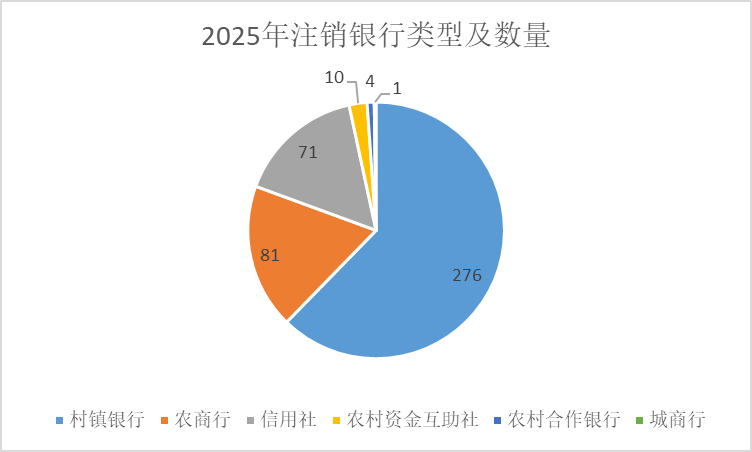
2025年443家银行注销,村镇银行占比超六成!专家:行业整体抗风险能力将显著提升
Jin Rong Jie· 2025-12-29 10:20
Core Insights - The Chinese banking sector is undergoing a significant exit and consolidation process, with 443 banking institutions deregistered by December 29, 2025, primarily involving rural banks, rural commercial banks, and credit cooperatives [1][2]. Group 1: Exit Characteristics - The exit process is characterized by three structural features: - Village banks are the main contributors, with 276 banks exiting, accounting for 62.3% of total exits [2]. - Rural commercial banks and credit cooperatives follow, with 81 and 71 exits respectively, together making up about 34.3% of the total [2]. - Other institutions, including rural mutual aid societies and city commercial banks, also contributed to the exit landscape [2]. Group 2: Regional Distribution - The exit of banking institutions shows a highly concentrated regional distribution: - Inner Mongolia leads with 140 exits, representing 31.6% of the national total [4]. - Shandong follows with 34 exits, while Sichuan, Hubei, and Henan each have 27 exits, indicating a regional focus in this adjustment [4]. - All 29 provincial-level administrative regions have seen banking institutions exit, highlighting the widespread nature of this industry adjustment [4]. Group 3: Timing of Exits - The exit process is not evenly distributed throughout the year, with a noticeable acceleration in the second half: - May marked the peak month with 130 exits, aligning with reform initiatives in Inner Mongolia [5]. - November and December also saw significant exits, with 64 and 54 respectively, while April recorded the lowest with only 3 exits [5][6]. - Overall, the number of exits in the second half of the year surpassed that of the first half, closely linked to regulatory guidance and regional reform progress [5]. Group 4: Underlying Logic of Consolidation - The concentration of exits is seen as a necessary outcome of the Chinese banking sector's development, focusing on risk management and sustainable growth: - The primary goal of mergers and acquisitions is to address risk management and ensure sustainable development, particularly for small and medium-sized banks facing profitability pressures [7]. - Issues such as fragmented ownership and inadequate corporate governance in rural financial institutions have led to increased risk, necessitating consolidation to improve operational quality [7]. - The consolidation process aims not only to reduce the number of institutions but also to enhance the quality of banking services, fostering a transition towards high-quality development in the sector [7][8]. Group 5: Future Outlook - The future trajectory for village banks indicates a trend towards "reducing quantity while increasing speed": - Currently, there are approximately 1,500 village banks, with expectations that this number will decrease to around 1,000 in the next three to five years, focusing on establishing a robust and specialized banking sector [8]. - The ongoing consolidation reflects the improvement of market exit mechanisms, enhancing the overall resilience and operational efficiency of the banking industry [8].
加大监管力度,显著提高违法成本!这一草案公开征求意见
Zhong Guo Zheng Quan Bao· 2025-12-28 05:03
Core Viewpoint - The revision of the Banking Supervision Law aims to enhance regulatory effectiveness and address the complexities and risks faced by the banking industry, reflecting significant changes in the internal and external environment over the past two decades [1][3]. Regulatory Enhancements - The revision extends the regulatory chain to include major shareholders and actual controllers, establishing a comprehensive regulatory framework that covers preemptive, ongoing, and post-event supervision [2][3]. - It emphasizes the need for a systematic arrangement for risk disposal, allowing regulatory authorities to adopt flexible measures based on the risk status of institutions and market conditions [2][4]. Consumer Protection - The revision clarifies the supervisory role of the State Council's banking regulatory authority in consumer rights protection, guiding the establishment of consumer dispute mediation organizations [4][6]. - It details the obligations of banking institutions regarding consumer protection, prohibiting false advertising and illegal charges to foster a fair market environment [4][5]. Strengthening Penalties - The revision focuses on increasing the deterrent effect of administrative penalties by enhancing the penalties for key individuals and behaviors that pose significant financial risks [5][7]. - It introduces stricter rules for administrative penalties, including the confiscation of illegal gains and increased fines, to ensure compliance and elevate the cost of financial misconduct [5][7]. Comprehensive Regulatory Framework - The revision aims to solidify effective practices from years of regulatory experience into legal frameworks, ensuring a more complete regulatory focus that includes not just licensed institutions but also key relationships and processes that underpin their operations [6][7]. - It seeks to integrate risk sources and transmission chains into the governance framework, covering the entire spectrum from funding to consumer interactions [6][7].
国新证券欲甩“历史包袱”,一次性抹平逾60亿亏损,频频调整人事、组织架构
Sou Hu Cai Jing· 2025-07-17 05:13
Core Viewpoint - The company, Guoxin Securities, is utilizing risk reserves, statutory surplus reserves, and capital reserves to offset a cumulative loss of 6.121 billion yuan, effectively resetting its retained earnings to zero, which is seen as a move to shed the historical burdens from its predecessor, Huarong Securities [1][3][4]. Financial Summary - As of the end of 2024, Guoxin Securities reported a cumulative retained earnings deficit of -6.121 billion yuan, with general risk reserves, trading risk reserves, and surplus reserves each at 707 million yuan, and capital reserves at 9.628 billion yuan [2]. - The company plans to use 707 million yuan from each of the general risk reserves, trading risk reserves, and surplus reserves, along with 3.999 billion yuan from capital reserves, totaling 6.121 billion yuan to cover the losses [2]. - Post-loss compensation, the general risk reserve will be reduced to 170.78 yuan, trading risk reserve to 0 yuan, surplus reserve to 0 yuan, and capital reserve to 5.629 billion yuan, resulting in a retained earnings balance of 0 yuan [2]. Strategic Moves - The recent actions of Guoxin Securities, including the loss compensation, are part of a broader strategic reset following its rebranding and change of ownership, which includes two rounds of capital increases and significant adjustments in management and organizational structure within a year [1][5][10]. - The company has initiated two rounds of capital increases since last August, with plans to raise up to 1 billion shares in 2024 and an additional 2.4 billion shares in 2025, indicating a focus on strengthening its capital base [8][9]. - Guoxin Securities has also made significant changes in its management team, including the appointment of new executives and restructuring of key business departments, aimed at enhancing operational efficiency and adapting to market changes [9][10]. Performance Overview - Despite a gradual increase in revenue from 597 million yuan in 2022 to 1.751 billion yuan in 2024, the net profit has declined from 502 million yuan to 32 million yuan during the same period, highlighting ongoing financial challenges [4]. - The decision to clear historical losses is viewed as a necessary step for financial health and is expected to improve investor confidence and market perception, facilitating future business expansion and financing opportunities [4][10].

中国人民银行副行长陆磊出席金融稳定理事会全体会议
news flash· 2025-06-13 03:07
Group 1 - The meeting of the Financial Stability Board (FSB) in Madrid discussed global financial system vulnerabilities, non-bank financial intermediation, crypto assets, climate-related financial risks, and risk management [1] - The appointment of Andrew Bailey, Governor of the Bank of England, as the new Chair of the FSB was approved during the meeting [1] - The Deputy Governor of the People's Bank of China, Lu Lei, expressed appreciation for the outgoing Chair, Klaas Knot, for his effective leadership and contributions [1] Group 2 - Lu Lei held discussions with the Chair of the FSB's Standards Implementation Committee and the Deputy Governor of the Bank of Japan, Masayoshi Amamiya, regarding international financial regulatory standards and peer reviews [1]
平安银行:信贷结构优化提速,风险处置扰动业绩-20250316
申万宏源· 2025-03-16 08:44
Investment Rating - The report maintains a "Buy" rating for Ping An Bank [1] Core Views - The capital market has anticipated the pressure on Ping An Bank's profit for 2024, primarily due to a continuous decline in revenue and proactive provisioning, which has turned profit growth negative. The bank's revenue for 2024 decreased by 10.9% year-on-year, while net profit attributable to shareholders fell by 4.2% [6][8] - The report highlights the ongoing optimization of the retail structure and a reduction in high-risk loans, indicating that credit growth will depend on the recovery of demand from low-risk retail customers [6][11] Financial Data and Profit Forecast - Revenue and profit forecasts for Ping An Bank from 2023 to 2027 are as follows: - Total revenue (million): 2023: 164,699, 2024: 146,695, 2025E: 134,677, 2026E: 133,440, 2027E: 138,182 [5] - Net profit (million): 2023: 46,455, 2024: 44,508, 2025E: 44,109, 2026E: 44,407, 2027E: 45,677 [5] - The report projects a decline in net profit growth rates for 2025-2026, with estimates of -0.9% and 0.7% respectively [6][9] Key Financial Metrics - As of the end of 2024, the bank's non-performing loan (NPL) ratio remained stable at 1.06%, while the provision coverage ratio decreased to 251% [4][6] - The bank's net interest margin for Q4 2024 was reported at 1.7%, reflecting a quarter-on-quarter decline of 17 basis points [9][12] - The report notes a significant reduction in retail loans, with a total decrease of 334 billion yuan in 2024, including a reduction of over 210 billion yuan in retail loans [6][11] Asset Quality and Risk Management - The report emphasizes the importance of actively managing problem assets and maintaining a stable asset quality, with a focus on potential risks in real estate loans and retail loan risk mitigation [9][14] - The bank's proactive approach to asset write-offs and provisioning is highlighted as a strategic move to strengthen its financial position [9][14] Dividend Policy - The dividend payout ratio for 2024 has been reduced to 28.3%, aligning with the industry average, which corresponds to an estimated dividend yield of approximately 5.08% for 2025 [6][9]

平安银行(000001):信贷结构优化提速,风险处置扰动业绩
Shenwan Hongyuan Securities· 2025-03-16 03:29
Investment Rating - The report maintains a "Buy" rating for Ping An Bank [1] Core Views - The bank's 2024 revenue decreased by 10.9% year-on-year, with a net profit attributable to shareholders of 44.5 billion yuan, down 4.2% year-on-year. The fourth quarter of 2024 saw a significant decline in profit due to increased provisioning [4][6] - The bank's strategy focuses on optimizing its credit structure, with a notable reduction in high-risk retail loans and a cautious approach to corporate lending [6][9] - The bank's net interest margin has been under pressure due to interest rate cuts and a decrease in high-yield retail loans, leading to a 21% decline in net interest income for 2024 [6][9] Financial Data and Profit Forecast - Total revenue (in million yuan) is projected to decline from 164,699 in 2023 to 134,677 in 2025E, with a year-on-year growth rate of -8.19% [5] - Net profit attributable to shareholders is expected to decrease slightly from 46,455 in 2023 to 44,109 in 2025E, reflecting a year-on-year growth rate of -0.90% [5] - The bank's non-performing loan (NPL) ratio is expected to remain stable at around 1.06% through 2025, with a provisioning coverage ratio projected to decline to 239.90% [5][6] Key Financial Metrics - The bank's earnings per share (EPS) is forecasted to be 2.13 yuan in 2025, with a return on equity (ROE) of 9.39% [5] - The price-to-earnings (P/E) ratio is projected to be 5.63 in 2025, while the price-to-book (P/B) ratio is expected to be 0.51 [5][9] Loan and Asset Quality - The bank's total loans decreased by 33.4 billion yuan in 2024, with a significant reduction in retail loans exceeding 210 billion yuan [6][11] - The NPL ratio for corporate loans increased to 1.79% in the fourth quarter of 2024, indicating rising risks in the real estate sector [9][14] - Retail loan NPL generation is estimated to remain high at around 2.51% for 2024, despite a slight decrease in the overall retail loan NPL ratio [9][14] Dividend Policy - The bank has reduced its cash dividend payout ratio to 28.3% for 2024, which corresponds to a projected dividend yield of approximately 5.08% for 2025 [6][9]