
银行合规

Search documents
“喜欢拥有现金”:德意志银行与爱泼斯坦缓慢分手的内幕
Xin Lang Cai Jing· 2026-02-12 12:06
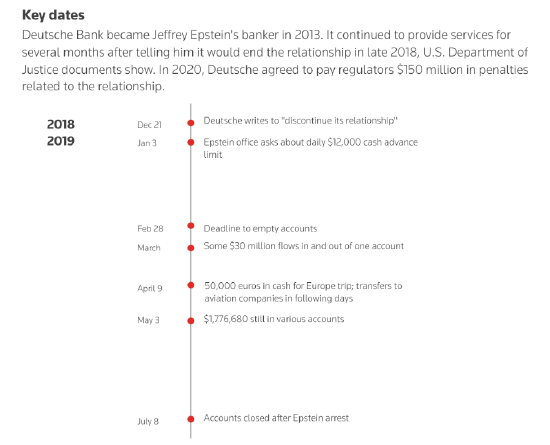
Core Viewpoint - Deutsche Bank continued to provide services to Jeffrey Epstein even after notifying him in late 2018 that they would terminate their relationship, only closing his accounts after his arrest in July 2019 [1][10]. Group 1: Relationship with Epstein - Deutsche Bank admitted to errors in accepting Epstein as a client in 2013 and expressed regret over their relationship [2][10]. - The bank officially notified Epstein on December 21, 2018, of their intention to close his accounts, but continued to provide services for several months thereafter [2][11]. - As of May 3, 2019, Epstein held at least nine accounts at Deutsche Bank with a total balance of $1,776,680 [9]. Group 2: Services Provided - Services provided to Epstein included arranging €50,000 (approximately $59,300) in cash shortly before his trip to Europe in April 2019 [1][11]. - The bank assisted Epstein in refunding a €10,000 deposit from a Mercedes-Benz dealer and processed multiple currency orders exceeding €6,000 each [3][11]. - Even after the official termination notice, Deutsche Bank continued to facilitate transactions, including transferring over $100,000 to various airlines in April 2019 [8][16]. Group 3: Internal Communications and Compliance - Internal emails revealed that Deutsche Bank employees were concerned about confirming Epstein's status as a client following his arrest [12]. - An urgent internal email listed 28 accounts that needed to be closed immediately after Epstein's arrest [4][12]. - Compliance issues were highlighted, as the New York State Department of Financial Services criticized the bank for inadequate scrutiny of payments made to Epstein [15].

2025,银行大罚单明显变多了
Xin Lang Cai Jing· 2026-01-04 12:48
Core Insights - A significant trend observed in 2025 is the increase in large fines imposed on banks, reflecting compliance shortcomings and risk points during the transition to high-quality development in the banking industry [2][16] - In 2025, regulatory authorities issued a total of 454 fines exceeding one million yuan to banking institutions and personnel, an increase of 58 from the previous year, with the total amount of fines nearly doubling [2][16] - The main areas of violations in 2025 were concentrated in credit business, anti-money laundering, and internal control systems, with anti-money laundering violations seeing the most notable increase, reaching 894 fines, a rise of 185.09% compared to the previous year [2][16] Summary of Fines Over 20 Million Yuan - In 2025, there were 12 fines disclosed with amounts exceeding 20 million yuan, primarily related to compliance management issues in traditional business areas such as loans and bills, indicating deficiencies in basic business risk control and regulatory cooperation [4][17] - Common violations included issues with account management and anti-money laundering, highlighting flaws in customer identity verification and transaction monitoring processes [3][17] Summary of Fines Between 10 Million and 20 Million Yuan - This category of fines predominantly involved joint-stock banks, reflecting a conflict between business innovation and compliance management [6] - Violations were mainly related to compliance operations (account and anti-money laundering) and business management (internet loans and agency sales), with cross-border foreign exchange violations being a secondary concern [7] Summary of Fines Between 5 Million and 10 Million Yuan - Fines in this range were primarily concentrated among city commercial banks, joint-stock banks, and rural commercial banks [10] - The most common violations included anti-money laundering and customer identity verification issues, alongside traditional problems related to credit "three checks" failures [10]





这家银行,被罚!
Zhong Guo Ji Jin Bao· 2025-09-22 14:45
Core Points - Huzhou Bank was fined 4.27 million yuan for multiple business violations, marking the largest penalty since its establishment [1][2][3] - The violations included breaches of financial statistical management, account management, merchant management, anti-counterfeit currency regulations, and improper handling of customer identity data [3][6] - The bank's total assets reached 162.04 billion yuan by the end of 2024, with a net profit of 1.09 billion yuan and a non-performing loan ratio of 0.98% [5][6] Regulatory Actions - The People's Bank of China, Zhejiang Branch, issued a warning and imposed a fine of 4.27 million yuan on Huzhou Bank for various regulatory breaches [1][3] - Several senior officials were penalized, including the general manager of the Operations Management Department and the Retail Banking Department, each fined 50,000 yuan for their respective violations [3][6] IPO Status - Huzhou Bank has been preparing for an IPO since 2019 but has not yet achieved this goal, with its application currently in the "inquiry" stage [5][6] - The bank's IPO process has faced delays, particularly after its application was transferred to the Shanghai Stock Exchange following the implementation of the A-share registration system in 2023 [5][6] Industry Context - The recent penalty adds uncertainty to Huzhou Bank's IPO prospects, reflecting a trend of increasing regulatory scrutiny on financial institutions, especially smaller banks [6]