
银行股投资逻辑转变

Search documents
详解2025年理财年度报告:规模稳步增长,增配现金类资产【中泰银行·戴志锋/邓美君/陈程】
Xin Lang Cai Jing· 2026-02-10 12:45
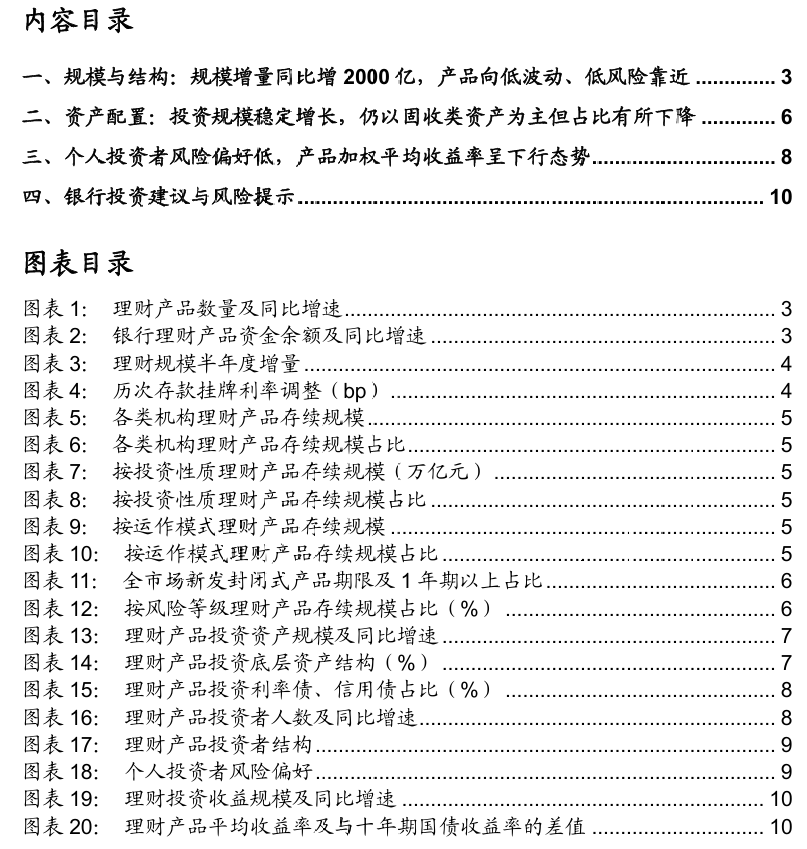
Group 1 - The total scale of wealth management products reached 33.29 trillion yuan, with a year-on-year growth of 11.2%, and the total annual increment was 3.34 trillion yuan, an increase of 0.19 trillion yuan compared to 2024 [1][51] - The narrative of "deposit migration" continues to be a hot topic in the market, with a nearly 200 billion yuan year-on-year increase in scale increment, as funds from maturing fixed deposits flow into capital markets such as funds, wealth management, and asset management [1][51] - By the end of 2025, the number of wealth management products reached 46,300, a year-on-year increase of 14.8%, the highest level since 2020 [1][51] Group 2 - Wealth management companies and banks had a total scale of 30.71 trillion yuan and 2.58 trillion yuan respectively, accounting for 92.25% and 7.75% of the market, with wealth management companies' share exceeding 90% for the first time [2][52] - Fixed income products accounted for 97.1% of the total, with a stable high proportion, while mixed and equity products accounted for 2.6% and 0.2% respectively [2][52] - Open-ended wealth management products remained the main driver of scale expansion, with a total of 26.59 trillion yuan, while closed-end products had a scale of 6.79 trillion yuan [2][52] Group 3 - By the end of 2025, the total investment assets of wealth management products reached 35.66 trillion yuan, a year-on-year growth of 10.99%, with liabilities totaling 2.35 trillion yuan and a leverage ratio of 107.05%, a decrease of 0.09 percentage points year-on-year [2][32] - The proportion of fixed income assets in wealth management investments was 57.03%, a decrease of 6.23 percentage points from the beginning of the year, primarily due to a decline in bond asset proportions [3][53] - Cash and bank deposits investment proportion increased significantly to 28.2%, up 4.30 percentage points from the beginning of the year [3][53] Group 4 - The number of wealth management investors reached 143 million, a year-on-year increase of 14.4%, with individual investors accounting for 98.6% of the total [4][54] - The average weighted return on wealth management products was 1.98%, showing a downward trend influenced by market interest rate fluctuations [4][54] - The total investment income for 2025 was 730.3 billion yuan, a year-on-year increase of 2.9% [4][54] Group 5 - Investment recommendations suggest a shift in bank stock operating models from "pro-cyclical" to "weak-cyclical," with a focus on high-dividend stability during economic downturns [5][55] - Key investment lines include regional banks with strong certainty and large banks with high dividends [5][55]

详解基金4Q25银行持仓:板块资金面整体稳健,主动基金比例小幅提升0.04pcts至2.08%
ZHONGTAI SECURITIES· 2026-01-25 06:28
Investment Rating - The industry investment rating is "Overweight" (maintained) [2] Core Insights - The overall funding situation in the banking sector is stable, with a slight increase in the proportion of active funds by 0.04 percentage points to 2.08% [3][4] - The report indicates that the banking sector is expected to continue its positive trend into 2026, supported by improved credit issuance and stable deposit growth [2][3] Summary by Sections Active Fund Allocation in the Banking Sector - The proportion of active funds holding bank stocks increased to 2.08%, but the underweight ratio slightly expanded [6][11] - The top five banks held by active funds are China Merchants Bank, Ningbo Bank, Chongqing Rural Commercial Bank, Industrial and Commercial Bank of China, and Jiangsu Bank, accounting for 0.48%, 0.36%, 0.12%, 0.12%, and 0.12% of the total active fund holdings respectively [14][16] Passive Fund Allocation in the Banking Sector - There was a total net inflow of 62.03 billion yuan into the banking sector from passive funds in Q4 2025 [20][25] - The total market value of bank stocks held by passive funds reached 2015.56 billion yuan, a 3.18% increase from the previous quarter [20][21] Northbound Capital Allocation in the Banking Sector - Northbound capital experienced a net outflow from the banking sector, with a reduction of 53 billion yuan [26][29] - The total market value of bank stocks held by northbound capital was 1772.60 billion yuan, reflecting a 2.06% increase from the previous quarter [26][28] Summary of Fund Flows - Overall, the funding situation showed minor fluctuations, with passive funds holding a relatively high proportion of the circulating market value [31] - The net inflow and outflow figures for Q4 2025 were 62.0 billion yuan for passive funds, -12.6 billion yuan for active funds, and -53.0 billion yuan for northbound funds, indicating a stable overall performance [31]





11月金融数据前瞻:预计新增贷款3000-6500亿,社融增速维持8.5%
ZHONGTAI SECURITIES· 2025-12-08 12:55
Investment Rating - The industry investment rating is maintained at "Overweight" [2] Core Insights - The report anticipates new RMB loans in November to be between 300 billion to 450 billion, with a year-on-year decrease of 130 billion to 280 billion, leading to a loan growth rate of approximately 6.4% [5][9] - The expected new social financing scale for November is projected to be between 2.16 trillion to 2.32 trillion, with a year-on-year decrease of 0.01 trillion to 0.17 trillion, maintaining a stock growth rate of around 8.5% [20][25] - The report highlights a weak corporate activity backdrop, with the manufacturing PMI at 49.2%, indicating a contraction, and a decline in production, new orders, and new export orders [5][9] - The residential loan sector is expected to see a decline due to policy cycles and a drop in housing transaction volumes, with significant decreases in average transaction areas in major cities [9] Summary by Sections 1. RMB Loans - New RMB loans for November are expected to be between 300 billion to 450 billion, with a year-on-year decrease of 130 billion to 280 billion, resulting in a loan growth rate of about 6.4% [5][9] 2. Social Financing - The anticipated new social financing scale for November is projected to be between 2.16 trillion to 2.32 trillion, with a year-on-year decrease of 0.01 trillion to 0.17 trillion, maintaining a stock growth rate of around 8.5% [20][25] 3. Liquidity - M1 and M2 growth rates are expected to decline but remain relatively high, with M1 projected to drop to 6.0% and M2 to 8.1% by the end of November [27][28] 4. Investment Recommendations - The report suggests a shift in bank stock investment logic from "pro-cyclical" to "weak-cyclical," emphasizing the attractiveness of high-dividend bank stocks during periods of economic stagnation [29]
券商晨会精华 | 半年报业绩压力释放 看好地产板块后续弹性空间
智通财经网· 2025-09-02 00:31
Group 1 - The overall market showed mixed performance with the ChiNext Index leading gains while the Shanghai Composite Index experienced narrow fluctuations. The total trading volume in the Shanghai and Shenzhen markets was 2.75 trillion, a decrease of 48.3 billion from the previous trading day [1] - By the end of the trading session, the Shanghai Composite Index rose by 0.46%, the Shenzhen Component Index increased by 1.05%, and the ChiNext Index gained 2.29% [1] Group 2 - Galaxy Securities stated that the current A-share valuation is still within a reasonable range, although there are significant differences across industries. The overall net profit of A-share companies increased by 2.45% year-on-year, with non-financial sectors showing a 1.04% increase [2] - The report highlighted that A-share absolute valuations are still lower than those of U.S. stocks, indicating substantial room for improvement. Certain sectors like finance and transportation infrastructure still possess valuation advantages, presenting structural opportunities [2] - The performance expectations for companies are improving, with a focus on reducing excessive competition [2] Group 3 - GF Securities noted that the pressure from semi-annual report earnings has been released, and they are optimistic about the future elasticity of the real estate sector. September is identified as a crucial window for making decisions regarding real estate sector allocations [3] - The report emphasized that the market atmosphere is gradually forming, and marginal policy changes will increasingly impact the sector. Current valuations are at historical lows, and the pressure from semi-annual earnings has been fully released, particularly for well-performing leading companies [3] Group 4 - Zhongtai Securities expressed continued confidence in the stability and sustainability of bank stocks, noting a shift in their operating model and investment logic from "pro-cyclical" to "weak-cyclical" [4] - During periods of economic stagnation, bank stocks with high dividends will remain attractive. The investment focus is on regional banks with strong certainty and advantages, particularly in regions like Jiangsu, Shanghai, Chengdu-Chongqing, Shandong, and Fujian [4]
中泰证券:预计全年银行股营收业绩延续平稳改善趋势
智通财经网· 2025-08-31 23:49
Core Viewpoint - Listed banks in China have shown a positive growth trend in revenue and net profit for the first half of 2025, with stable asset quality and expenses, indicating a steady improvement in performance for the year ahead [1][2][7]. Revenue and Profit Analysis - Revenue growth turned positive in 1H25, with a year-on-year increase of 0.8%, compared to a decline of 1.8% in 1Q25, driven by low base effects and non-interest income recovery [2][3]. - Net profit also saw a year-on-year increase of 0.8% in 1H25, improving from a decline of 1.2% in 1Q25, supported by revenue growth and cost improvements [2][3]. - The overall asset quality remains stable, with a non-performing loan (NPL) generation rate of 0.75% in 2Q25, showing a slight year-on-year increase of 4 basis points [5][6]. Interest and Non-Interest Income - Net interest income for the industry decreased by 1.3% year-on-year in 1H25, but the growth rate of interest-earning assets increased by 9.7% [4]. - Non-interest income turned positive with a year-on-year growth of 6.6% in 1H25, driven by a recovery in fee income, which increased by 3.1% [4]. Asset Quality and Provisions - The industry maintained a stable asset quality, with the NPL ratio at 1.23% in 2Q25, remaining stable across various sectors [5][6]. - The provision coverage ratio increased by 59 basis points to 238.58% in 1H25, primarily driven by state-owned banks [6]. Investment Recommendations - The investment logic for bank stocks has shifted from "pro-cyclical" to "weak-cyclical," with high dividend yields becoming attractive during periods of economic stagnation [1][7]. - Two main investment themes are identified: regional banks with strong certainty and high dividend yield large banks, including major state-owned banks and selected joint-stock banks [1][7].

银行股当前推荐及基本面更新
2025-06-16 15:20
Summary of Key Points from the Conference Call Industry Overview - The current investment logic for bank stocks has shifted from high dividends to focusing on performance, ROE advantages, long-term governance, and strong fundamentals [1][2] - The overall dividend yield in the AH market is converging towards 4.0%, with state-owned banks also approaching this level [1][2] - Headquartered city commercial banks benefit from regional economic advantages, maintaining double-digit credit growth rates, outperforming the national average [1][3] Key Insights on City Commercial Banks - Leading city commercial banks are expected to continue outperforming in terms of credit growth, with regions like Zhejiang and Jiangsu maintaining credit growth rates of 9-10% [1][3][4] - These banks are gaining market share in their respective provinces and cities, with credit growth rates projected to remain between 10-15% [3][4] - The asset expansion speed and high loan growth contribute to superior performance and profitability for these banks [4][5] Performance Metrics and Future Expectations - City commercial banks are leading the industry in net interest margin, asset scale, and credit growth, with ROE expected to remain between 13% and 17% [6][1] - The banking sector's valuation remains low, with PE and PB ratios among the lowest across major industries [7][8] - There is a divergence in market expectations regarding the stability of interest margins, with some anticipating continued downward pressure [8][9] Specific Bank Performances - Hangzhou Bank is highlighted for its strong profit growth, achieving approximately 17% growth in Q1 2025, with a focus on government and urban construction-related businesses [10][11][13] - Chengdu Bank is expected to maintain a credit growth rate of 14-15% in 2025, benefiting from a high proportion of government-related business [14] - Jiangsu and Nanjing city commercial banks are experiencing significant growth in interest income, with Q1 growth rates between 17% and 20% [15] Dividend and Valuation Insights - Nanjing Bank's recent convertible bond redemption indicates a dividend yield of over 4.3%, suggesting strong dividend potential [17] - The four leading city commercial banks are expected to maintain stable asset quality and low non-performing loan ratios, with growth rates varying from single digits to over 15% for some [18] - The valuation of these banks remains attractive, with Hangzhou Bank noted for its low PB ratio of less than 0.9 and PE ratio of approximately 5.5 to 6 [13] Conclusion on Future Prospects - The outlook for major banks, particularly city commercial banks, remains positive due to their strong fundamentals and market share gains [16][22] - The market is expected to continue favoring banks with robust performance and stable dividends, particularly those with low valuations and high growth potential [21][22]


