
长假效应

Search documents
【广发宏观王丹】当前中观景气度的行业分布是怎样的
郭磊宏观茶座· 2026-03-07 04:08
Core Viewpoint - The article analyzes the February PMI data from a mid-level perspective, highlighting the seasonal characteristics of various manufacturing sectors and the impact of the Spring Festival on consumer activity. Group 1: Manufacturing Sector Analysis - In February, the PMI for high-tech manufacturing, equipment manufacturing, and high-energy-consuming industries decreased by 0.5, 0.3, and 0.1 points respectively, aligning with the seasonal characteristics of the manufacturing sector [1][6] - The consumer goods manufacturing PMI increased by 0.5 points, indicating a seasonal uptrend due to the Spring Festival's influence on consumer activities [1][6] - The three-month average PMI shows that industries such as non-ferrous metals, computer communication electronics, and pharmaceuticals are performing above the average, while automotive and specialized equipment sectors are also experiencing high levels of activity [1][8] Group 2: Marginal Changes in February - Among 17 sub-manufacturing sectors, the non-metallic mineral products PMI rose by 1.8 points, with export orders and product orders increasing by 10.6 and 2.0 points respectively [2][12] - The decline in sectors like non-ferrous metallurgy and petroleum processing is attributed to significant fluctuations in commodity prices at the beginning of the year [2][12] - The computer communication electronics sector saw a notable decrease, primarily due to the impact of the long holiday, although retail sales of electronic products showed rapid growth [2][12] Group 3: Price Trends - In February, prices in the petrochemical, black metal, and pharmaceutical sectors generally increased, while prices in non-ferrous metals, textiles, and food decreased [3][16] - The factory price index remained stable compared to the previous month, with most industries experiencing price increases, particularly in petroleum processing, which saw a rise of 15.5 points [3][16] Group 4: Emerging Industries - The new energy sector led the emerging industries with a PMI above 50, increasing by 5.2 points, while the energy-saving and environmental protection sector also saw a rise of 3.1 points [3][21] - The new generation information technology sector, despite being in a contraction phase, showed minimal deviation from seasonal averages, likely due to accelerated applications in artificial intelligence [3][21] Group 5: Construction and Service Industries - The construction sector's PMI decreased by 0.6 points to 48.2, with a slight recovery in housing construction PMI by 1.3 points, indicating optimism among construction firms regarding the upcoming working season [4][22] - The service sector's PMI increased significantly by 10.9 points, driven by strong performance in accommodation, catering, and cultural entertainment sectors, reflecting the positive impact of the long holiday [4][27]


当前中观景气度的行业分布是怎样的
GF SECURITIES· 2026-03-06 09:28
Manufacturing Sector Insights - In February, the manufacturing PMI decreased by 0.3 points to 49.0, with high-tech manufacturing PMI at 51.5, down 0.5 points[3] - The consumer goods manufacturing PMI increased by 0.5 points to 48.8, showing seasonal strength related to the Spring Festival[3] - Among 17 sub-sectors, non-metallic mineral products PMI rose by 1.8 points, while specialized equipment saw a decline of 5.0 points[5] Price Trends - In February, the factory price index remained flat compared to the previous month, with notable increases in sectors like petroleum processing (up 15.5 points) and general equipment (up 3.1 points)[7] - Several industries, including non-ferrous metallurgy and chemical fibers, experienced significant price declines, with non-ferrous metallurgy down 10.2 points[7] Economic Outlook - The service sector PMI rose by 0.2 points to 49.7, with significant increases in hospitality and entertainment sectors, reflecting a "long holiday effect" on consumer spending[12] - The construction sector showed a slight recovery, with housing construction PMI up 1.3 points, although overall construction PMI fell by 0.6 points to 48.2[10] Emerging Industries - The new energy sector is the only strategic emerging industry with a PMI above 50, increasing by 5.2 points, indicating expansion[9] - Energy-saving and environmental protection industries also saw improvements, with PMIs rising by 3.1 points, reflecting government support for eco-friendly projects[9]
“史上最长”春节假期激发A股旅游行情
Zheng Quan Ri Bao· 2025-11-05 15:38
Group 1 - The A-share tourism sector showed significant activity, with companies like Caesar Travel, Jishi Media, and others reaching their daily price limits [1] - The State Council announced an extended Spring Festival holiday in 2026, increasing it to 9 days, which is the longest in history, igniting enthusiasm in the tourism market [1] - The holiday schedule includes the Spring Festival from February 15 to February 23, 2026, with additional holidays for the Mid-Autumn Festival and National Day [1] Group 2 - Following the announcement, domestic flight and hotel search volumes for February 14 and 15, 2026, surged over 100% compared to the previous day, with Qunar reporting a threefold increase in flight searches for the Spring Festival [2] - Popular domestic travel destinations during the Spring Festival include Sanya, Dali, Harbin, Haikou, and Kunming, while international interest has notably increased for Berlin, Busan, and Melbourne [2] - Industry experts are optimistic about the long holiday effect, suggesting it will lead to more balanced daily passenger flows and a more comfortable travel experience [2] Group 3 - Companies like Zhongxin Travel plan to develop long-term travel products in response to the anticipated increase in travel due to the extended holiday [3] - The combination of long holidays, including potential "拼假" (combining leave) strategies, is expected to significantly boost market confidence [3] - Spring and Autumn breaks, along with snow holidays, are seen as tools to stimulate consumer spending and promote population mobility [2][3]


利好来袭!这一板块多股涨停!
Zheng Quan Ri Bao Zhi Sheng· 2025-11-05 05:04
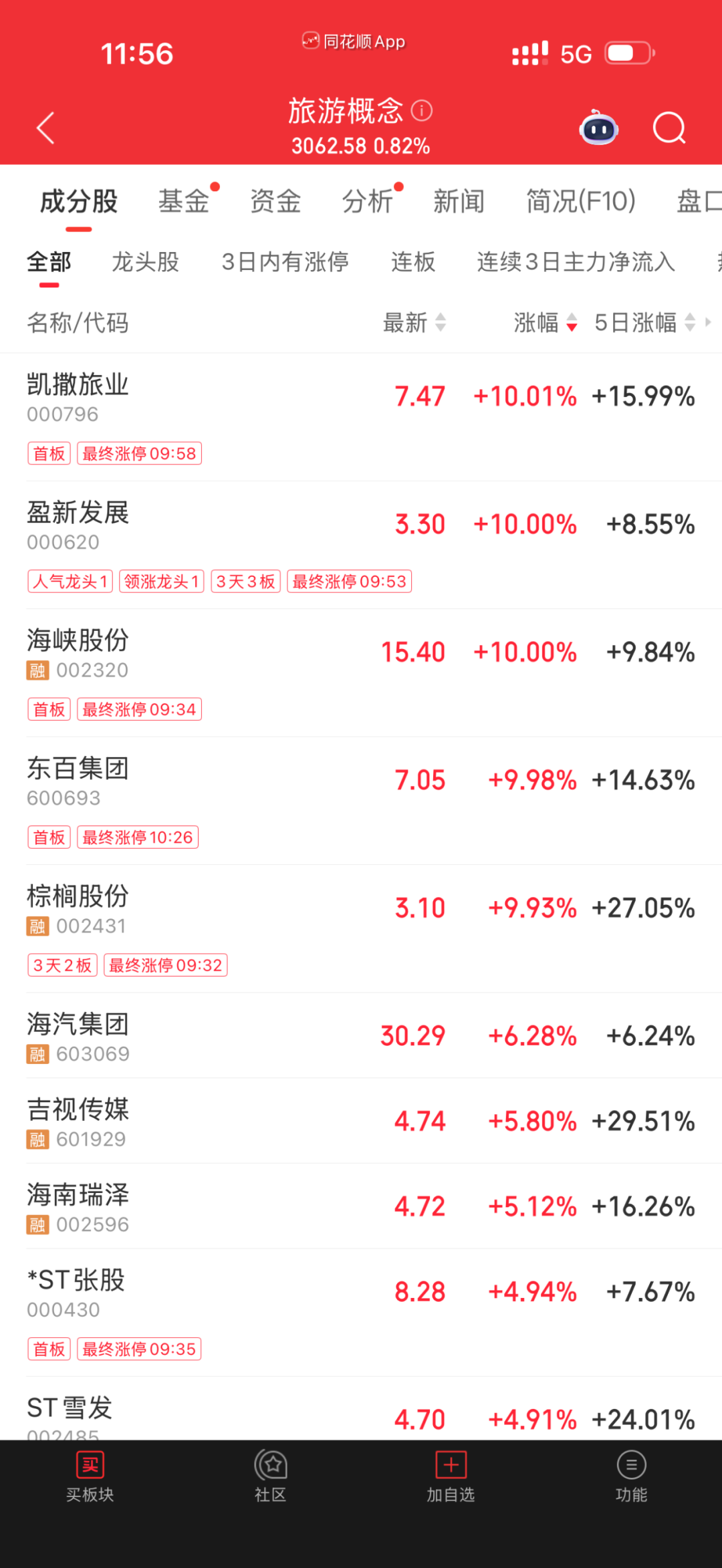
Core Viewpoint - The tourism sector is experiencing a significant surge in activity, driven by the announcement of an extended Spring Festival holiday in 2026, which is expected to boost travel demand and market confidence [3][4][5]. Group 1: Market Performance - As of November 5, several tourism-related stocks, including Caesar Travel and Strait Holdings, reached their daily limit up, indicating strong investor interest [1][2]. - The tourism concept index rose by 0.82%, reflecting overall positive sentiment in the sector [2]. Group 2: Holiday Impact - The 2026 Spring Festival holiday will last for 9 days, marking the longest holiday in history, which is anticipated to significantly increase travel activity [4][5]. - Following the announcement, ticket search volumes for domestic flights and hotels surged over 100%, with international flight searches tripling for the Spring Festival period [4][5]. Group 3: Destination Preferences - Popular domestic travel destinations during the Spring Festival include Sanya, Dali, and Harbin, while international interest is growing for Berlin, Busan, and Melbourne [5]. Group 4: Policy Changes - The recent optimization of the Hainan duty-free shopping policy, effective from November 1, expands the range of eligible products, which is expected to further stimulate tourism and consumption in the region [6][7].
中秋国庆假期,跨区域人员流动量将达23.6亿人次
Ren Min Ri Bao· 2025-09-28 02:07
Core Insights - The upcoming Mid-Autumn Festival and National Day holiday is expected to see significant public travel, with an estimated 2.36 billion trips, averaging about 295 million trips per day, representing a 3.2% increase from last year's daily average of 286 million trips [1] Group 1: Travel Trends - The primary modes of travel during the holiday will be tourism and family visits, with self-driving trips expected to reach 1.87 billion, accounting for nearly 80% of total travel [1] - Peak traffic on highways is projected to reach 70 million vehicles, with 14 million of those being new energy vehicles [1] - There will be a notable increase in medium to long-distance travel, driven by the "long holiday effect," particularly in key urban clusters such as Beijing-Tianjin-Hebei, Yangtze River Delta, Guangdong-Hong Kong-Macau Greater Bay Area, and Chengdu-Chongqing [1] Group 2: Tourism Demand - Domestic tourism is expected to be robust, with family and parent-child travel demand anticipated to strengthen, particularly in urban areas like Guangzhou, Chengdu, Beijing, Shanghai, Xi'an, Hangzhou, Nanjing, and Chongqing, which are likely to surpass last year's tourism levels [1] - International travel is also expected to rise significantly, with increased numbers of tourists heading to Japan, South Korea, and Southeast Asian countries [1] Group 3: Travel Regulations - The Ministry of Transport has announced that small passenger vehicles will enjoy free passage on highways from October 1 at 00:00 to October 8 at 24:00, with specific guidelines on how to qualify for the exemption based on exit timing [2]