
险企发债

Search documents
发新还旧、资本承压 险企忙发债
经济观察报· 2025-11-29 07:30
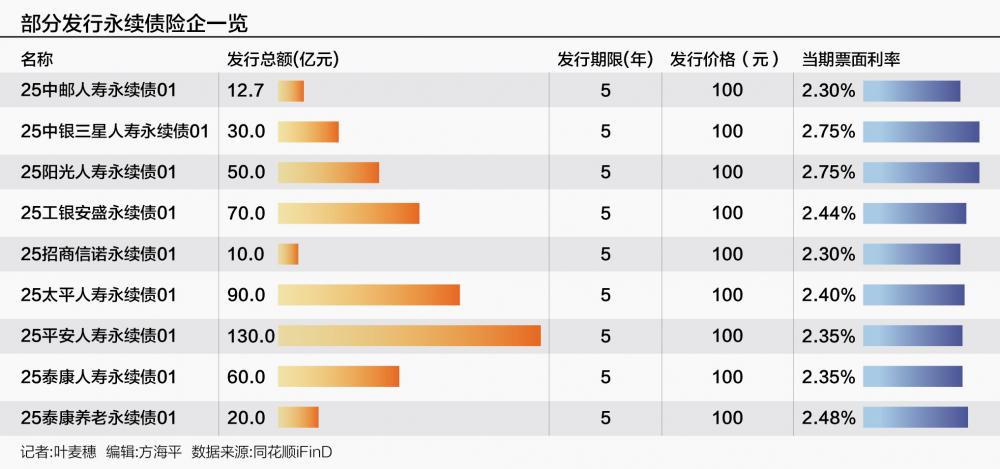
Core Viewpoint - The insurance industry is experiencing a wave of bond issuance, driven by the need for capital supplementation and the replacement of high-interest bonds, with 20 insurance companies issuing financial bonds totaling 74.1 billion yuan since 2025, although this is lower than the 100 billion yuan levels of 2023 and 2024 [1][5]. Group 1: Bond Issuance Trends - Since November 2025, China Merchants Renhe Life Insurance Co., Ltd. issued capital supplementary bonds with a coupon rate of 2.4%, while redeeming an 8 million yuan bond with a 4.95% coupon rate, saving 20 million yuan in interest annually [2][3]. - The bond issuance trend includes 19 insurance companies issuing subordinated bonds in 2025, an increase from 2024, but the total issuance remains lower than previous years, with 74.1 billion yuan issued [7][8]. - The continuous decline in medium to long-term risk-free interest rates and narrowing credit spreads provide a favorable window for insurance companies to issue bonds and refinance existing debt [8]. Group 2: Types of Bonds and Their Impact - The issued bonds are primarily categorized into capital supplementary bonds and perpetual bonds, with the latter being favored by larger insurance companies due to their ability to enhance core capital ratios [11][12]. - Since 2023, there have been 23 issuances of perpetual bonds totaling 121.64 billion yuan, accounting for nearly 30% of the total bond balance of insurance companies, with a significant increase in issuance by life insurance companies [12][13]. Group 3: Capital Adequacy Challenges - The insurance industry faces increasing capital adequacy pressures, with 50 out of 72 companies reporting a year-on-year decline in core solvency ratios as of Q3 2025 [16]. - Smaller insurance companies are particularly affected, relying heavily on interest spreads for stability, which poses sustainability risks [16]. - The issuance costs for smaller insurance companies are higher, as evidenced by the differing coupon rates for similar bond issuances, highlighting the challenges they face in the current market [16].


发新还旧、资本承压 险企忙发债
Jing Ji Guan Cha Wang· 2025-11-29 03:53
Core Viewpoint - The issuance of capital supplementary bonds by insurance companies continues, with a focus on replacing high-interest debt to optimize financial structures and reduce interest expenses [2][5][9]. Group 1: Bond Issuance and Financial Impact - China Merchants Jinhe Life Insurance Co., Ltd. issued capital supplementary bonds with a coupon rate of 2.4%, replacing a previous bond with a rate of 4.95%, saving 20 million yuan in annual interest [2][5]. - In 2025, 20 insurance companies have issued financial bonds totaling 74.1 billion yuan, which is lower than the 100 billion yuan levels of 2023 and 2024 but still at a high level [2][3]. - The trend of issuing bonds is driven by the need for capital supplementation and the replacement of high-interest bonds, with a significant number of companies participating in this activity [3][5]. Group 2: Market Trends and Regulatory Environment - The average coupon rates for insurance companies' subordinated bonds have decreased from 3.6%-5.5% in 2020-2021 to below 3% in 2024-2025, reflecting a favorable borrowing environment [4][9]. - The issuance of perpetual bonds has become a new trend, with 23 issuances since 2023 totaling 121.64 billion yuan, indicating a shift in capital raising strategies among larger insurance firms [7][8]. - The regulatory framework has tightened capital requirements, leading to increased demand for capital supplementation among insurance companies, particularly smaller firms facing greater financial pressures [9][11]. Group 3: Challenges and Financial Health - The solvency ratios of many small and medium-sized insurance companies are under pressure, with 50 out of 72 companies reporting a year-on-year decline in core solvency ratios [10][11]. - Smaller insurance companies are more reliant on interest rate spreads for profitability, which poses sustainability risks as they face higher financing costs compared to larger firms [11][12]. - The inability of some smaller firms to meet bond obligations has raised concerns about their financial stability and the overall market for insurance bonds [12].

险企发债观察:发行规模仍居历史高位 永续债占比超七成
2 1 Shi Ji Jing Ji Bao Dao· 2025-11-27 23:25
Core Viewpoint - Perpetual bonds have become a favored financial instrument for large insurance companies and banks due to their accounting treatment as equity, enhancing capital strength and providing a buffer against long-term solvency fluctuations [1][3] Group 1: Market Trends - As of November 26, 2023, 19 insurance companies have issued capital supplementary bonds or perpetual bonds, totaling over 70 billion yuan, with nearly 70% of this amount being perpetual bonds, highlighting their importance in core capital supplementation for insurers [1][4] - The issuance of perpetual bonds has surged, with 472.7 billion yuan issued in 2023, accounting for 71.2% of total bond issuance, a significant increase from approximately 25% in the previous year [4] Group 2: Regulatory and Strategic Insights - The regulatory framework for perpetual bonds was established in August 2022, allowing insurance companies to tap into core secondary capital, which addresses solvency ratio challenges [3] - The decision to issue perpetual bonds is influenced by a company's strategic planning and funding needs, as these bonds provide a stable funding source and optimize debt structure [3] Group 3: Financial Performance and Cost of Capital - The overall capital position of the insurance industry remains robust, with only five companies failing to meet solvency standards as of the latest reports, a decrease from previous years [5] - The low interest rate environment has driven strong demand for bond issuance, with perpetual bond rates dropping to between 2.15% and 2.8% in 2025, compared to higher rates in previous years [5][6] - Companies are increasingly redeeming older, higher-interest bonds in favor of new, lower-cost perpetual bonds, significantly reducing their interest expenses [6]

年内6家险企获批增资67.8亿元 中小险企需建立多元化融资渠道
Xin Hua Wang· 2025-08-12 05:47
Core Viewpoint - Hengqin Life Insurance plans to increase its registered capital by approximately 753 million yuan, which will raise the shareholding ratio of its shareholder Zhuhai Huachuang Investment Management Co., Ltd. from 32.9% to 49% [1] Group 1: Capital Increase and Insurance Industry Trends - A total of 6 insurance companies have been approved for capital increases amounting to 6.78 billion yuan this year, with Sunshine Life leading at over 2.7 billion yuan [2][3] - The capital increase plans are primarily from small and medium-sized insurance companies, reflecting their significant capital pressure and need for capital replenishment [3][4] - The China Insurance Security Fund's report indicates that insurance companies face challenges in capital replenishment due to insufficient profitability and limited external capital supply [4] Group 2: Debt Issuance Status - No insurance companies have issued bonds this year as of March 10, contrasting with the capital increase activity [5] - In 2023, the bond issuance scale for insurance institutions reached 112.17 billion yuan, a 399.6% increase from 2022, with various companies participating [5] - Two insurance companies chose not to redeem their capital supplement bonds, raising concerns about their financial structure and market credibility [6]
