非法荐股

Search documents
3·15 | 卸下“交易”的伪装第七期:揭秘非法荐股团队的“抢帽子”交易骗局
申万宏源证券上海北京西路营业部· 2026-03-26 03:01
Core Viewpoint - The article reveals the "hat-snatching" trading scam perpetrated by illegal stock recommendation teams, highlighting how stocks are packaged as "guaranteed profits" and the manipulation involved in influencing investor behavior [2][9]. Group 1: Nature of the Scam - "Hat-snatching" trading is identified as a typical market manipulation behavior, explicitly prohibited by the Securities Law. Perpetrators make public evaluations of securities issuers, recommend stocks, and engage in reverse trading to influence stock prices or trading volumes [9]. - The article questions whether the guidance provided is professional or a carefully designed trap for investors, emphasizing the deceptive nature of the recommendations [2]. Group 2: Investor Warnings - Investors are urged to remain rational and skeptical of phrases like "guaranteed profits" and "short-term windfalls," and to avoid blindly following trends. It is recommended to verify qualifications through official channels [9]. - The article stresses the importance of reporting suspected illegal stock recommendations or market manipulation to regulatory authorities [9].

媒体视点 | 非法荐股、市场操纵、造谣传谣……,网红黑嘴大V被查处→
证监会发布· 2026-03-23 09:43
Core Viewpoint - The article highlights the rise of fraudulent investment practices by internet influencers, particularly those posing as wealthy investors, leading to significant financial losses for unsuspecting investors [2][10][27]. Group 1: Case of the "Rich Second Generation" Influencer - A so-called "rich second generation" influencer was found to be illegally recommending stocks without any securities qualifications, resulting in substantial financial losses for investors [10][11]. - Victim Mr. Wang lost nearly 1 million yuan after investing 3 million yuan based on the influencer's stock recommendations, which consistently led to losses [4][5]. - Over 40 complaints were filed against this influencer, with victims collectively losing around 5 million yuan, indicating a widespread issue [6][8]. Group 2: Manipulative Practices by "Finance Influencers" - Another case involved an influencer named "Jin Huo," who manipulated stock prices through misleading recommendations, earning over 40 million yuan in just six months [18][20]. - This influencer's strategy included promoting low-priced stocks and creating hype, leading to significant price increases before selling off shares for profit, leaving many investors with losses [20][22]. - Regulatory bodies have identified a pattern of behavior among these influencers, including the use of emotional and sensational content to attract attention and manipulate market movements [32]. Group 3: Regulatory Response and Recommendations - Regulatory authorities are increasing efforts to combat fraudulent activities by enhancing platform governance and implementing stricter regulations on financial influencers [30][32]. - Legal experts emphasize that any stock recommendation, regardless of whether it involves a fee, may be considered illegal without proper licensing, highlighting the need for investor awareness [27][29]. - The article calls for a comprehensive approach to governance, including legal accountability and investor protection, to create a more transparent and resilient capital market [34].

罚没超8300万元!知名“黑嘴大V”,被封号
券商中国· 2026-03-22 03:47
Core Viewpoint - The article highlights the rise of fraudulent investment influencers on short video and live streaming platforms, who create false personas to attract followers and manipulate stock investments [1][2]. Group 1: Case of "京圈富少" - A netizen named Mr. Wang was drawn to an influencer claiming to be a wealthy investor, showcasing luxury cars and homes, which led him to invest 150,000 yuan in a so-called "core group" for stock tips [3][5]. - The influencer lacked any securities qualifications, and the luxurious lifestyle was fabricated, resulting in losses for Mr. Wang and hundreds of other victims, with total damages exceeding 10 million yuan [5][6]. Group 2: "黑嘴大V" Manipulation - Another type of fraudulent influencer, referred to as "黑嘴大V," misleads investors through their online presence, with one account named "金浤" reportedly earning over 40 million yuan in just six months by manipulating stock prices [8][9]. - The investigation revealed a systematic approach where low-cap stocks were promoted, leading to price surges followed by the influencer selling off their holdings, causing significant losses for followers [9][11]. Group 3: Regulatory Actions - Regulatory bodies have taken action against these fraudulent activities, with the influencer "王某" sentenced to two and a half years in prison and fined 15 million yuan for illegal operations [6]. - The "金浤" account faced penalties exceeding 83 million yuan, including confiscation of illegal gains and a three-year ban from the securities market [11].

315投资者保护日|防范AI技术非法荐股
天天基金网· 2026-03-13 09:09
Group 1 - The article highlights the rise of fraudulent activities using AI tools to lure investors with promises of high returns and efficient stock selection courses [1][2][3] - Criminals are utilizing AI technology to create fake images or videos of well-known stock market figures to promote illegal stock recommendations, misleading investors [4][5] - A specific case in Jiangsu, where a criminal group used AI robots to make 17 million calls, resulted in a scam involving nearly 180 million yuan, showcasing the scale of AI-driven investment fraud [5] Group 2 - The article emphasizes the importance of investor vigilance against scams that leverage AI for deceptive practices, urging individuals to be cautious and informed [1][2][4] - It discusses the methods used by fraudsters, including the generation of fake endorsements and the use of AI for mass communication to target potential victims [5][6] - The content serves as a warning to investors about the potential risks associated with AI-driven investment schemes and the necessity for due diligence [1][3][5]

315投资者保护日|防非侦探笔记之场外配资、代客理财、非法荐股、股市“杀猪盘”
天天基金网· 2026-03-13 09:09
Group 1 - The article discusses the risks associated with stock market margin financing and the potential for scams through unregulated platforms [2][3] - Investors are warned about "virtual trading" platforms where trading activities are not genuine, and they may face demands for additional funds [3] - It is advised that investors retain evidence such as transaction records and chat logs if they encounter issues with withdrawal or are blocked by customer service [3] Group 2 - The article highlights a case where an individual was misled by a self-proclaimed investment advisor who promised high returns in exchange for a share of profits [7][8] - Any individual or institution conducting unauthorized investment advisory services is deemed illegal, and claims of guaranteed high returns are considered fraudulent [8] - Investors are encouraged to verify the legitimacy of investment advice and to be cautious of high-risk promises [8] Group 3 - The article describes a scenario involving insider trading tips from a group claiming to have inside information about a company's asset restructuring, which is not credible [10] - Investors are advised to be vigilant against such stock recommendations and to verify the credentials of those providing investment advice [10] Group 4 - A case is presented where an investor was lured into a "pig butchering" scheme through social media, promising high returns from new three-board companies [12][13] - The article outlines the typical tactics used in such scams, including building trust through free stock tips and creating a sense of urgency to invest [13] - Investors are cautioned about the manipulation of stock prices in low-volume markets and the dissemination of false information to entice them into buying at inflated prices [13]

莫被财经大V荐股迷了眼
Jing Ji Ri Bao· 2026-01-28 22:00
Core Viewpoint - The recent regulatory actions against financial influencer Jin for illegal stock recommendations and reverse trading highlight the serious consequences of market manipulation and the need for a transparent investment environment in the capital market [1][2][3]. Group 1: Regulatory Actions - Jin was fined over 83 million yuan and banned from the securities market for three years due to manipulating the market through illegal stock recommendations [1]. - The regulatory authorities have intensified their crackdown on illegal activities by financial influencers, emphasizing a zero-tolerance policy towards market manipulation [2]. Group 2: Impact on Investors - Many inexperienced investors blindly follow financial influencers, leading to significant financial losses as they become "bag holders" after buying stocks at inflated prices [2]. - The illegal stock recommendations distort price signals and disrupt market order, ultimately harming the interests of ordinary investors [2]. Group 3: Market Environment - A stable and healthy capital market requires a fair and transparent investment environment, which all participants must help maintain [3]. - The incident serves as a warning to financial influencers that greater responsibility comes with increased influence, and they must adhere to legal standards to avoid severe penalties [3]. Group 4: Investor Education - The popularity of financial influencers reflects the ongoing need for investor education, as many individual investors lack the ability to identify risks and understand the dangers of illegal stock recommendations [3]. - The case of Jin underscores the importance of systematic learning and rational analysis in investment, rather than relying solely on influencers or hearsay [3].
媒体视点 | 拆解股市“财经大V”骗局:三层套路构建“收割闭环”
证监会发布· 2026-01-28 10:29
Core Viewpoint - The article highlights the emergence of a black market for misleading investment advice, particularly through "pseudo-financial influencers" who exploit ordinary investors' psychological weaknesses for profit [2][4]. Group 1: Pseudo-Financial Influencers' Tactics - Pseudo-financial influencers create a complete scam loop by manipulating investors' trust in authority, desire for high returns, and urgency for profit [4]. - They establish a false identity as "authoritative stock gods" through deceptive practices, including fabricating credentials and using multiple platforms to amplify their reach [4][6]. - The "step-by-step harvesting" strategy involves initially attracting investors with free stock tips, then charging for premium services, and ultimately executing reverse trades for profit [6]. Group 2: Regulatory Response and Platform Measures - Platforms like Xueqiu are transitioning from passive responses to proactive measures against pseudo-financial influencers, implementing systematic regulations and technical barriers [8]. - Enhanced content review mechanisms and strict identity verification processes are being established to prevent the spread of misleading investment information [8]. - Despite these efforts, gaps remain in content review and identity verification, allowing some pseudo-influencers to continue their activities across different platforms [8]. Group 3: Market Protection and Education - Regulatory bodies are intensifying their crackdown on illegal stock recommendations, establishing a comprehensive framework for prevention, enforcement, and accountability [11]. - The dual approach of administrative and criminal penalties aims to deter pseudo-influencers and protect investors [12]. - Educational initiatives are being promoted to enhance investors' risk awareness and understanding of market dynamics, fostering a culture of rational and professional investment [13].

@投资者,警惕!起底“伪财经大V”三大套路
证券时报· 2026-01-28 00:41
Core Viewpoint - The article exposes the deceptive practices of "pseudo-financial influencers" in the stock market, highlighting a complete black industry chain that exploits ordinary investors' psychological weaknesses for profit [1][3]. Group 1: Structure of Deceptive Practices - Pseudo-financial influencers create a "fake authority" persona through identity fabrication and multi-platform promotion, manipulating investors' trust in authority [3][4]. - They employ a three-step "harvesting" strategy: free offerings to attract investors, followed by paid services, and ultimately, significant financial losses through reverse trading [4][9]. - The influencers often evade accountability by using disclaimers and changing identities after scams, making it difficult for regulators to track them [4][10]. Group 2: Regulatory Response and Industry Measures - Regulatory bodies are increasing efforts to combat these fraudulent activities, establishing a comprehensive framework for prevention, enforcement, and accountability [9][10]. - Platforms are enhancing their technical and institutional safeguards, including algorithm upgrades to intercept misleading content and strict identity verification for content creators [6][9]. - Despite these efforts, gaps remain in content and identity verification processes, allowing pseudo-influencers to continue their operations across different platforms [6][9]. Group 3: Market Environment and Investor Behavior - The current market recovery has led to a rise in illegal stock recommendations, with many small investors relying on influencers for trading decisions, creating fertile ground for scams [7][10]. - The majority of investors in the A-share market are retail investors, who often lack the knowledge to discern credible financial advice from scams, further enabling the activities of pseudo-financial influencers [7][10].

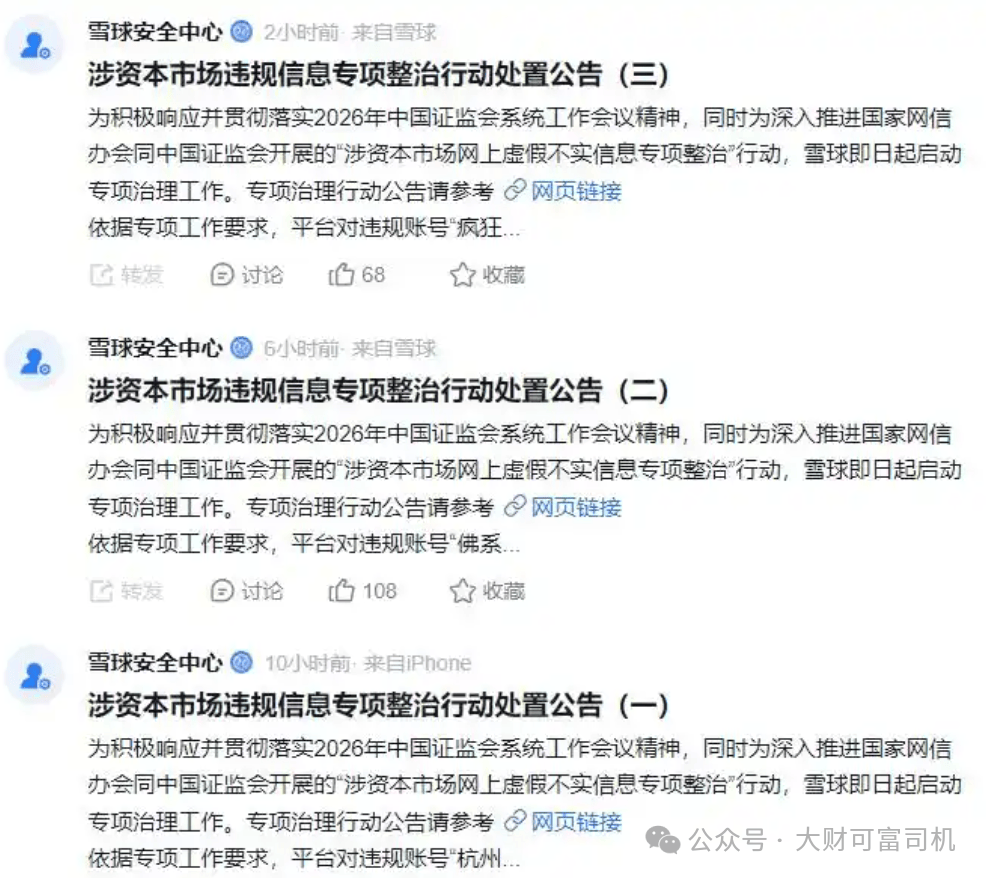
雪球大V团灭!
Sou Hu Cai Jing· 2026-01-27 06:32
Core Viewpoint - The recent crackdown on influential stock market figures on the Snowball platform signifies a significant regulatory move against market manipulation and fraudulent practices targeting retail investors [1][4]. Group 1: Regulatory Actions - The regulatory measures specifically target four types of misconduct: inducing follow-the-trend trading, illegal stock recommendations, organized manipulation, and the use of AI to create misleading content [4]. - The crackdown is not merely a show of force by the platform but a serious attempt to eliminate harmful practices that exploit retail investors [4]. Group 2: Impact on Influencers - Influential figures on Snowball, once revered by retail investors, have been banned, leading to a dramatic fall from grace for many who built their reputations on misleading claims [1][4]. - Some influencers, after gaining substantial followings, transitioned to private equity, continuing to exploit their followers for profit [5]. Group 3: Case Studies - The case of Guan Shanxiang, who claimed to have turned 300,000 yuan into over a billion, illustrates the deceptive nature of some influencers, as his private equity funds suffered significant losses, with net values plummeting to as low as 0.38 [6]. - Another influencer, Li Jie, who marketed himself as a successful investor, faced scrutiny when his fund's performance revealed a significant decline, with a net value of only 0.72 after nearly five years [10]. - Similar stories of failure and deception are prevalent among other influencers, highlighting a pattern of inflated claims and poor investment performance [14]. Group 4: Market Implications - The downfall of these influencers serves as a wake-up call for market participants, emphasizing the need for personal responsibility and critical thinking in investment decisions [14]. - The incident underscores the importance of accountability for those wielding influence in the financial markets, as misuse of such power can lead to legal consequences [14].
防非宣传月|防非提示词条(一):警惕股市黑嘴
野村东方国际证券· 2026-01-23 10:03
Core Viewpoint - The article emphasizes the importance of recognizing and avoiding illegal stock recommendations and fraudulent investment schemes during the National Campaign for Preventing Illegal Securities and Futures Fund Activities [3]. Group 1 - The article highlights the ongoing National Campaign aimed at raising awareness about illegal stock recommendations and the risks associated with them [3]. - It stresses the need for investors to be vigilant and informed to avoid falling into traps set by fraudulent entities [3].