
韩元危机

Search documents
突然!货币战争,紧急出手!
Zhong Guo Ji Jin Bao· 2025-12-14 16:41
Group 1 - The South Korean government is taking urgent measures to address the depreciation of the Korean won, which has recently reached its highest monthly average since the financial crisis, surpassing 1470 won per dollar [2][4] - An emergency meeting was convened by the Vice Prime Minister and Minister of Economy, along with other key financial and economic officials, to discuss the situation in the foreign exchange market and potential responses [2][3] - Concerns have been raised about the impact of the won's depreciation on inflation and consumer purchasing power, prompting calls for intervention from the Bank of Korea [3][4] Group 2 - The National Pension Service (NPS), South Korea's largest institutional investor, has a significant overseas asset portfolio of approximately $545 billion and has previously engaged in currency hedging to support the won [4][5] - The NPS has set a hedging limit of about 15% of its global assets and is currently executing a tactical hedging plan that allows for coverage of up to 5% of its overseas assets [5][6] - Analysts suggest that if the won approaches the psychologically significant level of 1500 won per dollar, the government may increase its intervention efforts to stabilize the currency [3][4]
货币战争 紧急出手!
Zhong Guo Ji Jin Bao· 2025-12-14 16:19
Group 1 - The South Korean government held an emergency meeting on December 14 to address the ongoing depreciation of the Korean won, which has reached its highest monthly average against the US dollar since the financial crisis, surpassing 1470 won per dollar [1][3] - The meeting included a broader range of participants beyond the usual foreign exchange authorities, indicating a comprehensive approach to assess factors affecting foreign exchange supply and demand, such as overseas investments by the National Pension Service [3][4] - Concerns have been raised by policymakers regarding the weakening of the won, as it may reignite inflationary pressures and reduce consumer purchasing power, especially as the interest rate differential with the US remains at a 24-year high of 2 percentage points [3][4] Group 2 - Analysts suggest that if the won continues to weaken towards the psychologically significant level of 1500 won per dollar, South Korea may increase intervention efforts, a level not seen since 2009 [4] - The National Pension Service, as the largest institutional investor in South Korea with overseas assets of approximately $545 billion, has previously engaged in currency hedging to support the won, indicating a potential for increased activity if the exchange rate approaches critical thresholds [4][5] - Expectations are rising for year-end currency management by foreign exchange authorities, particularly in light of thin market liquidity [5][6]

突然!货币战争,紧急出手!
中国基金报· 2025-12-14 16:16
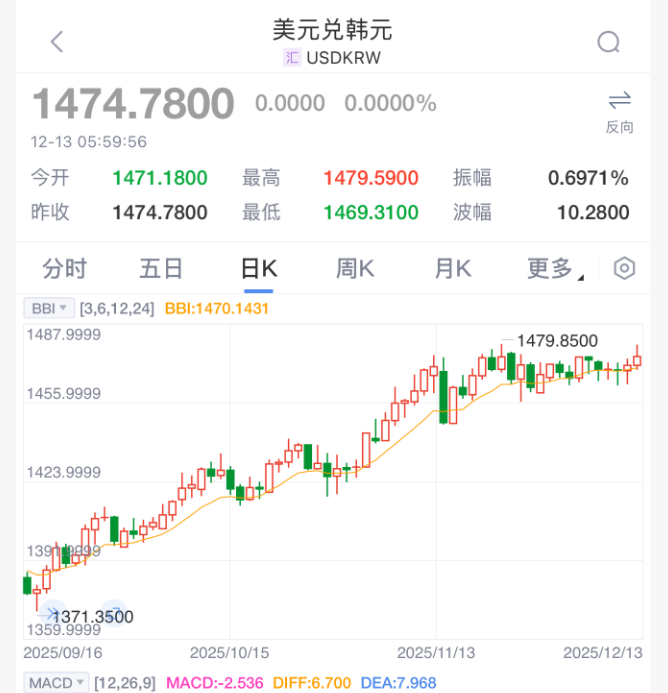
Group 1 - The South Korean government held an emergency meeting on December 14 to address the ongoing depreciation of the Korean won, which has reached its highest monthly average since the financial crisis, surpassing 1470 won per dollar [2][3]. - The meeting included a wide range of participants beyond the usual foreign exchange authorities, indicating a comprehensive approach to assess factors affecting foreign exchange supply and demand, such as overseas investments by the National Pension Service [5]. - Concerns have been raised by policymakers regarding the weakening of the won, particularly as the interest rate differential between South Korea and the U.S. remains at a historically high level, which could lead to further depreciation of the currency [6]. Group 2 - Analysts suggest that if the won continues to weaken and approaches the psychologically significant level of 1500 won per dollar, South Korea may increase its intervention efforts in the foreign exchange market [6]. - The National Pension Service, as the largest institutional investor in South Korea with overseas assets of approximately $545 billion, has previously engaged in currency hedging to support the won, indicating its potential role in stabilizing the currency [6][7]. - The expectation of year-end currency management by foreign exchange authorities is rising, particularly in light of thin market liquidity during this period [7].
