汇率管理

Search documents
离岸人民币破7,为何对美元升值对欧元却贬值?背后藏着大国战略
Sou Hu Cai Jing· 2025-12-28 16:02
Core Viewpoint - The offshore RMB exchange rate has strengthened, influenced by both external factors such as the Federal Reserve's continuous interest rate cuts and internal factors like China's robust export performance, leading to a historical trade surplus exceeding $1 trillion this year [1][3]. Group 1: Exchange Rate Dynamics - The RMB's appreciation against the USD is beneficial for imports, reducing costs for energy and raw materials, but it negatively impacts export competitiveness [1]. - The RMB's exchange rate management has evolved to be more sophisticated, transitioning from a single peg to the USD to a basket of currencies, resulting in differentiated performance against various currencies [3][5]. - The RMB has appreciated by 4% against the USD while depreciating by 8% against the Euro, indicating a strategic approach to enhance export competitiveness in Europe [3][5]. Group 2: Trade Relationships - China's largest trading partner has shifted from the US to ASEAN, with the EU now second and the US in third place, allowing for increased export competitiveness against European products [3]. - The trade surplus with the EU has expanded to $38.4 billion in the first 11 months of the year, facilitated by the RMB's depreciation against the Euro [3]. Group 3: Central Bank Influence - The People's Bank of China has significant control over the exchange rate, allowing for intervention based on trade surpluses and foreign exchange reserves exceeding $3 trillion [5]. - The RMB's appreciation against the USD is strategically beneficial as the US remains heavily reliant on Chinese manufacturing, particularly for high-end products, while the depreciation against the Euro aids in competing with European manufacturers [5]. Group 4: Impact on A-Share Market - The influence of RMB appreciation on the A-share market is limited, as foreign investment constitutes a small portion of the market, and the primary determinants are national policies and company fundamentals [7].


货币战争 紧急出手!
Zhong Guo Ji Jin Bao· 2025-12-14 16:19
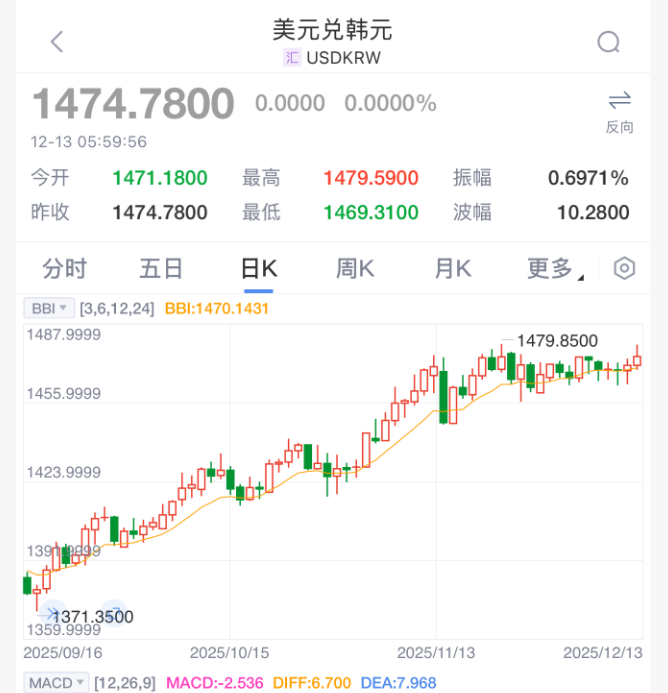
Group 1 - The South Korean government held an emergency meeting on December 14 to address the ongoing depreciation of the Korean won, which has reached its highest monthly average against the US dollar since the financial crisis, surpassing 1470 won per dollar [1][3] - The meeting included a broader range of participants beyond the usual foreign exchange authorities, indicating a comprehensive approach to assess factors affecting foreign exchange supply and demand, such as overseas investments by the National Pension Service [3][4] - Concerns have been raised by policymakers regarding the weakening of the won, as it may reignite inflationary pressures and reduce consumer purchasing power, especially as the interest rate differential with the US remains at a 24-year high of 2 percentage points [3][4] Group 2 - Analysts suggest that if the won continues to weaken towards the psychologically significant level of 1500 won per dollar, South Korea may increase intervention efforts, a level not seen since 2009 [4] - The National Pension Service, as the largest institutional investor in South Korea with overseas assets of approximately $545 billion, has previously engaged in currency hedging to support the won, indicating a potential for increased activity if the exchange rate approaches critical thresholds [4][5] - Expectations are rising for year-end currency management by foreign exchange authorities, particularly in light of thin market liquidity [5][6]
人民币中长期升值趋势,2026年度展望,汇率变动价值分析
Sou Hu Cai Jing· 2025-11-13 09:15
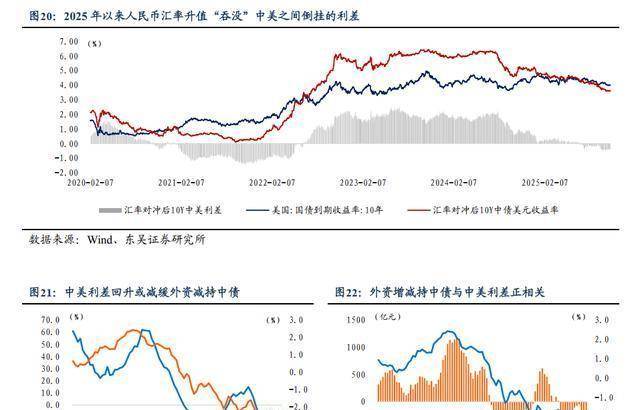
Core Viewpoint - The article suggests that the Chinese yuan may enter a medium to long-term appreciation cycle starting in 2026, with potential targets of 6.7 to 6.8 against the US dollar, contingent on a weak dollar, trade surpluses, and capital inflows [1][12] Group 1: Currency Trends - The yuan has experienced a depreciation phase from 2022 to 2024, with a significant drop in offshore rates, reaching a low of 7.42 in April 2025, but began to rebound thereafter [1] - By November 5, 2025, the yuan ended a three-year downtrend, rebounding by approximately 2-3% within the year [1] - The correlation between the yuan and a basket of currencies has weakened, indicating a shift in trade settlements towards the yuan and other non-dollar currencies [2] Group 2: Private Sector Changes - By mid-2025, the private sector's net foreign asset position turned positive, with overseas net assets reaching approximately $181.9 billion [3] - The trend of "hiding foreign exchange in the public" and low interest rates have driven Chinese enterprises and individuals to invest abroad [3] Group 3: Trade and Capital Flows - China's export share is projected to recover to 14.62% in 2024, with a significant trade surplus contributing to a current account surplus by 2025 [5] - As of September 2025, there was a backlog of approximately $465 billion in pending foreign exchange settlements from exports, which could influence exchange rate fluctuations upon repatriation [5] Group 4: Investment Trends - Cross-border securities investment shifted from net outflows to net inflows in the first three quarters of 2025, with foreign investment in A-shares increasing by approximately 622.9 billion yuan [6] - The attractiveness of holding yuan-denominated assets has improved due to changes in swap points and interest rate differentials [6][7] Group 5: Policy and Regulatory Environment - The People's Bank of China prioritizes exchange rate stability, adjusting the midpoint rate to manage external shocks and maintain market expectations [9] - Regulatory measures have been implemented to respond to fluctuations in US-China trade dynamics and to stabilize the yuan [9] Group 6: Future Outlook - The article predicts that if the US dollar remains structurally weak in 2026, alongside a current account surplus and net inflows from securities investments, the yuan could potentially break below 7.0 and reach the 6.70-6.80 range by the end of the year [12] - A similar appreciation pattern to that observed from September 2019 to March 2022 could see the yuan gradually move towards the 6.40-6.50 range from its April 2025 low [12]
中国_央行三季度货币政策报告基调更趋中性;降息预期推迟一个季度-China_ PBOC Q3 monetary policy report adopts an even less dovish tone; pushing rate cut forecasts back by one quarter
2025-11-12 02:20
Summary of PBOC Q3 Monetary Policy Report Industry Overview - The report pertains to the monetary policy of the People's Bank of China (PBOC) and its implications for the Chinese economy. Key Points and Arguments 1. Monetary Policy Stance - The PBOC maintained a "moderately loose" policy stance in its Q3 report, but emphasized cross-cyclical adjustments, indicating a less dovish tone compared to the Q2 report [2][6] - The central bank signaled limited appetite for broad-based monetary easing, contrasting with previous assessments of China's growth outlook [2][6] 2. Constraints on Monetary Easing - Banks' net interest margins are identified as a major constraint on further monetary easing [2][6] - The PBOC highlighted the need to improve monetary policy transmission, particularly aligning banks' asset returns with funding costs [2][6] 3. Credit Policy - The PBOC downplayed the significance of slower loan growth, attributing it to a shift from indirect financing (bank loans) to direct financing (bond and equity issuance) [7] - The report suggests monitoring total social financing and money supply instead of focusing solely on loan growth as an economic indicator [7] 4. Interest Rate Management - The PBOC emphasized managing interest rate differentials for effective policy transmission, monitoring five categories including policy vs. market rates and banks' lending rates vs. liability costs [8] - This reflects the PBOC's approach to stabilize banks' net interest margins and maintain a relatively steep yield curve [8] 5. Exchange Rate Policy - The PBOC plans to maintain exchange rate flexibility, indicating less depreciation pressure on the CNY against the dollar [9][11] - The report promotes RMB internationalization, suggesting a policy preference for gradual CNY appreciation against the dollar [9][11] 6. Future Monetary Policy Forecast - The forecast for a "dual cut" (10bp policy rate cut and 50bp RRR cut) has been pushed back from Q4 2025 to Q1 2026, with a subsequent rate cut in Q2 2026 shifted to Q3 2026 [1][2] Additional Important Content - The report indicates a policy tilt towards financial stability over growth, suggesting a comprehensive macro-prudential management framework [6] - The PBOC's approach reflects a data-based methodology, focusing on executing existing policies rather than incremental easing [6] This summary encapsulates the critical insights from the PBOC's Q3 monetary policy report, highlighting the central bank's cautious approach amidst economic challenges.
兴业银行乌鲁木齐分行助力外贸企业汇率管理再升级
Zheng Quan Shi Bao Wang· 2025-11-11 04:58
Core Viewpoint - The successful implementation of foreign exchange hedging services by Industrial Bank's Urumqi branch demonstrates the bank's commitment to supporting local foreign trade enterprises in managing exchange rate fluctuations and enhancing asset value [1] Group 1: Financial Services and Solutions - The Urumqi branch tailored a "foreign exchange derivative" service plan based on the specific needs of a local foreign trade enterprise, addressing the increasing demand for refined financial management amid intensified exchange rate volatility [1] - The service provided by the bank helped the enterprise improve its settlement prices and convert the uncertainty of exchange rate fluctuations into predictable costs or revenues, thereby stabilizing its financial condition and clarifying development plans [1] Group 2: Strategic Focus and Future Plans - The bank is integrating a comprehensive suite of financial products, including exchange rate management, capital appreciation, and transaction settlement, to build a full-chain financial service ecosystem for import and export enterprises [1] - Moving forward, the Urumqi branch aims to leverage its cross-border financial service advantages, focusing on the actual needs of foreign trade enterprises, and continuously optimizing financial service offerings through specialized, differentiated, and comprehensive financial solutions to contribute to high-quality enterprise development [1]

上海·强鲸思客参加新形势下跨境电商企业交流会
Sou Hu Cai Jing· 2025-08-08 10:28
Core Insights - The event focused on the impact of the U.S. extreme tariff policies on global trade dynamics and explored solutions for cross-border e-commerce companies [1][5] - Industry experts and representatives from notable companies such as Amazon and Qiangjing Sike participated in discussions about navigating challenges in the current trade environment [1][5] Group 1: Event Overview - The "Cross-Border E-commerce Enterprise Exchange Conference" was held in Shanghai, organized by the Shanghai E-commerce Industry Association [1] - The event featured a visit to Yitong International's digital exhibition hall, showcasing innovative digital solutions for cross-border trade [3] Group 2: Key Presentations - Gao Ping, Deputy Secretary-General of the Shanghai E-commerce Industry Association, emphasized the need for cross-border e-commerce companies to seek new opportunities amid profound adjustments in global trade [5] - Li Sichao, CEO of Qiangjing Sike, presented on the localization practices of DTC brands going overseas, highlighting a strategy to reduce logistics costs by 18% through supply chain restructuring [5] - Xu Rong, General Manager of the Financial Market Department at Ningbo Bank Shanghai Branch, discussed the importance of dynamic exchange rate management for cross-border enterprises [7] Group 3: Industry Collaboration - The event concluded with discussions among company representatives on industry development hotspots, reinforcing the association's commitment to enhancing communication and collaboration within the cross-border e-commerce sector [9]