顺风车通勤

Search documents
嘀嗒出行发布顺风车通勤报告:市内及跨城通勤订单规模为3:1,市内通勤20公里以上订单占近七成
Xin Lang Ke Ji· 2025-11-13 13:06
Core Insights - Dida Chuxing released the "2025 Dida Ridesharing Commute Observation Report," highlighting trends in ridesharing efficiency and cost based on big data and user surveys [1][2] - Ridesharing commute efficiency has improved for three consecutive years, while costs have decreased over the same period [1] Summary by Sections Commute Efficiency and Cost Trends - In 2025, the average speed for urban and intercity ridesharing commutes is projected to be 40.2 km/h and 56 km/h, representing increases of 9.2% and 14.5% from 2023, respectively [1] - The average cost for urban and intercity ridesharing commutes is expected to be 37.2 yuan and 100.3 yuan, reflecting decreases of 10.4% and 5.8% [1] - The order volume ratio for urban to intercity ridesharing is approximately 3:1 [1] Order Characteristics - Nearly 70% of urban ridesharing orders are for distances over 20 kilometers, while almost 60% of intercity orders exceed 90 kilometers [1] - Most ridesharing routes are between residential areas and office locations, typically offering direct one-stop service [1] City Comparisons - The efficiency of urban ridesharing in first-tier cities is comparable to that in new first-tier cities, with average distances of 32.2 km and 36.5 km, and average speeds of 38.7 km/h and 42.7 km/h, respectively [2] - The top five cities for early morning ridesharing orders (6:00-7:00 AM) are Dongguan, Tianjin, Qingdao, Chongqing, and Beijing [2] - The leading city clusters for intercity ridesharing are the Pearl River Delta, Yangtze River Delta, Beijing-Tianjin-Hebei, Shandong Peninsula, and Chengdu-Chongqing [2] - The top five popular intercity routes include Dongguan-Shenzhen, Suzhou-Shanghai, Langfang-Beijing, Huizhou-Shenzhen, and Guangzhou-Shenzhen [2]
顺风车通勤,效率成本有哪些新趋势?2025嘀嗒顺风车通勤观察报告多维度解析
Jing Ji Guan Cha Wang· 2025-11-13 07:43
Core Insights - The report highlights the continuous improvement in ride-sharing commuting efficiency and the decline in commuting costs over the past three years, indicating a positive trend in the ride-sharing market [6][11][43] Group 1: Commuting Efficiency and Cost Trends - Ride-sharing commuting efficiency has improved for three consecutive years, with average speeds for city and intercity commuting reaching 40.2 km/h and 56 km/h respectively in 2025, marking increases of 9.2% and 14.5% compared to 2023 [6][9][14] - Average commuting costs for city and intercity rides have decreased to 37.2 yuan and 100.3 yuan, reflecting declines of 10.4% and 5.8% respectively [6][14][39] Group 2: Order Distribution and Characteristics - The order distribution for ride-sharing commuting is approximately 3:1 in favor of city commuting, with nearly 70% of city orders being over 20 kilometers and nearly 60% of intercity orders exceeding 90 kilometers [15][17][20] - The average commuting distances in first-tier and new first-tier cities are similar, with average distances of 32.2 km and 36.5 km, and average durations of 52.8 minutes and 52.1 minutes [3][22] Group 3: Peak Commuting Patterns - The report identifies the top ten early bird cities for ride-sharing commuting, with Dongguan, Tianjin, and Qingdao leading, indicating regional commuting habits [30][32] - Over 60% of surveyed passengers reported saving more than 20 minutes on their commute compared to public transport, highlighting the efficiency of ride-sharing [33][35] Group 4: Intercity Commuting Trends - The top five city clusters for intercity ride-sharing commuting are the Pearl River Delta, Yangtze River Delta, Beijing-Tianjin-Hebei, Shandong Peninsula, and Chengdu-Chongqing, reflecting regional integration trends [36][39] - The most popular intercity routes include Dongguan-Shenzhen and Suzhou-Shanghai, with a significant concentration of routes in the Pearl River Delta [40][42]

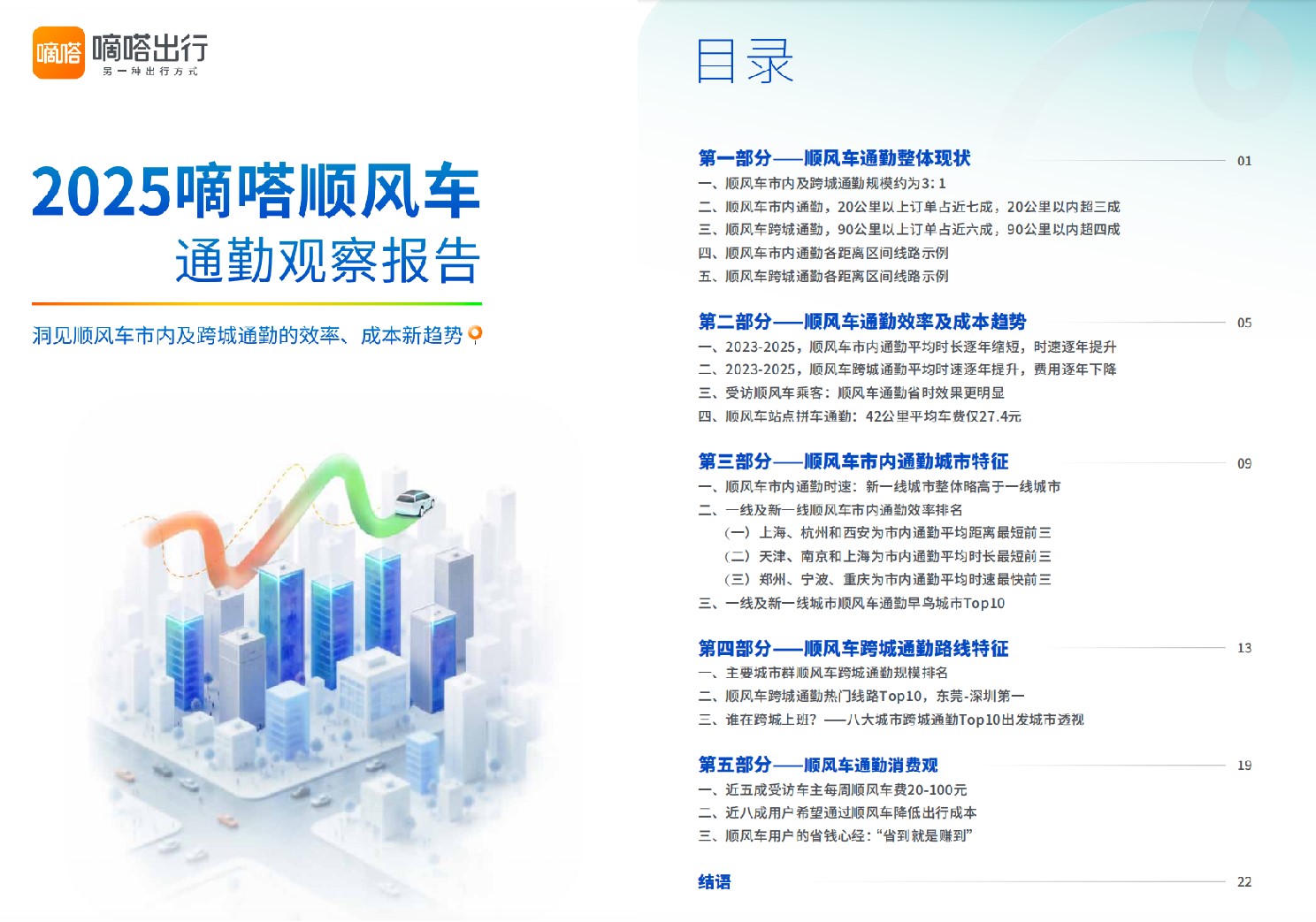
顺风车市内及跨城通勤,效率成本有哪些新趋势? 嘀嗒出行发布《2025嘀嗒顺风车通勤观察报告》
Bei Jing Shang Bao· 2025-11-13 07:42
Core Insights - The report indicates that ride-sharing commuting efficiency has improved continuously over the past three years, with commuting costs decreasing during the same period [5][6][8]. Group 1: Commuting Efficiency and Costs - In 2025, the average speed for city commuting is projected to be 40.2 km/h, an increase of 9.2% from 2023, while cross-city commuting speed is expected to reach 56 km/h, up 14.5% [5][10]. - The average costs for city and cross-city commuting are forecasted to be 37.2 yuan and 100.3 yuan, respectively, reflecting a decrease of 10.4% and 5.8% compared to 2023 [5][11]. - The ratio of city to cross-city ride-sharing orders is approximately 3:1, with city commuting orders predominantly over 20 km [11][13]. Group 2: City Characteristics and Commuting Patterns - The average commuting distance in first-tier cities is shorter at 32.2 km compared to 36.5 km in new first-tier cities, while average commuting times are similar [17]. - The top five cities for early morning ride-sharing orders (6:00-7:00 AM) are Dongguan, Tianjin, Qingdao, Chongqing, and Beijing, indicating a trend of early departures among commuters [25][26]. - The report identifies the top five city clusters for cross-city commuting as the Pearl River Delta, Yangtze River Delta, Beijing-Tianjin-Hebei, Shandong Peninsula, and Chengdu-Chongqing [30][32]. Group 3: Popular Routes and Commuting Trends - The top three popular cross-city commuting routes are Dongguan-Shenzhen, Suzhou-Shanghai, and Langfang-Beijing, with a significant concentration of routes in the Pearl River Delta [34][37]. - Over 60% of surveyed passengers reported saving more than 20 minutes on commuting time compared to public transport, highlighting the efficiency of ride-sharing [27][29]. - The report emphasizes that ride-sharing not only meets the commuting needs of urban workers but also enhances the quality and efficiency of long-distance commuting [37].