嘀嗒顺风车

Search documents
嘀嗒顺风车还有没有油?
BambooWorks· 2026-03-10 09:55
Core Viewpoint - Dida Chuxing is facing significant financial challenges, with a sharp decline in revenue and potential losses due to increased competition and inefficiencies in its ride-sharing model [2][3][5]. Financial Performance - Dida Chuxing's revenue for the last half of the year dropped approximately 44%, worsening from a 29% decline in the first half [1][5]. - The company expects its revenue for 2025 to be between 480 million to 530 million yuan (approximately 69 million USD), representing a year-on-year decrease of about 36% compared to 787 million yuan in 2024 [5]. - Adjusted profits fell by 92% in the second half of the year, leaving only 8.2 million yuan, while the first half saw a 4.7% increase [5]. Market Position and Competition - Dida Chuxing is struggling against larger competitors like Didi and Cao Cao Chuxing, with Didi's revenue in the first nine months of 2025 reaching 53.9 billion yuan, about 100 times Dida's expected annual revenue [7]. - The rise of new open platforms that allow multiple ride-hailing companies to operate without significant investment poses an additional threat to Dida's business model [7]. Operational Challenges - Dida's focus on ride-sharing for price-sensitive customers leads to longer travel times, which is a significant pain point for users [5][8]. - The company is attempting to improve its ride-sharing algorithm to optimize routes and reduce travel times for passengers [8]. Profitability and Cash Reserves - Dida Chuxing has a relatively high gross margin of 67%, compared to competitors like Uber and Lyft, which have around 40% [9]. - Despite a decline from 73.3% in the previous year, Dida's gross margin remains higher than that of Cao Cao Chuxing, which is at 8.4% [9]. - The company holds approximately 1 billion yuan in cash, which should sustain operations for the next couple of years, but ongoing revenue and profit declines could lead to cash flow issues in the future [9].


顺风车预测数据揭示春运新动向:返乡预约成主流,“反向过年”趋势显现
Xin Lang Cai Jing· 2026-02-06 10:41
Group 1 - The core viewpoint of the article is that the ride-sharing model, particularly through platforms like Dida Chuxing, is becoming a significant indicator of changes in population movement during the Spring Festival travel season in 2026 [1] - The peak travel day for cross-city ride-sharing during the Spring Festival is expected to be February 12, with a significant portion of users preferring to book rides in advance, with 70% of orders placed more than one hour ahead and over 40% placed more than 12 hours in advance [1] - More than 15% of return orders are anticipated to start directly from workplaces, highlighting the flexibility of ride-sharing in connecting commuting and returning home scenarios [1] Group 2 - The report also notes a trend of "reverse New Year," where the proportion of cross-city ride-sharing orders from lower-tier cities to new first-tier cities has been increasing over the past three years, while orders from first-tier cities to lower-tier cities have been declining [2] - This shift is associated with recent trends in population employment mobility, with some individuals moving back from first-tier cities to new first-tier cities [2]
嘀嗒出行发布春运顺风车出行预测:返乡下单高峰将从2月8日开始,2月12日出发人数最多
Xin Lang Cai Jing· 2026-02-05 02:17
Core Insights - Dida Chuxing has released a report predicting trends for the 2026 Spring Festival travel season, focusing on ride-sharing for returning home and travel [1][4] Group 1: Travel Trends - The peak days for ride-sharing orders and departures for outbound trips are expected to be February 11 and February 12, with high order volumes from February 8 to 11 [1][4] - The peak days for return trip orders and departures are projected to be February 22 and February 23, with sustained high order volumes around these peak days [1][4] Group 2: Travel Preferences - During the Spring Festival, ride-sharing orders for cross-city trips to hotels and tourist destinations are expected to remain high from the fifth to the ninth day of the Lunar New Year, with a ratio of approximately 1:2 compared to orders for residential destinations [1][4] - Over 15% of cross-city ride-sharing orders for returning home are expected to start directly from workplaces, indicating a trend towards convenience [1][4] Group 3: Booking Behavior - Users are increasingly favoring advance bookings for ride-sharing, with nearly 70% of orders placed more than one hour in advance and over 40% placed more than 12 hours in advance [1][4] Group 4: Popular Routes and Cities - The top five popular routes for returning home during the Spring Festival are expected to be Shenzhen-Dongguan, Shenzhen-Guangzhou, Shenzhen-Huizhou, Beijing-Langfang, and Shanghai-Suzhou [2][5] - The cities with the fastest-growing popularity for ride-sharing during the Spring Festival are projected to be Chengmai, Wuzhishan, Zhuzhou, Qujing, and Yuxi, with significant representation from Hainan, Shandong, Fujian, and Sichuan among the top 30 cities [1][4]
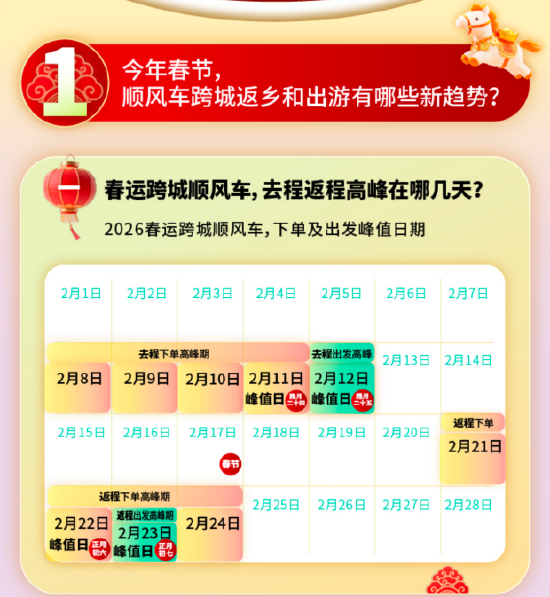
嘀嗒出行发布2026春运顺风车出行预测:春节顺风车返乡下单高峰将从2月8日开始 2月12日出发人数将最多
Jing Ji Guan Cha Wang· 2026-02-04 09:43
Core Insights - The 2026 Spring Festival travel season is expected to see significant trends in ride-sharing, particularly for cross-city trips during the holiday period [2][4][5] Group 1: Travel Trends - Peak days for ride-sharing bookings and departures for outbound trips are projected to be February 11 and 12, while return trip peaks are expected on February 22 and 23 [2][5] - The volume of ride-sharing bookings for outbound and return trips will remain high in the days surrounding these peak dates [2][5] - The ratio of ride-sharing bookings for hotel and tourism destinations compared to residential destinations is estimated to be approximately 1:2, indicating a growing trend in holiday travel [4][10][14] Group 2: User Behavior - Over 15% of cross-city ride-sharing bookings for residential destinations are expected to originate directly from workplaces, allowing for more efficient travel for those still working [10][19] - A significant portion of users (about 67.6%) are expected to book rides more than one hour in advance, with over 40.5% booking more than 12 hours ahead [7][10] - The majority of ride-sharing users tend to book their trips within two days of travel, reflecting the flexibility of ride-sharing as a transportation option during the Spring Festival [7][10] Group 3: Popular Routes and Cities - The top five popular routes for return trips are expected to be Shenzhen to Dongguan, Shenzhen to Guangzhou, Shenzhen to Huizhou, Beijing to Langfang, and Shanghai to Suzhou [25][28] - Cities predicted to experience the fastest growth in ride-sharing popularity during the Spring Festival include Chengmai, Wuzhishan, Zhuzhou, Qujing, and Yuxi [4][14][17] - Following the recent opening of Hainan, cities like Danzhou have seen a significant increase in ride-sharing bookings, with some cities reporting over a 145% increase since December 18, 2025 [17][19] Group 4: Changing Travel Patterns - There is a noticeable trend of increased ride-sharing bookings from lower-tier cities to new first-tier cities, with the proportion rising from 7.72% in 2022 to 9.07% in 2025 [20][24] - Conversely, the proportion of bookings from first-tier cities to lower-tier cities has decreased by over 3 percentage points during the same period [20][24]

嘀嗒出行报告:上下班是顺风车第一大场景,乘客00后占比近两成
Xin Lang Cai Jing· 2025-12-31 07:49
Core Insights - Dida Chuxing released the "2025 Workplace Carpool User Profile and Experience Insight Report," based on big data and surveys from nearly 10,000 users, highlighting user demographics and consumption preferences [1][3]. User Scenarios - Commuting is the primary scenario for carpooling, with passengers and drivers selecting this option at rates of 55% and 82.1% respectively. The second to fourth scenarios for passengers are station-to-station trips (35.6%), trips to hometowns (32%), and personal errands (31.8%). For drivers, the second to fourth scenarios are personal errands (45.8%), trips to hometowns (38.2%), and station-to-station trips (19%) [1][3]. User Demographics - The majority of carpool passengers are aged 20-25, 26-30, and 31-40, with respective proportions of 16.7%, 17.7%, and 28.8%. Additionally, those under 20 account for 2.8%, making the total for those under 25 approximately 19.5%. This indicates that the post-2000 generation is a significant group among carpool passengers. Among surveyed passengers, around 10% identify as university students. Carpool drivers are primarily aged 31-40 and 41-50, with respective shares of 43.9% and 30.4%, totaling 74.3% [1][3]. Vehicle Trends - From 2019 to 2025, the proportion of newly certified vehicles aged one year or less and two years or less is on the rise. By 2025, the share of vehicles aged one year or less among new certifications has increased sixfold compared to 2019, while the share of vehicles aged two years or less has grown by over five times [2][4]. Brand Rankings - The report ranks the total commuting order completion volume for certified carpool drivers from January to October 2025, with the top ten brands being Tesla, Xpeng, Leap Motor, NIO, Zeekr, Li Auto, Hongmeng Zhixing, Zhiji, Leda, and Xiaomi [2][4]. Regional Insights - The data indicates that regions with larger and denser cross-city carpool commuting orders are primarily concentrated in the Pearl River Delta, Yangtze River Delta, Beijing-Tianjin-Hebei, Shandong Peninsula, and Chengdu-Chongqing city clusters. The top five cities with the highest frequency of commuting carpooling are Shanghai, Dalian, Qingdao, Tianjin, and Shenyang [2][4].
嘀嗒顺风车上线特惠拼车新功能,拓展升级普惠出行产品体系
Xin Lang Ke Ji· 2025-11-28 03:39
Core Insights - Dida Chuxing has launched a new feature called "Discount Carpooling," which enhances the user experience for both drivers and passengers by offering lower prices and closer pick-up points [1] - A report indicates that nearly 80% of surveyed users are interested in using more carpooling options to save on travel expenses, with average costs for carpooling expected to decrease from 2023 to 2025 [1] - The automatic order grabbing feature has been improved, integrating with the new carpooling function, making it easier for drivers to secure various types of ride orders [1] Group 1 - The new "Discount Carpooling" feature aims to improve the driver experience and passenger comfort by providing more affordable pricing and closer pick-up points [1] - Since its launch, the order volume for the "Discount Carpooling" has been steadily increasing, with new users showing a higher order completion rate compared to the overall average [1] - Approximately 70% of drivers using the station carpooling feature are also utilizing the automatic order grabbing function, indicating strong adoption of the new technology [1] Group 2 - Dida Chuxing has introduced a random discount feature for advance bookings, allowing passengers to receive discounts of 10% to 5% if they book city rides at least one hour in advance and intercity rides at least three hours in advance [2]

顺风车跨城通勤时速三年提升14.5%,费用下降5.8%
Bei Ke Cai Jing· 2025-11-17 12:32
Core Insights - The report by Dida Chuxing indicates that from 2023 to 2025, the average speed of intercity carpool commuting is expected to increase by 14.5%, while the average cost is projected to decrease by 5.8%, enhancing the cost-effectiveness of intercity commuting [1][5]. Summary by Sections - **Intercity Commuting Trends** - The average distance for intercity carpool commuting is expected to rise from 107.7 kilometers to 124 kilometers, and the average duration will slightly increase from 130.6 minutes to 133.6 minutes. However, the average speed will significantly improve from 48.9 km/h to 56 km/h, marking a 14.5% increase [4]. - The overall efficiency of intercity carpool commuting is anticipated to improve continuously over three years, with costs decreasing consistently [3]. - **Cost Analysis** - By 2025, the average cost of intercity commuting is projected to drop from 106.5 yuan to 100.3 yuan, reflecting a 5.8% decrease compared to 2023 [5]. - **Popular Routes and City Clusters** - The top five city clusters for intercity commuting are the Pearl River Delta, Yangtze River Delta, Beijing-Tianjin-Hebei, Shandong Peninsula, and Chengdu-Chongqing [2]. - The most popular commuting routes include Dongguan-Shenzhen, Suzhou-Shanghai, and Langfang-Beijing, with Langfang-Beijing showing a significant commuting connection [2][7]. - In the Beijing-Tianjin-Hebei region, over 60% of intercity carpool commuting is concentrated on the routes between Langfang-Beijing, Tianjin-Beijing, and Langfang-Tianjin [8].
嘀嗒出行发布顺风车通勤报告:市内及跨城通勤订单规模为3:1,市内通勤20公里以上订单占近七成
Xin Lang Ke Ji· 2025-11-13 13:06
Core Insights - Dida Chuxing released the "2025 Dida Ridesharing Commute Observation Report," highlighting trends in ridesharing efficiency and cost based on big data and user surveys [1][2] - Ridesharing commute efficiency has improved for three consecutive years, while costs have decreased over the same period [1] Summary by Sections Commute Efficiency and Cost Trends - In 2025, the average speed for urban and intercity ridesharing commutes is projected to be 40.2 km/h and 56 km/h, representing increases of 9.2% and 14.5% from 2023, respectively [1] - The average cost for urban and intercity ridesharing commutes is expected to be 37.2 yuan and 100.3 yuan, reflecting decreases of 10.4% and 5.8% [1] - The order volume ratio for urban to intercity ridesharing is approximately 3:1 [1] Order Characteristics - Nearly 70% of urban ridesharing orders are for distances over 20 kilometers, while almost 60% of intercity orders exceed 90 kilometers [1] - Most ridesharing routes are between residential areas and office locations, typically offering direct one-stop service [1] City Comparisons - The efficiency of urban ridesharing in first-tier cities is comparable to that in new first-tier cities, with average distances of 32.2 km and 36.5 km, and average speeds of 38.7 km/h and 42.7 km/h, respectively [2] - The top five cities for early morning ridesharing orders (6:00-7:00 AM) are Dongguan, Tianjin, Qingdao, Chongqing, and Beijing [2] - The leading city clusters for intercity ridesharing are the Pearl River Delta, Yangtze River Delta, Beijing-Tianjin-Hebei, Shandong Peninsula, and Chengdu-Chongqing [2] - The top five popular intercity routes include Dongguan-Shenzhen, Suzhou-Shanghai, Langfang-Beijing, Huizhou-Shenzhen, and Guangzhou-Shenzhen [2]
顺风车通勤,效率成本有哪些新趋势?2025嘀嗒顺风车通勤观察报告多维度解析
Jing Ji Guan Cha Wang· 2025-11-13 07:43
Core Insights - The report highlights the continuous improvement in ride-sharing commuting efficiency and the decline in commuting costs over the past three years, indicating a positive trend in the ride-sharing market [6][11][43] Group 1: Commuting Efficiency and Cost Trends - Ride-sharing commuting efficiency has improved for three consecutive years, with average speeds for city and intercity commuting reaching 40.2 km/h and 56 km/h respectively in 2025, marking increases of 9.2% and 14.5% compared to 2023 [6][9][14] - Average commuting costs for city and intercity rides have decreased to 37.2 yuan and 100.3 yuan, reflecting declines of 10.4% and 5.8% respectively [6][14][39] Group 2: Order Distribution and Characteristics - The order distribution for ride-sharing commuting is approximately 3:1 in favor of city commuting, with nearly 70% of city orders being over 20 kilometers and nearly 60% of intercity orders exceeding 90 kilometers [15][17][20] - The average commuting distances in first-tier and new first-tier cities are similar, with average distances of 32.2 km and 36.5 km, and average durations of 52.8 minutes and 52.1 minutes [3][22] Group 3: Peak Commuting Patterns - The report identifies the top ten early bird cities for ride-sharing commuting, with Dongguan, Tianjin, and Qingdao leading, indicating regional commuting habits [30][32] - Over 60% of surveyed passengers reported saving more than 20 minutes on their commute compared to public transport, highlighting the efficiency of ride-sharing [33][35] Group 4: Intercity Commuting Trends - The top five city clusters for intercity ride-sharing commuting are the Pearl River Delta, Yangtze River Delta, Beijing-Tianjin-Hebei, Shandong Peninsula, and Chengdu-Chongqing, reflecting regional integration trends [36][39] - The most popular intercity routes include Dongguan-Shenzhen and Suzhou-Shanghai, with a significant concentration of routes in the Pearl River Delta [40][42]
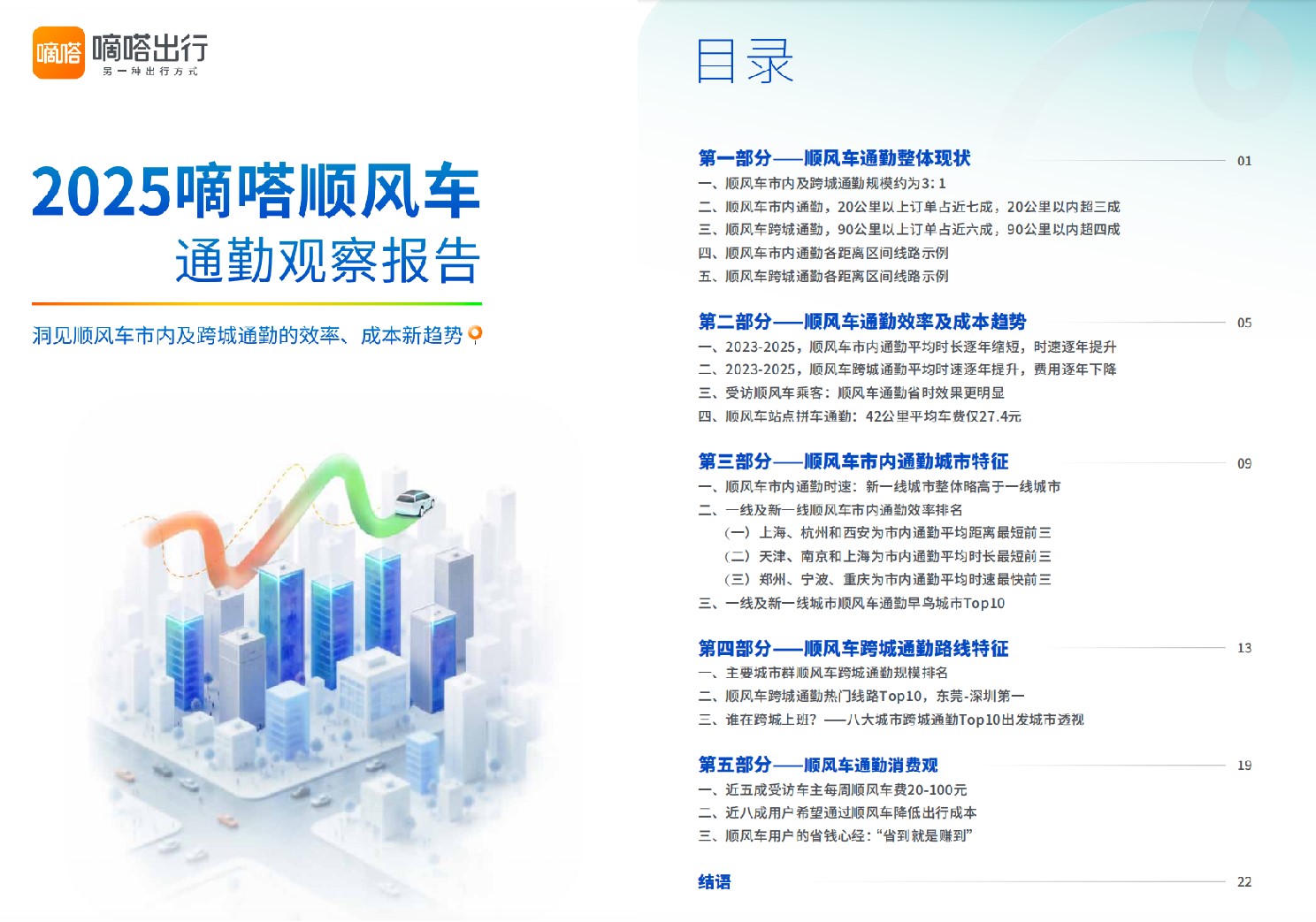
顺风车市内及跨城通勤,效率成本有哪些新趋势? 嘀嗒出行发布《2025嘀嗒顺风车通勤观察报告》
Bei Jing Shang Bao· 2025-11-13 07:42
Core Insights - The report indicates that ride-sharing commuting efficiency has improved continuously over the past three years, with commuting costs decreasing during the same period [5][6][8]. Group 1: Commuting Efficiency and Costs - In 2025, the average speed for city commuting is projected to be 40.2 km/h, an increase of 9.2% from 2023, while cross-city commuting speed is expected to reach 56 km/h, up 14.5% [5][10]. - The average costs for city and cross-city commuting are forecasted to be 37.2 yuan and 100.3 yuan, respectively, reflecting a decrease of 10.4% and 5.8% compared to 2023 [5][11]. - The ratio of city to cross-city ride-sharing orders is approximately 3:1, with city commuting orders predominantly over 20 km [11][13]. Group 2: City Characteristics and Commuting Patterns - The average commuting distance in first-tier cities is shorter at 32.2 km compared to 36.5 km in new first-tier cities, while average commuting times are similar [17]. - The top five cities for early morning ride-sharing orders (6:00-7:00 AM) are Dongguan, Tianjin, Qingdao, Chongqing, and Beijing, indicating a trend of early departures among commuters [25][26]. - The report identifies the top five city clusters for cross-city commuting as the Pearl River Delta, Yangtze River Delta, Beijing-Tianjin-Hebei, Shandong Peninsula, and Chengdu-Chongqing [30][32]. Group 3: Popular Routes and Commuting Trends - The top three popular cross-city commuting routes are Dongguan-Shenzhen, Suzhou-Shanghai, and Langfang-Beijing, with a significant concentration of routes in the Pearl River Delta [34][37]. - Over 60% of surveyed passengers reported saving more than 20 minutes on commuting time compared to public transport, highlighting the efficiency of ride-sharing [27][29]. - The report emphasizes that ride-sharing not only meets the commuting needs of urban workers but also enhances the quality and efficiency of long-distance commuting [37].