预测市场监管

Search documents
US Congressman Moves to Ban Staff From Trading on Prediction Markets
Yahoo Finance· 2026-03-26 15:28
Core Insights - A member of Congress has introduced legislation to prohibit congressional staff from trading on prediction markets, reflecting bipartisan concerns about insider information and financial incentives linked to political outcomes [1][2] - The proposed legislation aims to address inadequacies in existing ethics frameworks that do not account for event contracts, highlighting the need for updated regulations [2] Legislative Proposals - The Public Integrity in Financial Prediction Markets Act, introduced by Representative Ritchie Torres, targets federal officials and congressional staff, prohibiting trading based on nonpublic information accessed through official duties [3][4] - Other legislative efforts include the End Prediction Market Corruption Act, which seeks to ban trading on prediction markets for the president, vice president, and members of Congress [5] - The BETS OFF Act aims to ban event trading on sensitive operations, while the bipartisan Event Contract Enforcement Act directs the CFTC to prohibit contracts related to terrorism and illegal activities [5][6] Regulatory Environment - The current legislative landscape is crowded with multiple bills addressing prediction markets, but none are close to a floor vote, complicating the regulatory environment [6] - The Trump administration's permissive stance on prediction markets adds tension to the legislative process, impacting the potential for new regulations [6]
'If It Acts Like Gambling, It Is Gambling': Bipartisan Senate Bill Comes For Prediction Markets
Benzinga· 2026-03-25 18:45
Core Viewpoint - The introduction of the Prediction Markets Are Gambling Act aims to regulate prediction markets by classifying them as gambling, which could significantly impact platforms like Kalshi and Polymarket [1][2]. Group 1: Legislative Impact - The bill would prohibit any CFTC-registered platform from offering contracts related to sporting events or athletic competitions, directly affecting Kalshi and Polymarket [1]. - DraftKings initially saw a stock price increase of nearly 4% upon the bill's introduction, but later experienced a decline of over 6% as it became clear that its own prediction product would also be banned [3]. - Year-to-date, DraftKings' stock is down over 30%, while Flutter Entertainment has seen a slight increase of over 1% [4]. Group 2: Industry Reactions - Kalshi and Polymarket are facing increased scrutiny, with Kalshi recently facing criminal charges from Arizona's attorney general and cease-and-desist orders from eleven states [7]. - Both platforms have announced self-policing measures to prevent athletes and politicians from trading on their own events, although concerns about enforcement remain [5][6]. - Kalshi has criticized the bill as being driven by casino interests threatened by competition [7]. Group 3: Insider Trading Concerns - Senator Schiff raised concerns about potential insider trading on Polymarket, citing a trader with 93% accuracy on Iran war events as indicative of such practices [5]. - Schiff emphasized the challenges of enforcing regulations on blockchain-based platforms, while Curtis highlighted the potential for unethical betting practices [5][6]. Group 4: Bipartisan Support - Senators Schiff and Curtis claim that the bill has strong bipartisan support, presenting it as a rare opportunity for meaningful legislative action [8].



内华达州起诉阻止Kalshi在该州运营预测市场
Xin Lang Cai Jing· 2026-02-18 04:50
Core Viewpoint - The Nevada Gaming Control Board has filed a lawsuit to prevent the prediction market operator Kalshi from offering event contracts that allow residents to bet on sports like football and basketball, highlighting an ongoing struggle over regulatory authority between state and federal agencies [1][3]. Group 1: Legal Actions and Regulatory Authority - The lawsuit by Nevada argues that offering sports event contracts constitutes gambling under state law, thus requiring Kalshi to obtain a license [2][4]. - The Commodity Futures Trading Commission (CFTC) has expressed support for Kalshi, asserting that it has exclusive jurisdiction over prediction markets [1][3]. - If Nevada wins the lawsuit, it would become the second state to obtain a court order preventing Kalshi from offering sports event contracts, following a similar ruling in Massachusetts [1][3]. Group 2: Compliance and Regulatory Issues - The lawsuit claims that Kalshi has not complied with state gambling regulations, including prohibiting bets from individuals under 21 and implementing measures to prevent insider betting and game manipulation [2][4]. - Nevada has successfully convinced a judge to issue orders preventing other prediction market operators, Coinbase and Polymarket, from offering event contracts [5].
Coinbase CEO:预测市场应由美国商品期货交易委员会监管
Jin Rong Jie· 2025-12-22 03:02
Core Viewpoint - Coinbase CEO Brian Armstrong advocates for the regulation of prediction markets by the Commodity Futures Trading Commission (CFTC), arguing that state governments claiming otherwise hinder Americans from utilizing tools that enhance competitiveness [1] Group 1 - Coinbase has filed lawsuits against the states of Michigan, Illinois, and Connecticut regarding regulatory issues surrounding prediction markets [1]

Coinbase 起诉康涅狄格、伊利诺伊和密歇根三州,称预测市场应由 CFTC 监管
Xin Lang Cai Jing· 2025-12-19 11:40
Group 1 - Coinbase has filed a lawsuit against the states of Connecticut, Illinois, and Michigan regarding the attempt to regulate prediction markets under a "gambling regulatory" framework [1] - Coinbase's Chief Legal Officer, Paul Grewal, argues that prediction markets should be regulated by the Commodity Futures Trading Commission (CFTC) at the federal level, rather than by state-level gambling regulators [1] - The company claims that state-level restrictions will "stifle innovation and be unlawful" [1]
诺奖有“内鬼”?开奖前12小时,神秘交易员在Polymarket“精准押注”和平奖得主
Hua Er Jie Jian Wen· 2025-10-11 03:24
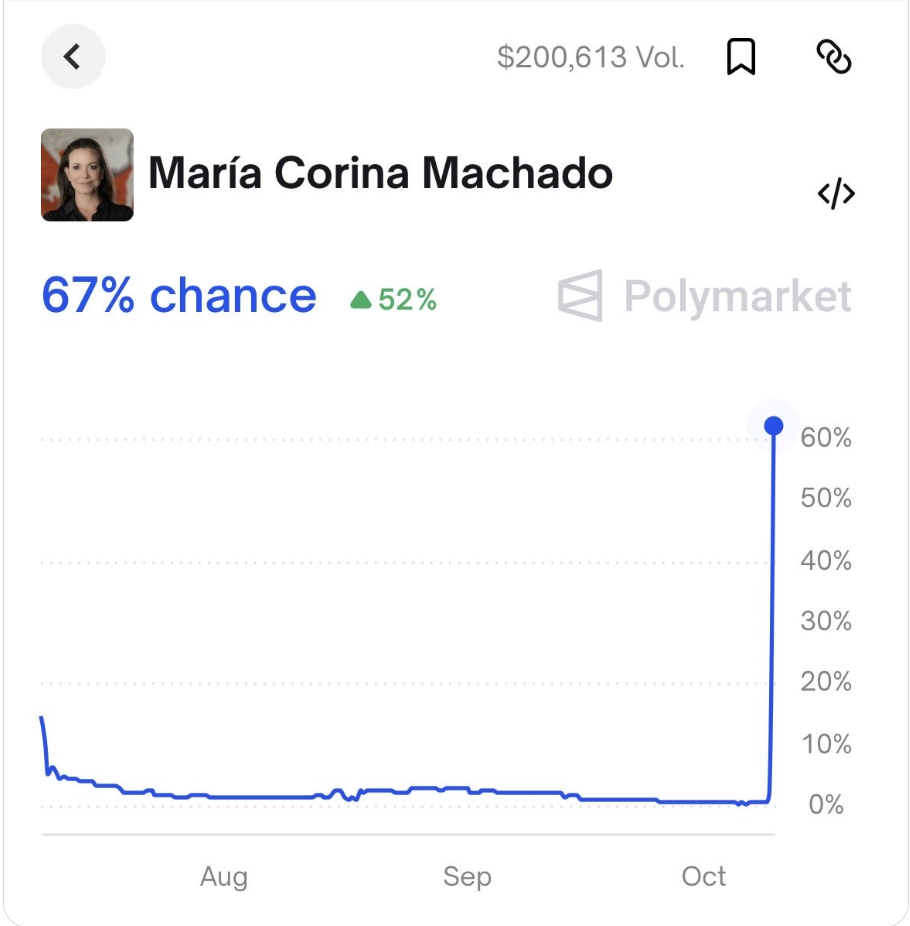
Core Insights - A mysterious trader made a significant bet on María Corina Machado winning the 2024 Nobel Peace Prize just 12 hours before the announcement, raising concerns about insider trading [1][2] - The trader, identified as "6741," increased Machado's winning probability from 5% to 70% on the Polymarket platform, resulting in over $50,000 in profits [1][4] - The Norwegian Nobel Institute has initiated an investigation into potential information leaks related to the betting activity [1][5] Summary by Sections Betting Activity - The account "6741" placed a $1,500 bet on Machado and $1,085 against the previously favored candidate, leading to a rapid increase in her winning odds from 3.7% to 73.5% [2][4] - Other traders followed suit, with one account named "GayPride" profiting over $85,000 as Machado's odds fluctuated between 60% and 71% [4] Regulatory Environment - Polymarket operates as an offshore, unregulated platform that does not prohibit insider trading, raising questions about the legality of trades based on leaked information [5][6] - The platform is currently barred from U.S. participation due to a settlement with the Commodity Futures Trading Commission (CFTC) [7] Market Dynamics - The controversy coincides with Polymarket's valuation surge to $8 billion, following a $2 billion investment announcement from the parent company of the New York Stock Exchange [1][7] - Polymarket has gained recognition for accurately predicting outcomes, such as the 2024 U.S. presidential election, and is exploring potential growth in sports betting [7]